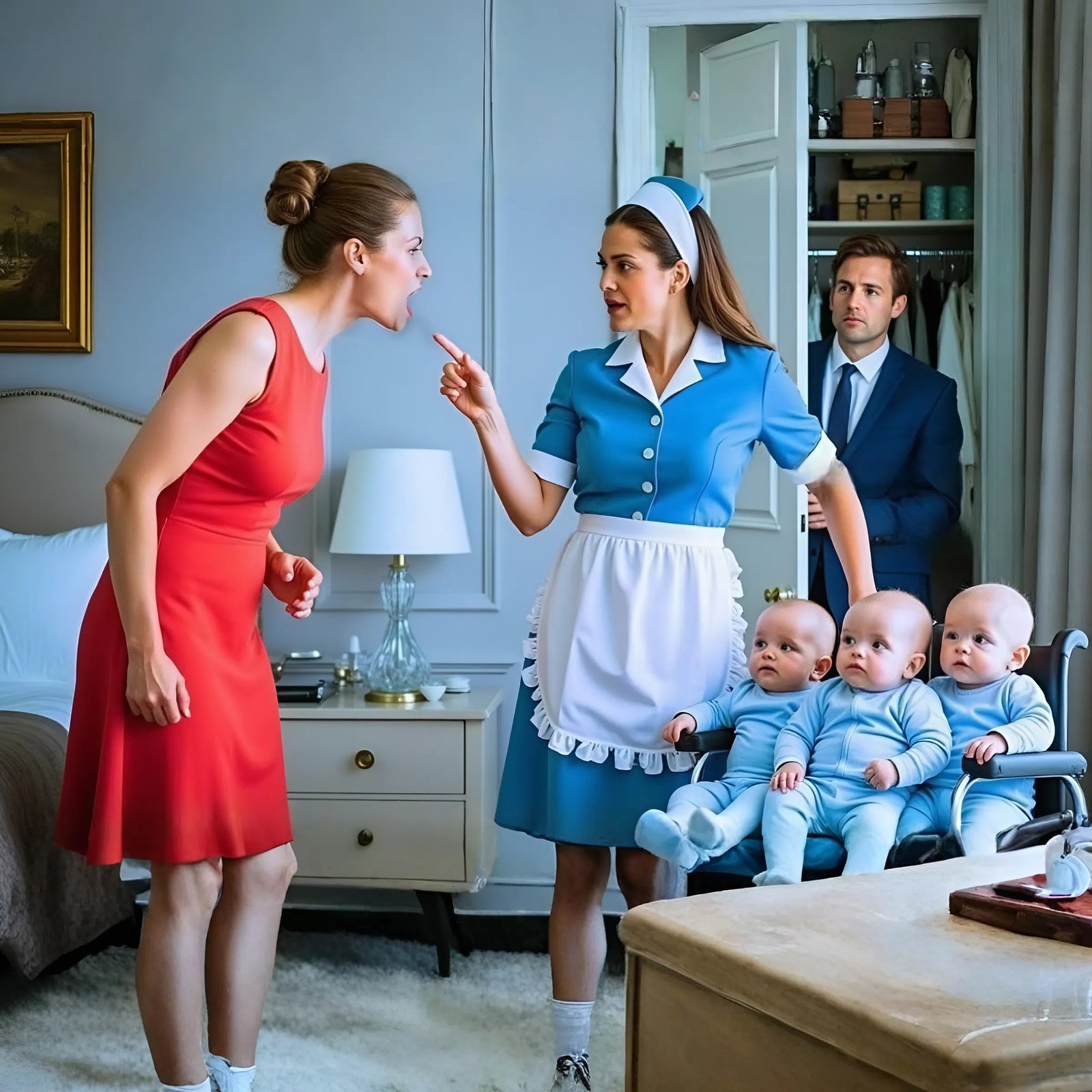
The house stood on a quiet hill overlooking manicured lawns and tall oak trees, its white stone exterior glowing softly under the late afternoon sun. From the outside, it looked peaceful and dignified, the kind of place strangers admired and assumed happiness lived behind every window.
Inside, the silence told a different story, heavy and watchful, like the house itself had learned to whisper warnings instead of comfort.
Miles Callahan stood motionless behind a partially closed study door, his palm flat on the wood, as if pressure could steady his heartbeat.
The stillness felt unnatural, almost hostile, and although he had lived here for years, the air suddenly seemed unfamiliar and sharp.
Three years had passed since his wife died without warning, leaving him alone with their three children and a grief he kept swallowing.
He functioned through meetings, charity galas, and endless responsibilities, yet grief lived in quiet corners and returned at night when lights went out.
His children were the only reason he kept moving forward, the only reason he still believed tomorrow could be endured.
Aaron, the oldest, carried seriousness beyond his years, watching every adult expression as if reading danger in shifting shadows.
Naomi was gentle and imaginative, clinging to small comforts and soft routines, trying to avoid conflict by disappearing inside her own quiet world.
Elias, the youngest, spoke little but felt everything deeply, his emotions visible in tense shoulders and curled fingers at sudden sounds.
They were his heart, his responsibility, and the fragile center of a family still trying to stand after losing its foundation.
When Vanessa entered his life, she seemed like an answer to a question he never dared to ask out loud.
She was composed, charming, polished in every room, and people praised her elegance, her warmth, and her apparent devotion to his children.
Friends told him he was lucky, and even the children were polite at first, eager to please and hoping peace could be rebuilt.
Yet something about Vanessa had always unsettled him, not in what she said, but in what she never offered.
There were small absences of tenderness, glances that lingered too long, and a tone that changed when she believed nobody was listening.
That morning Miles made a decision that frightened him more than grief, because it meant admitting his doubt might be real.
He told Vanessa he needed to leave town for an urgent business meeting, kissed the children goodbye, forced a smile, and walked out.
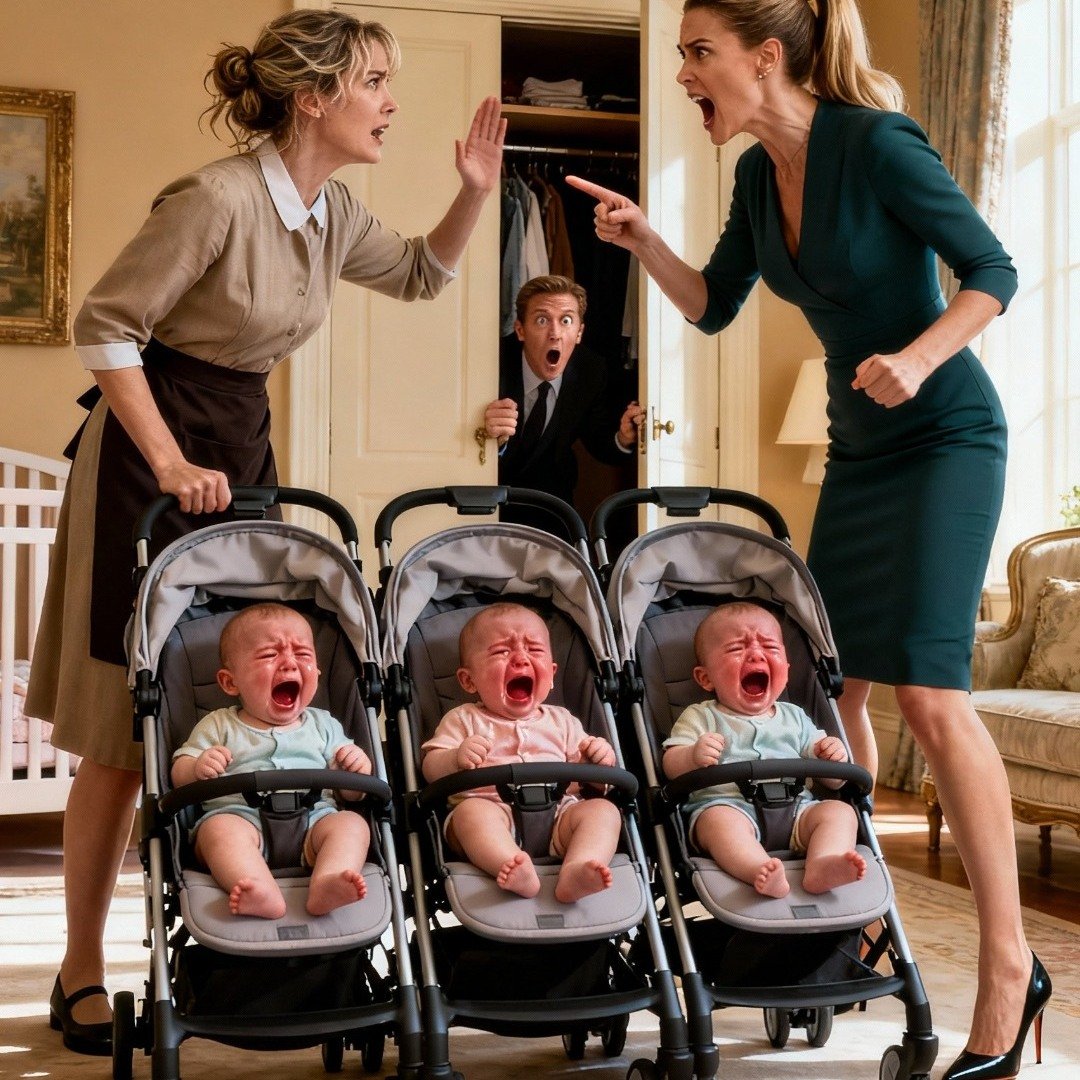
Then he circled back, parked quietly, returned through a side entrance, and placed himself where the truth could not hide.
Now he stood hidden, listening, trying to keep his breathing silent while every instinct demanded he step in too soon.
Vanessa’s heels echoed across the marble floor as she entered the living room, the sound cutting the quiet like a warning bell.
Miles felt his chest tighten as if the house itself recognized her footsteps and braced for what they usually meant.
The children sat on the couch where Vanessa had told them to wait, still and tense in the posture of practiced obedience.
Naomi held a small stuffed rabbit against her chest, while Elias swung his legs nervously, and Aaron sat upright with a set jaw.
Vanessa stopped in front of them, posture stiff, expression controlled, like she was putting on a mask she didn’t bother to soften.
“Sit still,” she said, voice stripped of the warmth she performed in public, “I don’t want any chaos today.”
Naomi hugged the rabbit tighter, Elias nodded quickly, and Aaron glanced up before lowering his eyes like he understood consequences.
Miles felt his stomach drop, because the fear in their faces answered questions he had refused to name for weeks.
Minutes passed, and the tension thickened, turning the room into something sharp, silent, and difficult to breathe inside.
Elias reached for a glass of water on the table, his hands trembling slightly, the movement careful as if noise itself was dangerous.

The glass tipped and spilled onto the floor with a soft splash, barely a sound, yet it landed like an explosion in the room.
Vanessa’s reaction was immediate, her head snapping toward him, her patience evaporating as if it had never existed.
“Unbelievable,” she snapped, “can you not do anything right,” and the words hit harder than the small spill ever could.
Elias froze, eyes filling with tears, his voice shrinking to a whisper as he said, “I’m sorry,” like apology was survival.
Vanessa ignored the apology, turned slowly toward Naomi, and her gaze landed on the stuffed rabbit with cold irritation.
“And that thing,” she said, pointing sharply, “you’re not a baby, put it away,” as if comfort was a crime in her house.
Naomi hesitated, lips trembling, and Vanessa stepped forward, snatched the toy from her hands, and tossed it onto a nearby chair.
Naomi pressed her lips together and cried silently, shoulders shaking, trying to make her sadness invisible so it wouldn’t be punished.
Aaron rose halfway, instinct pulling him between Vanessa and his siblings, his body tense with a child’s attempt at protection.
“That’s enough,” Vanessa said, smile thin and unsettling, “sit down before you make things worse,” and her tone carried threat.
Aaron obeyed, but his hands clenched at his sides, knuckles white, the restraint of a boy swallowing anger for survival.
Miles gripped the doorframe harder, breath shallow, every muscle begging to intervene, but he forced himself to wait.
He needed the full truth, without interruptions, without excuses, so she could not twist it into misunderstanding later.
Vanessa’s phone rang, and she answered with a bright laugh so sudden it made Miles’ skin crawl with disgust.
“Yes, everything is under control,” she said lightly, “he has no idea, and once this marriage is official, it’ll be easier.”
She paced slowly, voice lowering as if secrets were sweeter when they were spoken near children who weren’t allowed to protest.
“The children won’t be my responsibility for long,” Vanessa said, “there are services for that,” like they were disposable problems.
Something inside Miles broke cleanly and completely, because cruelty spoken casually is the kind that never stops on its own.
Vanessa ended the call and turned back to the couch, eyes cold, voice quiet in a way that made it more dangerous.
“You will not tell your father anything,” she said, “no one would believe you anyway,” and she smiled as if certainty was power.
That was when Miles stepped forward, no longer hidden, no longer silent, because the moment demanded protection, not caution.
“I believe them,” he said, and the sound of his voice struck the room like a force that snapped her control in half.
Vanessa spun around, color draining from her face, because she hadn’t expected the house to answer back.
The children reacted instantly, rushing toward him, and Miles dropped to his knees and wrapped his arms around them.
He felt their small bodies trembling against his chest, and the realization hurt like guilt turning into something sharper than grief.
“How long,” he asked calmly, voice edged with certainty, “has this been happening,” and the question left no room to hide.
Vanessa struggled for words, and when she found them, they sounded thin, desperate, and rehearsed.
“Miles, you’re misunderstanding everything,” she said, reaching for control with the same polished tone she used in public rooms.
“There is nothing to misunderstand,” he replied, “you were never alone, and I heard everything you said to them.”
She stepped toward him, then stopped when he raised one hand, not violent, but final, like a door locking.
“This ends now,” Miles said, “you will leave this house today,” and his voice carried protection instead of negotiation.
“You can’t be serious,” Vanessa whispered, and for the first time her confidence sounded frightened.
“I am,” he said, “and if you contact my children again, there will be consequences you will not enjoy.”
Vanessa gathered her belongings in silence, every movement stiff, her polished mask cracked by the simple fact of being witnessed.
The front door closed behind her with a final click that echoed softly down the hall, like the house exhaling after holding pain.
Miles held his children until their breathing slowed, until trembling became stillness, until fear loosened its grip one inch at a time.
“You are safe,” he told them, voice steady, “I promise you that,” and this time his promise had teeth.
That evening the house felt different, not magically healed, but lighter, as if the corners had stopped hiding secrets.
As the sun set and painted the windows gold, Miles understood love isn’t measured by appearances or polite performances.
Love is measured by protection, by listening, by believing your children, and by acting when the moment finally demands it.
He had waited too long, and the guilt would stay, but he had not waited forever, and that mattered more than pride.
From that moment on, his children would never doubt where he stood, because he had chosen them when it mattered most.
Website Disclaimer
The information provided on this website is for general informational and educational purposes only. While we strive to ensure that all content is accurate and up to date, we make no guarantees regarding the completeness, reliability, or accuracy of any information published.
The views and opinions expressed in articles belong to their respective authors and do not necessarily reflect the views of this website. Any action you take based on the information found on this website is strictly at your own risk. We will not be liable for any losses, damages, or inconveniences arising from the use of our content.
Some articles may contain opinions, third-party information, or external links. We do not endorse or guarantee the accuracy of content on external websites and are not responsible for their practices or policies.
All content on this website is provided in good faith and is intended for informational purposes only. Readers are encouraged to verify information independently and seek professional advice where appropriate.