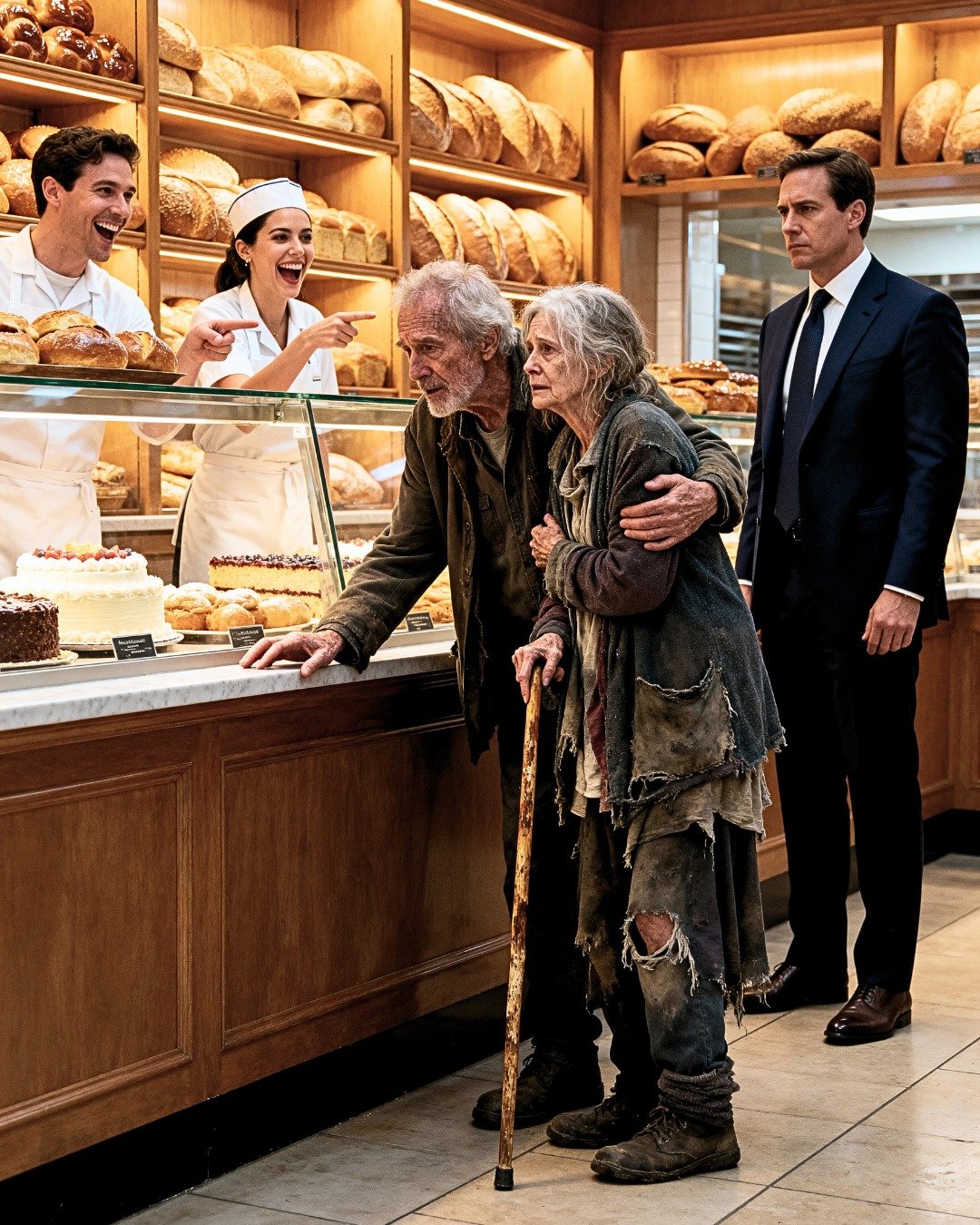
A man in torn clothes and worn shoes stepped into an upscale pastry shop in Barcelona. His beard was untrimmed, his jacket frayed at the edges.
With his gaze fixed on the floor, he quietly asked the owner if there happened to be a cake nearing its expiration date. It was his wedding anniversary, he explained, and he wanted to bring his wife a gift.
The pastry chef burst out laughing and told him to get out before the police were called. What no one realized was that, sitting silently at a corner table, was Alejandro Valdés—one of Spain’s wealthiest men and owner of a luxury hotel empire—and what he witnessed would alter every life in that room.
The city stirred beneath a dull November sky. Office workers hurried along sidewalks, eyes glued to phones, coffee in hand. No one noticed the people curled up in doorways, wrapped in threadbare blankets.
Miguel Herrera was sixty-four, though hardship made him look far older. Years on the street had carved deep lines into his face and bowed his shoulders. Yet his eyes—dark, steady, the same eyes his wife Isabel had fallen in love with decades earlier—still held warmth and quiet strength.
That morning, Miguel had woken before sunrise beneath a bridge in El Raval, where he lived with Isabel. He watched her sleep, fragile and coughing even in rest, wrapped in a blanket salvaged months earlier. To him, she was still the most beautiful woman in the world.
It was November 24th—their anniversary. Thirty-seven years before, they had married in a small church in Andalusia. Isabel wore a simple white dress sewn by her mother; Miguel borrowed a suit from his brother. They had nothing but love, and for years, it had been enough.
Everything collapsed six years earlier when the construction firm Miguel had worked for decades shut down. No one would hire him. Their savings vanished, then their apartment. Family turned away. Isabel fell ill, medication cost more than they could manage, and eventually, they found themselves on the streets.
Still, Miguel never stopped caring for her. He brought flowers from public gardens, read discarded newspapers aloud, told stories to distract her pain, and always found a way to honor their anniversary.
This year, Isabel was worse. Her cough deepened, her strength fading. Miguel knew she needed warmth, medicine, real food—but all he could give was love.
That morning, he decided to try. A cake, he thought. Something small to remind her of better days.
He walked for hours past bakery windows, imagining flavors he would never taste himself. He hoped someone might offer food destined for the trash—still good, just unsellable.
That hope led him to La Corona Pastelería, one of the most exclusive shops in the Eixample district. The window glittered with elegant desserts. After a long moment, Miguel stepped inside.
The marble floors, crystal lights, and well-dressed customers made him feel invisible and exposed at once. Whispers followed him. He forced himself forward.
Behind the counter stood Sergio Molina, the owner, whose polite smile vanished instantly. Miguel explained softly: the anniversary, the illness, the lack of money. He asked only for something that would otherwise be thrown away.
Sergio laughed loudly and told him this wasn’t a shelter for beggars. He ordered Miguel to leave at once.
Miguel lowered his head, swallowing tears, and turned toward the door.
Then a man stood.
Alejandro Valdés—sixty-seven, billionaire, owner of the Valdés Royal Hotels across Europe—rose from his seat. That morning, he wasn’t there for business. He had come for a meeting that never happened and stayed, lost in thoughts of his late wife, Elena, who had died four years earlier. All his wealth hadn’t saved her.
He had watched everything.
Alejandro crossed the room and placed a steady hand on Miguel’s shoulder. Miguel braced himself for another insult, but instead met calm, compassionate eyes.
Alejandro asked the baker if that was how customers were treated. Sergio scoffed, calling Miguel a homeless nuisance.
Without raising his voice, Alejandro asked the price of the most expensive cake.
Confused, Sergio pointed to a three-tier cake decorated with chocolate and strawberries—€350.
Alejandro placed four €100 bills on the counter. He said the cake was for Miguel and his wife, for their anniversary.
The room went silent.
Alejandro then spoke of dignity—how true elegance had nothing to do with chandeliers or price tags. He introduced himself and announced that La Corona Pastelería would lose all contracts with his hotels, effective immediately.
Sergio paled and rushed to apologize. Alejandro stopped him and told him to apologize to Miguel instead.
Sergio did—awkwardly, fearfully. Miguel accepted with a nod.
Later, over coffee, Miguel told Alejandro everything. When he spoke of Isabel’s illness, Alejandro made a choice.
He met her that afternoon beneath the bridge.
Soon after, Miguel was offered a job at one of Alejandro’s hotels, along with an apartment and medical care for Isabel—not charity, Alejandro said, but justice.
Months passed. Isabel recovered. Miguel rebuilt his life. Alejandro found meaning again.
From it all, the Elena Valdés Foundation was born, helping people rise from the streets.
And it had all begun with a cake Miguel could never afford.
A reminder that changing the world doesn’t require wealth—only humanity.
Website Disclaimer
The information provided on this website is for general informational and educational purposes only. While we strive to ensure that all content is accurate and up to date, we make no guarantees regarding the completeness, reliability, or accuracy of any information published.
The views and opinions expressed in articles belong to their respective authors and do not necessarily reflect the views of this website. Any action you take based on the information found on this website is strictly at your own risk. We will not be liable for any losses, damages, or inconveniences arising from the use of our content.
Some articles may contain opinions, third-party information, or external links. We do not endorse or guarantee the accuracy of content on external websites and are not responsible for their practices or policies.
All content on this website is provided in good faith and is intended for informational purposes only. Readers are encouraged to verify information independently and seek professional advice where appropriate.