Part 1
The night my husband nearly froze outside, my phone quietly assumed I was fast asleep and kept sending me cheerful notifications for kitchen remodels.
The clock read 2:41 a.m. when I reached across the bed and felt nothing but cold sheets.
I didn’t scream. I didn’t panic. I simply… stopped breathing for a moment.
Then I noticed something else. The dog bed in the corner of our room was empty.
“Arthur?” I called softly, even though I already knew there wouldn’t be an answer.
My husband is seventy-eight. There was a time he could work long shifts at the steel mill and still make it to Little League practice to coach our son. Now, some mornings, he forgets which room is the kitchen.
Dementia arrived slowly—first the mixed-up dates, then the wrong names, then the moments that would be funny if they didn’t break your heart. Last month he tried to butter his coffee.
We live on the edge of a small town in Wisconsin. In January, the cold isn’t just uncomfortable—it’s d*ngerous. That night the temperature was three degrees below zero.
I walked into the hallway and saw the front door slightly open, letting in a thin blade of icy air. My stomach dropped.
His boots were still by the door. His heavy coat still hung on the hook. But his slippers were gone… and so was the old flannel robe draped over the chair.
And the dog bed was still empty.
“Barnaby?” I called, voice shaking.
Barnaby is our elderly yellow Lab—sixteen years old, gray around the muzzle, with stiff legs and cloudy eyes. He moves slowly, with the careful steps of a dog who’s lived a long, loyal life. He and Arthur have always understood each other in a quiet way.
Every day, Barnaby curls up at Arthur’s feet. When Arthur stands, Barnaby stands. When Arthur sits, Barnaby lies down beside him. He has always stayed close, as if keeping watch.
That night, the leash still hung on the wall. Barnaby hadn’t waited to be taken out. He had simply followed.
I grabbed my car keys—no coat, no socks—just pure fear adrenaline. As I backed out of the driveway, the headlights swept across our yard and revealed footprints in the thin layer of fresh snow.
Slow, uneven steps. And beside them, dog prints—one dragging slightly.
I followed the tracks with the minivan, crawling along the shoulder of the two-lane road. The ice gleamed under the streetlights. Cars fly down that stretch during the day, but tonight it was desolate. Next to the road is a deep ditch that fills with water in spring and freezes solid in winter.
Half a mile from home, my headlights caught a shape in the ditch. At first, it looked like a pile of discarded clothing.
Then I recognized the blue plaid of his robe.
“Arthur!” I screamed, parking the car askew and sliding down the icy embankment, my knees hitting the frozen ground hard.
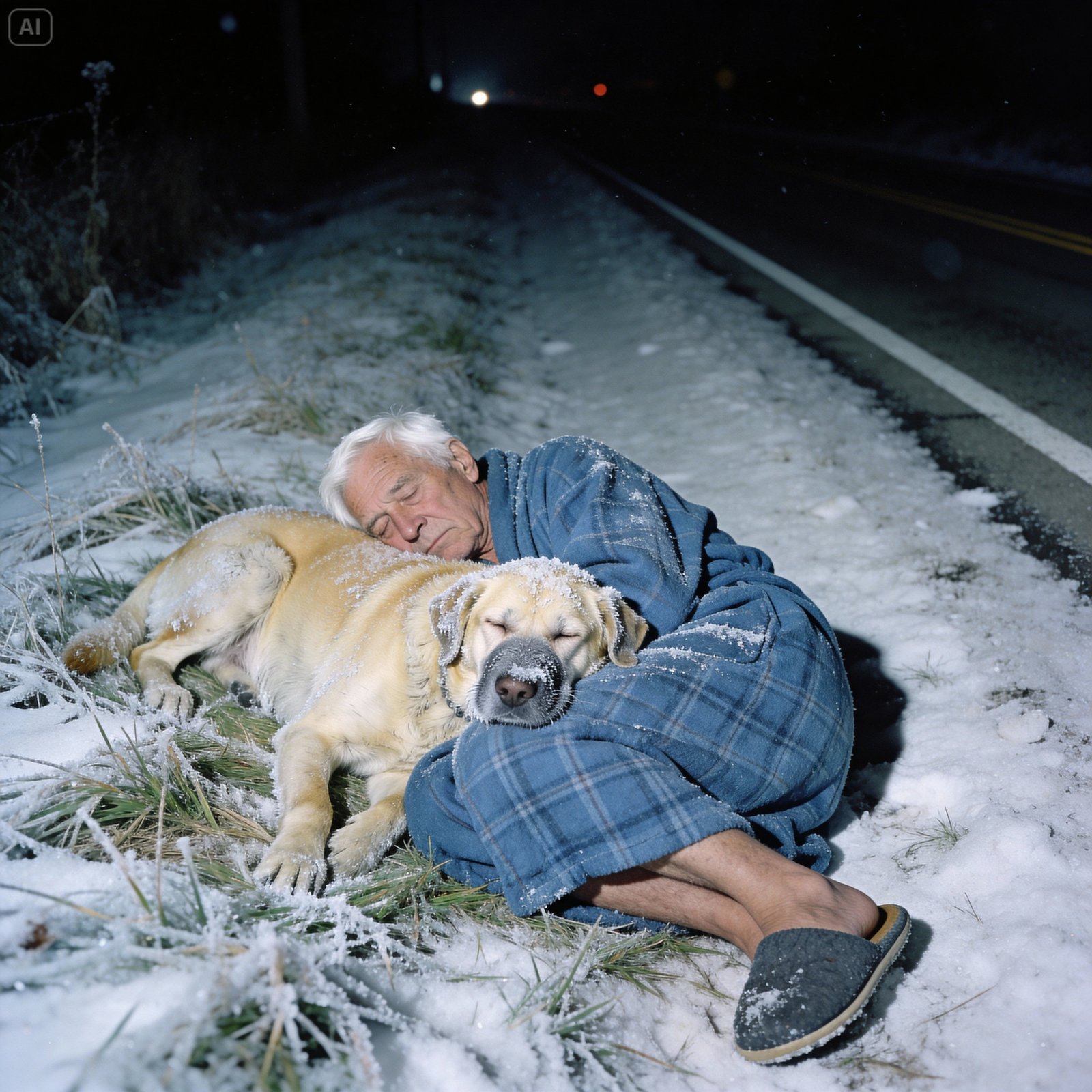
He was curled on his side, slippers nearly off, face pale, lips turning a terrifying shade of blue.
And lying right on top of him—like a blanket with a heartbeat—was Barnaby.
Part 2
The wind cut through my thin nightgown like a butcher’s knife, but I didn’t feel the cold. I only felt the terrifying stillness of the two creatures I loved most in this world.
“Arthur!” I screamed again, my voice cracking against the frozen air.
He didn’t move. His skin, usually flushed with the ruddy complexion of a man who spent forty years working outdoors, was a terrifying shade of gray. His eyes were half-open, staring unseeingly at the snow-crusted weeds of the ditch.
And Barnaby.
Oh, God, Barnaby.
The old dog was lying flat across Arthur’s chest. He wasn’t curled up in a ball to conserve his own warmth; he was sprawled out, maximizing the contact between his belly and Arthur’s core. He was shivering so violently that his teeth chattered, a sound that cut through the howling wind. His fur, usually a soft, sunny yellow, was matted with ice and mud.
When I slid down the embankment, Barnaby lifted his head just an inch. His tail gave a single, weak thump against Arthur’s frozen robe. It was the saddest sound I have ever heard.
“I’m here, boys. I’m here,” I sobbed, my hands shaking so badly I could barely zip the parka I had thrown into the backseat earlier. I draped it over Arthur, but I knew a coat wasn’t enough. I had to get them into the van.
This is the part of the story they don’t tell you in movies. In movies, adrenaline gives you superpowers. You scoop up your loved ones and sprint.
In real life, Arthur is six-foot-two and weighs two hundred pounds, even after the dementia started stealing his appetite. In real life, the ground was a sheet of black ice, and I am a seventy-four-year-old woman with arthritis in her hips.
I grabbed Arthur under the arms. “Come on, Artie. You have to help me. Please, baby, you have to stand up.”
He groaned, a low, guttural sound that terrified me. He was dead weight. His limbs were stiff, his muscles locked by the cold.
“Barnaby, move,” I commanded, tears freezing on my cheeks.
The dog whimpered but didn’t budge. He wouldn’t leave his post. It was as if he knew that if he moved, the cold would claim Arthur for good.
“Barnaby, I need to move him! Get up!” I had to shove the poor dog aside. He collapsed into the snow, his legs giving out. He tried to stand, his paws scrambling uselessly on the ice, but he just sank back down, wheezing.
Panic, hot and acidic, rose in my throat. I couldn’t carry them. I was going to lose them both right here, a mile from our warm, safe living room, under the indifferent glare of the streetlights.
Then, anger took over. A fierce, primal anger at the disease that took my husband’s mind, at the winter that wanted his body, and at the universe for testing us like this.
“No,” I growled.
I grabbed Arthur’s ankles and pulled. I slipped, fell, scraped my hands on the frozen asphalt until they bled, but I got his legs onto the shoulder of the road. Then I went back for his shoulders. I dragged him inch by agonizing inch up that embankment. I don’t know how long it took. It felt like hours. It was probably five minutes.
I managed to prop him up against the open side door of the minivan. With a heave that I felt tear something in my lower back, I tumbled him onto the floor of the van. He didn’t even try to sit up; he just lay on the floor mats.
Then I ran back for Barnaby.
He was lighter than Arthur, but he was limp. When I picked him up, he let out a sharp yelp of pain. His hips. His bad hips. I was hurting him, but I had no choice. I cradled seventy pounds of wet, freezing dog in my arms and staggered up the slope.
I laid Barnaby right next to Arthur. The moment I put him down, the dog dragged himself forward, inching back into that protective position against Arthur’s side.
I slammed the door, jumped into the driver’s seat, and cranked the heat to the maximum.
The drive to the hospital was a blur of terror.
I talked to them the whole way. I needed them to hear my voice. I needed them to know they weren’t alone.
“Stay with me, Artie. Remember the summer we drove to the Grand Canyon? Remember how the air conditioning broke in that old station wagon and we had to drive with the windows down? It was so hot. Think about the heat, Artie. Think about the sun.”
I glanced in the rearview mirror. Arthur was silent.
“Barnaby! Good boy. You’re such a good boy. Remember the steak bone from Christmas? We have another one at home. You have to come home for it.”
The only answer was the hum of the tires and the aggressive blast of the car heater, which felt like it was taking years to warm up.
My mind started racing back to before the darkness set in. Before the dementia.
I remembered the day Arthur brought Barnaby home. It was sixteen years ago. Arthur had just retired from the mill, and he said the house felt too quiet. He came back from the shelter with a clumsy yellow puppy who had paws too big for his body and a tail that knocked over everything in its path.
Arthur had spent hours in the backyard with that dog. They had a language of their own. Hand signals. Whistles. Quiet murmurs.
People used to joke that Arthur loved that dog more than he loved me. I knew it wasn’t true, but the bond was different. It was primal. It was two souls who understood duty and loyalty above all else.
When Arthur got sick, when the names started slipping away, Barnaby changed. The playful bouncing stopped. He became a shadow. If Arthur paced the hallway at 3 a.m., Barnaby paced with him. If Arthur sat staring at a blank TV screen for hours, Barnaby sat at his feet, resting his chin on Arthur’s slipper.
Tonight, Barnaby had done what he had been trained to do for a lifetime. He had protected his pack.
I pulled into the Emergency Room bay at St. Joseph’s Hospital, horn honking before the van even stopped rolling.
I jumped out, screaming. “Help! My husband! Hypothermia!”
The automatic doors slid open, and a security guard and two nurses came running out with a gurney. They were efficient, fast, professional. They didn’t ask questions; they saw the gray skin and the stillness and they moved.
They pulled Arthur out of the van.
“He’s unresponsive,” one nurse shouted. “Code Blue on arrival! Let’s move!”
They were running him inside. I took a step to follow, my heart hammering against my ribs—and then I stopped.
I looked back at the van.
The side door was still open. And there, alone on the floor mat, was Barnaby.
He tried to lift his head to watch Arthur go, but he couldn’t. His head flopped back down. He was panting, shallow, rapid breaths that rattled deep in his chest.
I stood frozen in the sliding doors of the ER.
To my left, my husband of fifty years was dying.
To my right, the dog who had just saved his life was dying.
I looked at the nurse holding the clipboard near the door. “My husband…”
“We’ve got him, honey,” she said, her voice kind but firm. “You go in the waiting room. We’re working on him.”
“No,” I said, tears streaming down my face. “I can’t come in yet.”
She looked confused. “Ma’am?”
“My dog,” I choked out, pointing to the van. “He… he covered him. He kept him warm. He’s freezing to death.”
The nurse’s eyes widened. She looked at the van, then back at me. She saw the blood on my hands from the asphalt. She saw the desperation in my eyes.
“Go,” she whispered. “We will take care of Arthur. You go save his hero.”
I didn’t hesitate. I jumped back into the van, slammed the door, and peeled out of the ambulance bay.
The emergency veterinary clinic was ten minutes away. Those ten minutes were longer than the last ten years of my life.
“Hold on, Barnaby. Hold on, buddy.”
I reached back with one hand, fumbling blindly until I felt his fur. It was starting to dry in the heat of the car, but he was so cold. Shockingly cold.
He didn’t lick my hand. He didn’t move.
When I arrived at the vet clinic, I didn’t care about dignity. I ran into the lobby screaming.
“Please! Someone help me!”
A young vet tech, a burly guy with tattoos on his arms, jumped over the reception desk. He didn’t wait for me to explain. He ran out to the van with me.
When he saw Barnaby, his face fell. He scooped the big dog up in his arms like he was a featherweight.
“He’s barely breathing,” the tech said, turning and sprinting back into the clinic. “Get the warming blankets! Get an IV line started! Stat!”
I chased them into the back room, a sterile place of stainless steel and bright lights. They laid Barnaby on a metal table.
“Core temperature is eighty-eight degrees,” the veterinarian, Dr. Evans, announced grimly. “Heart rate is thready. He’s in severe shock.”
They swarmed him. Warm fluids, heating pads, oxygen masks.
I stood in the corner, pressing my knuckles into my mouth to keep from screaming. I felt like I was being torn in two. My heart was back at St. Joseph’s with Arthur, but my soul was here in this room with Barnaby.
Dr. Evans looked up at me over his glasses. “Mrs. Higgins, what happened? Was he in the river?”
“No,” I whispered. “He was lying on top of Arthur in a ditch. It’s three below zero. He… he wouldn’t get up.”
The room went silent for a second. The vet tech paused while inserting the IV. They all looked at the gray-muzzled dog on the table with a new kind of reverence.
“He gave his heat to your husband,” Dr. Evans said softly. “That’s why he’s in this state. He transferred his body heat. He literally drained his own battery to keep your husband’s running.”
I collapsed into a plastic chair in the corner.
The next three hours were a nightmare of waiting.
I used the clinic’s phone to call the hospital.
“He’s alive,” the ER doctor told me. “We’re warming him up slowly. It’s a miracle, Mrs. Higgins. Based on how long you think he was out there, he should have severe frostbite or cardiac arrest. But his core temp was just high enough to keep the organ functions stable. Whatever insulation he had… it saved him.”
“It wasn’t insulation,” I said, my voice hollow. “It was Barnaby.”
“The dog?” The doctor paused. “Well. You tell that dog he’s a better doctor than I am.”
I hung up and looked at the metal table.
Barnaby wasn’t waking up.
The warming blankets were doing their job. His temperature was rising. But his eyes remained closed. His breathing was a ragged hitching sound.
Dr. Evans came over and kneeled in front of me. He took my bruised, bloody hand in his.
“Eleanor,” he said gently. “We’ve got his temperature up. But… you know Barnaby is very old.”
“Sixteen,” I said. “Last November.”
“His heart was already tired,” Dr. Evans explained. “This kind of stress… the hypothermia, the physical exertion of walking that far in the snow… it’s caused a cascading failure. His kidneys are shutting down. His heart is struggling to beat.”
“Can you fix him?” I asked, though I knew the answer.
“We can keep him comfortable,” he said. “But I don’t think he’s going to bounce back from this. He poured everything he had into that ditch, Eleanor. He didn’t save anything for himself.”
I walked over to the table. They had lowered it so I could be close to him.
I buried my face in his neck. He smelled like wet dog, antiseptic, and faintly, like the cedar shavings from his bed at home.
“You stubborn old mule,” I whispered into his fur. “You weren’t supposed to trade. It wasn’t supposed to be a trade.”
I thought about Arthur, safe in his warm hospital bed, probably waking up now, confused, asking for me. He would be alive tomorrow. He would see another sunrise. He would have more moments with our grandkids.
Because of this dog.
Suddenly, Barnaby stirred.
It was a small movement. Just a shift of his shoulder.
I pulled back. “Barnaby?”
His eyes opened. They were milky with cataracts, tired and heavy. But he focused on me. He saw me.
And then, he did something that broke me completely.
He turned his head toward the door—the door that led to the street, to the direction of the hospital where Arthur was. He let out a soft, questioning whine.
Where is he?
He wasn’t worried about his pain. He wasn’t worried about the cold. He was checking. He was still on duty.
“He’s safe, Buddy,” I sobbed, stroking his velvet ears. “You did it. You saved Artie. He’s warm. He’s safe.”
Barnaby let out a long sigh. It sounded like relief.
His head grew heavy in my hands. He didn’t close his eyes yet, but the tension left his body. He stopped fighting the exhaustion.
I knew then that we were in the final chapter.
The vet stepped back to give us space. The machines beeped rhythmically, counting down the seconds of a life that had been defined by pure, unadulterated love.
But as I sat there, watching the rise and fall of his chest, a thought struck me. A memory of something Arthur had said years ago, back when his mind was sharp as a tack.
We were sitting on the porch, watching a young Barnaby chase fireflies.
“You know, El,” Arthur had said, sipping his iced tea. “Dogs don’t live as long as us because they don’t need to learn how to love. We spend seventy years trying to figure out how to be selfless. They come out of the womb knowing it. They graduate early.”
Barnaby was graduating.
But I wasn’t ready to let him go. Not without Arthur. They needed to say goodbye.
“Dr. Evans,” I said, wiping my face with my sleeve. “I need to take him to Arthur.”
The vet looked shocked. “Eleanor, he’s on oxygen. He’s dying. You can’t move him.”
“Arthur is at St. Joe’s. It’s ten minutes away. If Barnaby dies here, without seeing him… it’s not right. It’s not how their story ends.”
Dr. Evans looked at the dog, then at me. He saw the resolve in my face. The same resolve that had dragged a two-hundred-pound man out of a frozen ditch.
“I can’t officially discharge him,” Dr. Evans said, standing up. “But… if I were to help you load him into your car with a portable oxygen tank… and if I were to drive you there myself to manage the IV…”
I grabbed the vet’s hand. “Thank you.”
We were going to break every rule in the hospital handbook. But tonight, rules didn’t matter. Only loyalty did.
We wrapped Barnaby in heated blankets. Dr. Evans carried him to my van. I drove, and the vet sat in the back with Barnaby, monitoring his pulse.
When we pulled up to St. Joseph’s, it was 5:00 a.m. The sky was turning a bruised purple in the east.
I ran to the front desk. The nurse from earlier was still there.
“How is he?” I asked breathlessly.
“He’s awake,” she said. “He’s confused, but stable. He keeps asking for ‘the boy’. We thought he meant your son.”
“He means the dog,” I said. “And the dog is outside.”
I explained the situation. I pleaded. I begged. I told her I would pay any fine, take any blame.
The nurse looked at me for a long moment. She looked at the empty waiting room. She looked at the automatic doors.
“Hospital policy strictly forbids animals,” she recited robotically.
Then she reached under the desk and pulled out a key card.
“However,” she continued, her voice softening, “the service elevator around the back loading dock has no security cameras. And if a ‘service animal’ were to visit a dying patient in Room 104… well, I certainly wouldn’t know anything about it.”
She slid the key card across the counter.
“Room 104. Hurry.”
We brought Barnaby in through the back. Dr. Evans carried him; he was too weak to walk. We sneaked through the sterile corridors like thieves, dodging the cleaning crew.
When we opened the door to Room 104, Arthur was lying in the bed, hooked up to monitors. He looked small and frail, his skin still pale.
He was staring at the ceiling, looking lost.
“Artie?” I whispered.
He turned his head. His eyes were foggy.
“El?” he croaked. “I… I was cold. I was so cold.”
“I know, honey. I know.”
“I lost him,” Arthur whispered, tears welling in his eyes. “I lost the boy. I was walking… and I fell… and I lost him.”
“No, Artie,” I said, stepping aside. “You didn’t lose him.”
Dr. Evans stepped forward and gently laid Barnaby on the hospital bed, right beside Arthur’s legs.
The moment Barnaby touched the mattress, a jolt of energy seemed to pass through him. He lifted his head. He smelled Arthur.
Arthur’s eyes widened. His trembling hand reached out.
“Buddy?”
Barnaby let out a low, happy groan. He scooted forward—painfully, slowly—until his head was resting on Arthur’s chest, exactly where it had been in the ditch. But this time, Arthur was warm.
Arthur buried his face in the dog’s fur. He began to weep—deep, racking sobs of relief and love.
“You came back,” Arthur whispered. “You stayed.”
Barnaby licked the tears off Arthur’s face. His tail gave a weak thump-thump against the hospital blanket.
Dr. Evans looked at me and checked his watch. He gave me a tiny shake of his head.
Not long now.
I walked to the other side of the bed and held Arthur’s hand.
“He brought you home, Artie,” I told him. “He carried you.”
Arthur nodded, his fingers burying themselves in the thick yellow fur. The confusion of the dementia seemed to clear for a moment, pushed back by the clarity of love.
“Good boy,” Arthur murmured, the old command voice soft and gentle. “You can rest now, Buddy. Shift’s over. I’m okay. You can rest.”
It was the permission Barnaby had been waiting for.
The dog let out one last, long exhale. His body went heavy against Arthur’s chest. The rhythmic thumping of the tail stopped.
In the quiet of Room 104, with the sun just starting to crest over the snowy Wisconsin fields outside, Barnaby slipped away.
He died exactly where he wanted to be: protecting his person.
Arthur didn’t pull away. He held the dog close, rocking him slightly. He didn’t ask if he was gone. He knew.
I cried silently, holding onto the bed rail. But as I looked at them—the old man who had forgotten so much, and the old dog who had remembered everything that mattered—I realized that this wasn’t a tragedy.
It was a victory.
Barnaby hadn’t lost to the cold. He had beaten it. He had held it back just long enough to finish his job.
And as the monitors beeped steadily for Arthur’s heart, I knew that every beat was a gift from a dog who had given his own heart to keep it going.
But the story wasn’t quite over. Because there was still the notebook. The notebook I would find three days later, buried in the garage, that would explain everything.
Part 3
The silence of a house is different when a dog is gone. It’s not just a lack of noise; it’s a lack of presence. It’s a vacuum.
Bringing Arthur home from the hospital three days later felt like walking into a museum of our past life. The doctors had cleared him physically—the frostbite on his toes was manageable, and his heart rhythm had stabilized—but his mind was more fragile than ever. The trauma of that night had shaken the loose foundations of his memory even further.
I wheeled him into the living room. The hospital bed had been delivered the day before, set up right where his favorite recliner used to be.
“Here we are, Artie,” I said, trying to inject a cheerfulness I didn’t feel into my voice. “Home sweet home.”
Arthur looked around, his eyes darting to the corners of the room. He looked at the rug in front of the fireplace. He looked at the spot by the back door where the water bowl used to sit.
I had put the bowl away. I had hidden the leash. I thought it would be kinder.
“Where is he?” Arthur asked. His voice was raspy.
“Who, honey?” I busied myself adjusting his pillows, avoiding his gaze.
“The… the yellow one. The shadow.”
My heart clenched. “Barnaby is gone, Artie. Remember? He went to sleep at the hospital. He’s in heaven now.”
Arthur frowned, a deep, etched line of confusion between his brows. “Gone? But he has shift work. He’s on shift.”
“His shift is over,” I whispered, repeating the words Arthur himself had said in that hospital room.
Arthur stared at his hands. “Oh,” he said softly. Then, thirty seconds later, he looked up again, bright and expectant. “Where’s the dog?”
This became our new torture.
For the next two days, the cycle repeated itself every hour. Arthur would look for Barnaby. I would explain Barnaby was gone. Arthur would grieve—a fresh, raw grief, as if hearing the news for the first time. Then he would forget. And then he would ask again.
It was breaking me.
I was exhausted. My body ached from the physical labor of caretaking, but my soul ached from the loneliness. Barnaby had been my partner. He was the one who alerted me when Arthur tried to use the stove. He was the one who nudged Arthur back to the bedroom when he wandered. Without him, I was a solo sentry on an endless watch.
On the third afternoon, Arthur finally fell into a fitful nap. I needed to escape. I needed to scream, or cry, or just be somewhere that didn’t smell like antiseptic and old age.
I put the baby monitor in my pocket and walked out to the detached garage.
This had been Arthur’s kingdom. Before his hands started shaking, he could fix anything. Lawnmowers, toasters, engines. The garage still smelled like him—old oil, sawdust, and Lava soap.
I walked past his workbench, now covered in a layer of dust. His tools were hung on the pegboard, outlined in marker so he’d know where they went. A ghost of the organized, capable man he used to be.
I sat down on his stool, pulling my cardigan tight around me. The garage was cold, but not as cold as that night in the ditch.
“I can’t do this, Artie,” I whispered to the empty room. “I’m not strong enough. I miss him too much. I miss you too much.”
My eyes wandered over the workbench. In the corner, shoved behind a stack of old Popular Mechanics magazines, was his red metal toolbox. The heavy one. The one he never let anyone touch because it held his “precision instruments.”
I don’t know why I reached for it. Maybe I was looking for a connection. Maybe I just wanted to hold something he used to hold.
I dragged it toward me. The hinges squeaked as I flipped the lid open.
Inside, it wasn’t precision instruments. It was junk. Twisted wires, random screws, a broken tape measure. The dementia had started earlier than we knew; he must have been “organizing” things in here for years, making messes he thought were systems.
But sitting right on top of the chaos was a small, black Moleskine notebook.
I recognized it. Arthur used to carry it in his breast pocket to write down measurements or parts lists.
I picked it up. The cover was worn smooth by his thumbs.
I opened it to the first page. It was a list of lumber for the deck he built in 1998. I flipped through the pages—grocery lists, phone numbers, sketches of birdhouses.
Then, the handwriting changed.
Around the middle of the book, the script became jagged. The letters were pressed hard into the paper, as if he was fighting to keep the pen steady. The dates were from five years ago—right around the time Dr. Henderson gave us the diagnosis.
I started reading.
October 12th.
Dr. H says it’s the early stages. I told him he’s full of crp. But I couldn’t find the truck keys yesterday. They were in the freezer. Carol laughed it off. I didn’t laugh. I’m scared.*
I gasped. He never told me he was scared. He had always been so stoic, so brave for me.
I turned the page.
November 4th.
It’s like a fog. Sometimes it lifts, and I see everything clear. Sometimes it settles, and I don’t know where I am for a minute. I don’t want Carol to know how bad it is. She worries too much. I have to make a plan.
December 20th.
Talked to the lawyer today. Power of attorney is signed. That’s the money stuff. But who takes care of the house? Who takes care of me so she doesn’t have to do everything? I look at Barnaby. He’s twelve now. Getting old. But he watches me. He knows.
My hands were trembling so hard I could barely turn the page.
January 8th.
I had a talk with Barnaby today in the garage. I know, I know. Talking to a dog. But he listened. I sat him down and gave him a piece of sharp cheddar. I told him: “Buddy, I’m going to go away. Not my body, but my head. I’m going to get stupid and I’m going to get lost.”
He put his paw on my knee. He knew.
I told him: “I need you to be my brain when I lose mine. You stick to my leg like a burr. If I go out the door, you go out the door. If I fall down, you make noise. You promise?”
He licked my hand. That’s a promise in dog language.
Tears were falling freely now, spotting the ink on the page. I wiped them away frantically, terrified of ruining his words.
I flipped to the last entry. It was dated two years ago. The handwriting was almost illegible, huge scrawling letters that slanted off the lines. It must have been on one of his last lucid days.
To Eleanor:
If you are reading this, I probably don’t know who you are anymore. Or maybe I’m gone. I hope I wasn’t too much trouble. I hope I didn’t yell. I love you more than I can remember to say.
Don’t be mad at the dog. I see you getting frustrated when he trips you up, getting underfoot. He’s doing what I told him. I gave him a job. His job is to never let me die alone.
If he’s still there, give him a steak. If he’s gone, bury him next to where you’re going to put me. We’re a team. He’s the best friend a man could ever have.
Love, Artie.
P.S. You looked beautiful in that blue dress at the 4th of July party. I’m writing it down so I don’t forget.
I stared at the page until the words blurred into gray smudges.
A guttural sob ripped out of my chest. It echoed off the cold concrete walls of the garage.
All those times I had scolded Barnaby for getting in the way. All those times I shooed him off the rug because he was “crowding” Arthur. All those times I thought he was just an anxious, clingy old dog.
He was a soldier following orders.
He was fulfilling a pact made between a man and his dog in the quiet privacy of this garage, while I was inside cooking dinner, completely unaware of the conspiracy of love happening right under my nose.
“His job is to never let me die alone.”
And he hadn’t.
When Arthur walked out that door into the freezing night, Barnaby didn’t hesitate. He didn’t think about his arthritis. He didn’t think about the cold. He just thought: The mission is active.
He had laid his body down as a living shield, trading his life for his master’s, just as he had promised for a piece of sharp cheddar five years ago.
I clutched the notebook to my chest and rocked back and forth on the stool, crying for the lost time, for the misunderstood moments, and for the sheer, overwhelming beauty of a love that transcends species and sanity.
The baby monitor in my pocket crackled.
“El?” Arthur’s voice came through, thin and frightened. “El? Where… where is everyone?”
I wiped my face with my sleeve. I took a deep breath. I looked at the rusty toolbox, the dusty workbench, the silent sanctuary of the man I loved.
“I’m coming, Artie,” I said into the darkness. “I’m coming.”
I stood up. My legs felt steadier than they had in days. I had the notebook in my hand. I had the truth. And suddenly, the house didn’t feel so empty anymore. It felt filled with the presence of a promise kept.
Part 4
I walked back into the house, the cold air from the garage still clinging to my cardigan. I went straight to the kitchen.
I didn’t go to Arthur immediately. First, I went to the fridge. I opened the meat drawer and pulled out the expensive ribeye steak I had bought for Sunday dinner—a dinner I hadn’t had the heart to cook.
I unwrapped it. I put it on a plate.
Then I walked into the living room.
Arthur was sitting up in the hospital bed, picking at the blanket. He looked small. When he saw me, his face crumpled with relief.
“I thought you left,” he whispered.
“I’ll never leave you, Artie,” I said, pulling a chair up close to the bed. “I was just in the garage. Look what I found.”
I held up the black notebook.
Arthur squinted at it. He reached out a shaking hand and touched the cover. “Mine?”
“Yes. It’s yours. You wrote in it. You wrote a story about you and Barnaby.”
“Barnaby?” He looked around, the cycle starting again. “Where is—”
“Listen to me, Arthur.” I opened the book to the page with the jagged handwriting. “I want to read you something you wrote. It’s very important.”
He settled back against the pillows, his eyes fixing on my face.
I began to read. I read him the entry about the diagnosis. I read him the entry about his fear. And then, I read him the entry about the pact.
“I told him: ‘I need you to be my brain when I lose mine… If I fall down, you make noise. You promise?’ He licked my hand. That’s a promise in dog language.”
As I read, I watched Arthur’s face.
Usually, his expressions were vague—a shifting weather pattern of confusion. But as he heard his own words, his own voice from the past speaking to him, something happened.
His jaw tightened. His eyes cleared. He wasn’t just hearing words; he was remembering a feeling. He was remembering the weight of a paw on his knee.
When I got to the part about the job—“His job is to never let me die alone”—Arthur closed his eyes. A single tear leaked out, tracking through the deep lines of his cheek.
“He did it,” Arthur whispered.
It wasn’t a question. It was a statement.
“Yes, he did,” I said, my voice thick. “He did his job perfectly, Artie. He kept you safe. He saved you.”
Arthur opened his eyes. They were wet, but they were peaceful. “Good boy,” he murmured. “He was always a good boy.”
“And look,” I said, pointing to the last paragraph. “If he’s gone, bury him next to where you’re going to put me. We’re a team.”
Arthur nodded slowly. “A team.”
I stood up and went to the kitchen counter where I had left the plate. I brought the raw steak into the living room.
“You also wrote that if he was still here, I should give him a steak,” I said. “But since he’s… since he’s moved on, I think we should offer it to him anyway.”
I opened the back door. The sun was setting, casting long, purple shadows across the snow. The air was crisp and clean.
Arthur watched me from the bed.
I walked out to the edge of the patio, to the spot under the old oak tree where Barnaby used to lie in the summer, chewing sticks and watching squirrels.
I placed the steak on the flat stone there.
“Thank you, Barnaby,” I called out, my voice carrying over the yard. “Thank you for keeping your promise. Thank you for bringing him back to me.”
I stood there for a moment, half-expecting a yellow shape to bound out of the bushes. But there was only the wind in the branches. And yet, I felt a warmth. A sense of approval.
When I went back inside, Arthur was asleep. He looked more peaceful than he had in months. The anxiety that usually furrowed his brow was gone. He knew, deep in whatever part of his soul the disease couldn’t touch, that he hadn’t been abandoned. He had been loved.
We buried Barnaby’s ashes two weeks later.
We didn’t have a funeral. It was just me, the pastor, and Arthur in his wheelchair, bundled up in three blankets.
We buried the small wooden box in the family plot at the cemetery, right next to the headstone that already bears our last name, waiting for us. It’s against the rules, technically. The cemetery director told me “no pets allowed.”
I showed him the notebook. I made him read the entry.
The director, a stiff man in a black suit, had wiped his eyes with a handkerchief and said, “Well, ma’am, I suppose if I look the other way, I won’t see what’s in that box.”
So Barnaby is there. He’s waiting. He’s holding the spot.
Life with Arthur is still hard. The dementia didn’t go away. The forgetting didn’t stop. There are days when he screams at me because he thinks I’m a stranger. There are nights when he cries for his mother.
But something has changed in the house.
The fear is gone.
I realized that I’m not doing this alone. I never was.
Every time I look at Arthur, I see the man who loved a dog enough to trust him with his life. And every time I look at the empty spot on the rug, I’m reminded that loyalty doesn’t end when a heart stops beating.
I keep the black notebook on the nightstand. When the days are particularly dark, when Arthur is lost in the fog and I am drowning in frustration, I open it.
I read the words: Love, Artie.
And I keep going.
We live in a world that is terrified of aging. We hide our elderly away. We fear the loss of control, the loss of self. We treat memory loss like a character flaw instead of a disease.
But my husband and his dog taught me something else.
They taught me that the mind is fragile, but the heart is a fortress.
You can lose your keys. You can lose your words. You can lose your memories of your wedding day or your children’s names. You can even lose yourself in the snow at 3 a.m.
But love? Love is an instinct. It doesn’t need a memory to survive. It just needs a connection.
Barnaby didn’t know what “hypothermia” was. He didn’t know what “dementia” was. He just knew that his person was cold, and he had warmth to give.
It was that simple.
So, tonight, as the snow begins to fall again outside our Wisconsin farmhouse, I am sitting by Arthur’s bed. He is holding my hand. He doesn’t know my name right now—he called me “Nurse” a few minutes ago—but he is holding my hand tight.
And I know that somewhere, just beyond the veil of this winter night, a big yellow dog is sleeping with one eye open, watching over us both.
waiting for the next shift.
THE END.
Website Disclaimer
The information provided on this website is for general informational and educational purposes only. While we strive to ensure that all content is accurate and up to date, we make no guarantees regarding the completeness, reliability, or accuracy of any information published.
The views and opinions expressed in articles belong to their respective authors and do not necessarily reflect the views of this website. Any action you take based on the information found on this website is strictly at your own risk. We will not be liable for any losses, damages, or inconveniences arising from the use of our content.
Some articles may contain opinions, third-party information, or external links. We do not endorse or guarantee the accuracy of content on external websites and are not responsible for their practices or policies.
All content on this website is provided in good faith and is intended for informational purposes only. Readers are encouraged to verify information independently and seek professional advice where appropriate.