There are places in life where stories quietly begin without anyone realizing it.
For me, that place was a rundown laundromat on the east side of town, the kind with flickering fluorescent lights, half-broken vending machines, and dryers that only worked if you kicked them just right.
Every Tuesday afternoon at exactly four o’clock, I sat in the same plastic chair near the dryers, waiting
People stared. Some whispered. A few pulled out their phones.
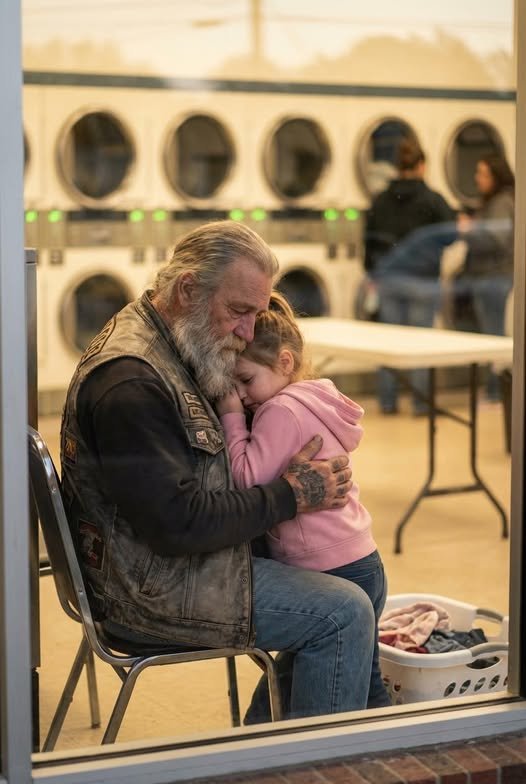
Because every Tuesday, a small girl ran straight toward me and collapsed into my arms, crying like her heart was breaking open.
And I wasn’t supposed to tell anyone why.
The Scary Man in the Corner
Let me explain something first.
I don’t look like the kind of man people trust with children.
I’m pushing seventy now. Broad shoulders, leather vest stitched with motorcycle club patches, arms and neck covered in ink earned decades ago. My beard reaches my chest, and my face looks like it’s been carved out of bad decisions and long highways.
Mothers tug their kids closer when I walk past in grocery stores. Cashiers watch me like I might steal something. I’ve gotten used to it.
So when a little girl—maybe seven years old—ran toward me instead of away from me, people didn’t know what to think.
Her name was Destiny.
She was small for her age, with big brown eyes that carried way too much weight behind them. Every Tuesday, she arrived alone, dragging a trash bag full of laundry nearly as big as she was.
And the moment she saw me, she broke.
She climbed into my lap, pressed her face into my leather vest, and cried like the world was ending.
I held her. Rocked her gently. Whispered comfort I wasn’t sure I believed myself.
The truth was, the world was ending for her.
When I First Met Destiny
Three months earlier, I hadn’t planned on meeting anyone.
I was passing through town after a long ride, washing my clothes before heading back out. That’s when I noticed her struggling.
She stood on her tiptoes, trying to lift the heavy bag into the washing machine. She tried once. Then again. On the third attempt, the bag slipped from her hands and hit the floor.
She didn’t scream. She didn’t yell.
She just sat down and started crying quietly, like she didn’t want to bother anyone.
That broke something in me.
I walked over slowly, crouched beside her.
“Need a hand, kiddo?” I asked.
She wiped her nose and shook her head hard. “I can do it. Mama says I’m a big girl now.”
But she couldn’t.
So I helped. Lifted the bag, loaded the clothes, poured the detergent. That’s when I noticed something strange.
Every piece of clothing was adult-sized. Women’s clothes. And they all smelled like antiseptic. Like hospitals. Like medicine.
Like sickness.
“Where’s your mom?” I asked gently.
“She’s… in the car,” Destiny said too fast. “She’s tired.”
I didn’t believe her. But I didn’t push.
Before she left, she looked at me seriously. “Please don’t tell anyone you helped me. Mama would be sad.”
I promised.
The Truth Comes Out
The next Tuesday, she came back.
Same trash bag. Same clothes.
Same outfit she’d worn the week before.
That’s when I noticed the bruises on her arms—not the kind that come from being hurt by someone else. The kind you get from sleeping on hard floors. From curling up in places not meant for rest.
I knelt beside her again.
“Is your mama really in the car, sweetheart?”
Her face crumpled.
“No,” she whispered. “Please don’t tell. They’ll take me away.”
That was when everything spilled out.
Her mother was dying. Stage four breast cancer. Too sick to work. Too weak to walk to the laundromat. They’d been evicted months earlier and were bouncing between shelters and their car.
The shelter didn’t have laundry machines.
So Destiny did it herself.
Every week.
At seven years old.
“She’s all I have,” Destiny sobbed into my chest. “When she dies, I’ll be alone.”
I held her and made a choice that day.
I wouldn’t let her be alone.
A Silent Promise
From that week on, Tuesday at four became sacred.
I helped with laundry. Bought her snacks. Slipped money into folded clothes when she wasn’t looking. Brought “extra” sandwiches I “couldn’t finish.”
I wanted to do more—housing, doctors, help—but Destiny begged me not to.
“If people know, they’ll take me away,” she said. “Mama says we just have to make it a little longer.”
We both knew what that meant.
So instead, I stayed.
I listened.
And every week, she cried in my arms, releasing fear she couldn’t show her mother.
Why I Helped
One day she asked me why.
I showed her a picture I carried in my wallet.
A little girl with pigtails and a crooked smile.
“My daughter,” I said. “Her name was Sarah. She died when she was eight.”
Leukemia.
Forty years ago.
“I couldn’t save her,” I told Destiny. “But maybe I can help you.”
She hugged me tighter.
When Destiny Disappeared
Three weeks before everything changed, Destiny didn’t show up.
I waited for hours.
I couldn’t look for her. Didn’t know her last name. Didn’t know which shelter.
I just waited.
When she finally came back the next week, she looked smaller. Thinner.
“Mama’s in the hospital,” she whispered.
That night, I showed her the paperwork I’d been carrying.
I’d become a licensed foster parent.
“If something happens,” I told her, “you can come live with me.”
She cried harder than I’d ever seen.
Saying Goodbye
Her mother passed away two weeks later.
I was there.
Held Destiny as she said goodbye. Watched a dying woman thank a stranger for protecting her child when she couldn’t anymore.
Three days later, Destiny moved in with me.
My apartment wasn’t ready for a child—but love doesn’t wait for perfection.
The guys from my motorcycle club helped turn my office into a pink bedroom. Their wives took her shopping.
She still cries sometimes.
But she laughs too.
A New Family
Now, when people stare at us in public, Destiny squeezes my hand tighter.
“That’s okay,” she says. “They don’t know you.”
She calls me Dad now.
And every Tuesday, we still go to the laundromat—not because we need to, but because that’s where our story began.
A place where a grieving man and a brave little girl found each other.
And became a family.
Family isn’t always about blood.
Sometimes it’s about showing up—every Tuesday at four.
Website Disclaimer
The information provided on this website is for general informational and educational purposes only. While we strive to ensure that all content is accurate and up to date, we make no guarantees regarding the completeness, reliability, or accuracy of any information published.
The views and opinions expressed in articles belong to their respective authors and do not necessarily reflect the views of this website. Any action you take based on the information found on this website is strictly at your own risk. We will not be liable for any losses, damages, or inconveniences arising from the use of our content.
Some articles may contain opinions, third-party information, or external links. We do not endorse or guarantee the accuracy of content on external websites and are not responsible for their practices or policies.
All content on this website is provided in good faith and is intended for informational purposes only. Readers are encouraged to verify information independently and seek professional advice where appropriate.