“Our Sons Lived at the Cost of Their Sisters”: A Mother’s Journey Through Loss, Survival, and Hope
Our journey to build a family began in August 2013, and the years that followed tested us in ways we never imagined. Infertility, unsuccessful treatments, and devastating adoption disappointments pushed us to emotional breaking points we didn’t know we had.
For six months, I took Clomid while undergoing countless tests. Eventually, doctors discovered that half of my husband’s sperm were swimming in the wrong direction, and I was diagnosed with endometriosis. Despite these findings, our original doctor was unwilling to move beyond Clomid, so we sought help from a fertility specialist at the Cleveland Clinic. She recommended surgery to remove the endometriosis, followed by Clomid combined with IUI. Over the next six months, we completed four IUI cycles, made even more challenging by my husband’s commitments with the Air Force Reserves.
During that time, we felt a strong pull toward adoption. We were quickly matched with an expectant mother in California who was carrying twin girls. We stopped fertility treatments and poured our hearts into preparing for those babies—sharing the news, setting up a nursery, and dreaming of the life ahead.
Then everything fell apart. The expectant mother delayed repeatedly, saying she wasn’t ready. Finally, we received the call that shattered us: she had chosen two families from two agencies, and another couple had already taken the babies home. We were devastated.
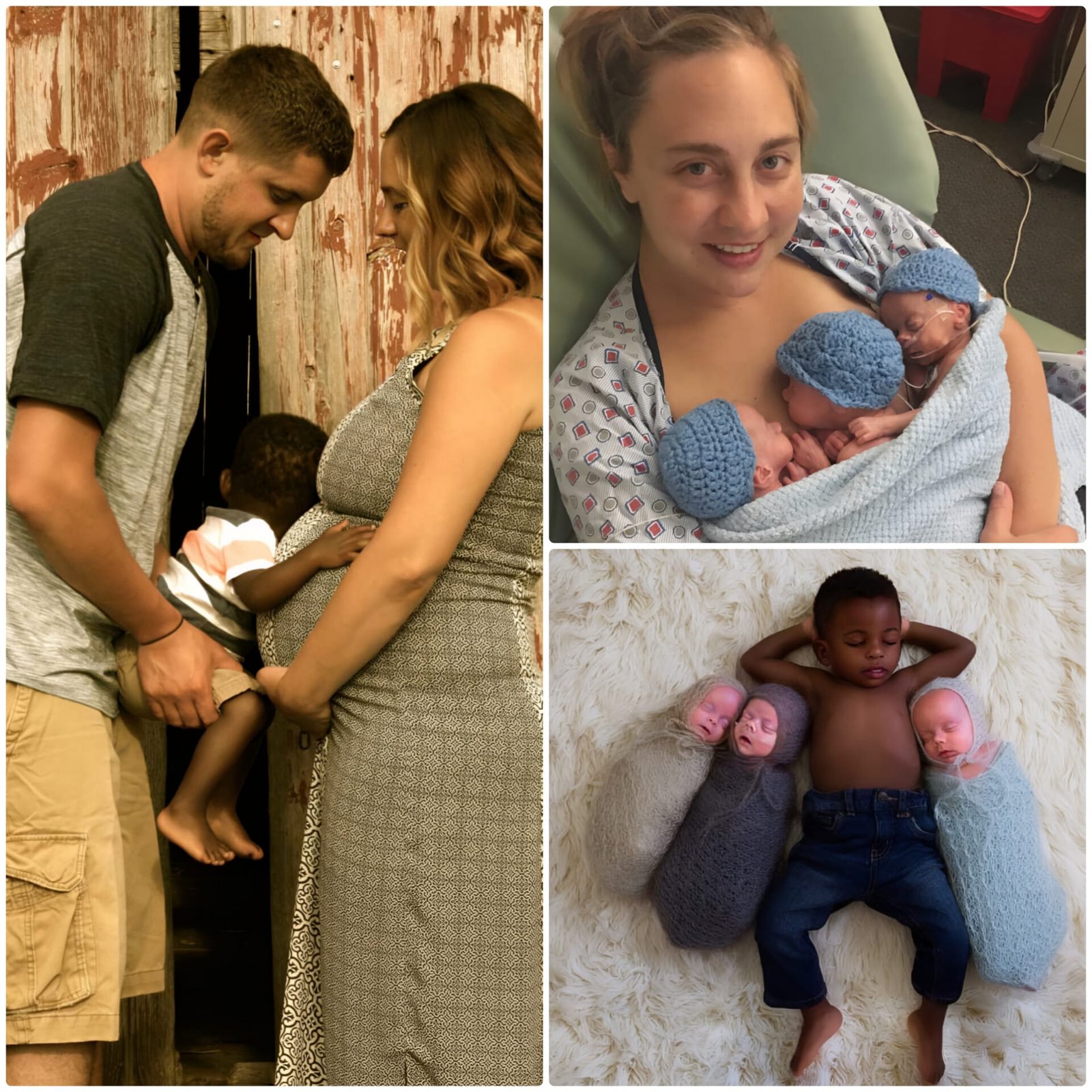
After taking a month to grieve and regroup, we tried again. The very first expectant mother we connected with chose us immediately. Just five days later, we traveled to Louisiana and brought home a spirited six-month-old boy—now our incredible, energetic toddler.
Once we found our rhythm as parents, we returned to fertility treatment, this time under the care of Dr. Mooney at Reproductive Gynecology. We completed four rounds of IUI using Gonal-f injections. On the final cycle, just before planning to move on to IVF, we received the call that left us stunned: we were expecting quintuplets. Three boys and identical twin girls. My husband nearly fainted, and I couldn’t stop laughing in disbelief.
The pregnancy was overwhelming from the start. We faced impossible decisions, including discussions about selective reduction, choosing specialists, planning delivery logistics, and preparing for long-term bed rest—all while raising a toddler. From 12 weeks on, my activity was extremely limited. My maternal-fetal medicine team worked tirelessly to keep the pregnancy stable.
Everything seemed calm until just before 24 weeks.
I noticed fluid leakage and went to the emergency room. At first, everything appeared normal. But during a follow-up appointment days later, our world collapsed: our twin girls no longer had heartbeats.
We had now lost two sets of twin daughters—one through adoption, and now the girls growing inside me. The grief was overwhelming. I blamed myself relentlessly, questioning every step, every bite of food, every moment of rest. Carrying quintuplets requires extraordinary nutrition—nearly 5,000 calories a day—and I convinced myself I hadn’t done enough.
From that moment on, fear consumed me. I watched every sign, terrified that I would lose our boys too.
About a week later, the girls’ sac ruptured, increasing the risk of infection for the boys. I was admitted to the hospital and placed on strict bed rest. My days were filled with nonstop monitoring—three daily non-stress tests and constant ultrasounds. My husband and toddler struggled with the separation, and we were living with my parents while our home was being remodeled to prepare for five babies.
At around 27 weeks, doctors noticed concerning changes in Jaxton’s cord flow, soon followed by Knox’s and Tucker’s. Then, at 28 weeks and four days, Tucker’s cord flow reversed completely. A doctor rushed in and said words I’ll never forget: “We have to deliver now.”
At 10:04 that morning, our three sons were born. We also held our daughters for the first and last time, saying goodbye to the girls we loved so deeply.
Life in the NICU was relentless—constant alarms, whispered conversations, and waiting anxiously for every update. Knox struggled with oxygen deprivation and developed brain cysts. Tucker battled recurring infections caused by urinary reflux. Slowly, painfully, they began to improve. By 34 weeks, they were learning to take bottles, and a week later, they were strong enough to come home. Tucker weighed just 3.5 pounds, Knox 4.5, and Jaxton 5.5.
Our first night home was terrifying. Knox stopped breathing and turned blue, sending us racing back to the hospital. Since then, our lives have been filled with specialist visits—for the babies and for our fearless toddler—but each month brings progress. Now, at eight months old, the boys are thriving, nearly as big as their older brother. They love cereal, their bouncers, and—most days—their big brother.
Even now, guilt over losing our daughters still lingers. I remind myself that our sons reached 28 weeks because of how the pregnancy unfolded, and they grew as strong as preemies possibly could. They survived because their sisters didn’t. That truth is devastating—and, somehow, also a source of comfort.
I wouldn’t change our story. Every loss, every miracle, every painful turn shaped the family we are today.
Our journey is raw, heartbreaking, beautiful, and uniquely ours—and I wouldn’t trade it for anything.
Website Disclaimer
The information provided on this website is for general informational and educational purposes only. While we strive to ensure that all content is accurate and up to date, we make no guarantees regarding the completeness, reliability, or accuracy of any information published.
The views and opinions expressed in articles belong to their respective authors and do not necessarily reflect the views of this website. Any action you take based on the information found on this website is strictly at your own risk. We will not be liable for any losses, damages, or inconveniences arising from the use of our content.
Some articles may contain opinions, third-party information, or external links. We do not endorse or guarantee the accuracy of content on external websites and are not responsible for their practices or policies.
All content on this website is provided in good faith and is intended for informational purposes only. Readers are encouraged to verify information independently and seek professional advice where appropriate.