The notification on my phone screen was innocuous enough. A simple ping, a flash of light, and a line of text from the American Express app: Authorized Charge: Le Jardin, $482.50.
I stared at it, the blue light reflecting in my eyes, sitting in the temperature-controlled silence of my home office. It was August 14th—my wife Sarah’s thirty-fourth birthday.
To anyone looking in from the outside, David Sterling was a man who had it all. I was the CFO of a mid-sized logistics firm, living in a sprawling colonial house in the suburbs, married to a woman who looked like she stepped out of a catalog. But the reality of my life was a balance sheet that never quite reconciled. I was less a husband and more of a venture capitalist funding a failing startup called “The Miller Family Image.”
“David, are you listening?”
I snapped my head up. Sarah was standing in the doorway of my office. She looked stunning, I had to admit—a vision in a cream-colored linen dress that I knew cost more than my first car. But her expression was one I knew too well: a mixture of impatience and mild disdain.
“I’m listening,” I said, putting my phone down. “Happy Birthday, Sarah.”
“Save it for the gift,” she said, checking her reflection in the glass of a framed diploma on my wall. “My parents are here. We’re taking the Escalade. Dad says the suspension in your sedan hurts his back.”
“The sedan is fine, Sarah,” I said, fighting the urge to sigh. “But take the SUV. Where are you going for lunch?”
“Le Jardin,” she said casually.
I frowned. “Le Jardin? That French bistro downtown? Sarah, that place is strictly white-tablecloth. They don’t have a kids’ menu. Leo hates that kind of food.”
Leo. My eight-year-old son. He was the only thing in this house that felt real to me. He was a quiet, sensitive boy who loved dinosaurs and drawing, and who shrank into himself whenever his grandparents, Robert and Eleanor Miller, were in the room.
“He needs to learn culture, David,” Sarah snapped, her voice sharpening. “Mother says we coddle him too much. He’s eight, not a toddler. He can sit still and eat a baguette while we celebrate.”
“It’s ninety-five degrees out there,” I noted, glancing at the window where the summer heat was making the air shimmer above the driveway. “Maybe go somewhere with a patio? Or leave him here with me? I can take a break around one.”
“Absolutely not,” Sarah said. “It’s a family celebration. He needs to be there for the photos. Appearance matters, David. You of all people should know that.” She checked her watch. “Just make sure the joint account is topped up. Dad ‘forgot’ his wallet at the club yesterday.”
She didn’t wait for a response. She turned on her heel and walked out.
I stood up and went to the window. I watched them in the driveway. Robert Miller, a man who hadn’t held a steady job since the late 90s yet acted like a feudal lord, was directing Leo into the backseat of the Escalade. Eleanor, his wife, was already in the passenger seat, likely critiquing the cleanliness of the dashboard.
I saw Leo look back at the house. He looked small. He was wearing a stiff polo shirt and khakis that Sarah had forced him into, looking uncomfortable in the heat. He caught my eye through the window and gave a small, sad wave.
I waved back, forcing a smile I didn’t feel.
As the massive black SUV pulled out of the driveway, that familiar tightening in my chest returned. It was the feeling of being an ATM with a pulse. I paid the mortgage on this house. I paid the lease on the Escalade. I paid the rent on Robert and Eleanor’s “downsized” luxury condo across town. I paid for the country club memberships they used to network with people who had actually earned their money.
I sat back down, telling myself it was just lunch. Just a few hours.
I didn’t know then that the credit card notification for $482.50 wasn’t just a receipt for lunch. It was the price tag for my son’s suffering.
Part 2: The Heat Index (Character Reactions)
Three hours passed. I buried myself in spreadsheets, trying to ignore the silence of the empty house.
At 2:30 PM, the front door opened.
I expected the noise of a return—Robert’s booming, pompous voice, Eleanor’s high-pitched complaints about the service, Sarah’s performative laughter.
Instead, there was silence. Then, a small, heavy thud, like a backpack being dropped.
“Leo?” I called out, pushing my chair back. “Sarah?”
No answer.
I walked into the foyer. The heavy oak door was wide open, letting in a blast of furnace-hot air. Sarah’s car wasn’t in the driveway.
Leo was standing in the hallway alone.
My heart stopped.
He didn’t look right. His face was a terrifying shade of beet-red, splotchy and inflamed. His hair was plastered to his skull with sweat, but his skin looked dry, almost papery. He was swaying slightly, his eyes glassy and unfocused.
“Leo!” I sprinted the ten feet between us and dropped to my knees.
As I grabbed his shoulders, his body heat radiated through his clothes like he was a burning coal. He didn’t hug me back. He just stared at me, his lips cracked and white.
“Buddy,” I whispered, panic clawing at my throat. “What happened? Where is Mom?”
“She… she dropped me off,” Leo croaked. His voice was a rasp, like sandpaper on wood. “She went… to Grandma’s. For wine.”
“Why are you so hot?” I asked, scooping him up. He was dead weight in my arms. “Did the AC break in the car?”
Leo rested his head against my chest. “They wouldn’t let me in.”
I froze, halfway to the kitchen. “What?”
” The restaurant,” Leo whispered, closing his eyes. “Grandma said… said my shoes were dirty. She said I looked like a street rat. They didn’t want the waiter to see me.”
My blood ran cold, instantly numbing the panic and replacing it with something darker. “So where did you eat, Leo?”
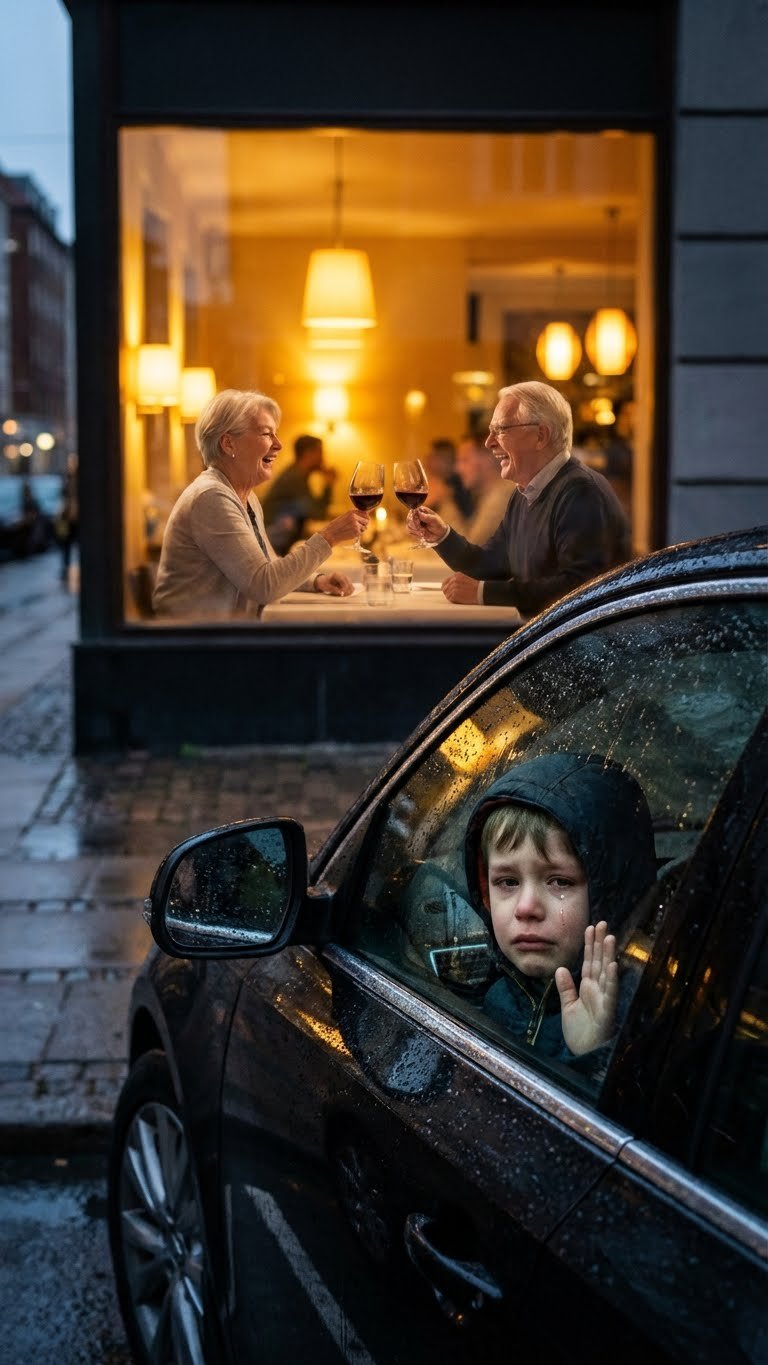
“I didn’t,” he mumbled. “They told me to wait in the car. They said it would be quick. Dad… it was so hot. The car turned off.”
The world tilted on its axis.
They had left him in the car.
I rushed him to the kitchen, sitting him on the counter. My hands were shaking, but my mind had entered a strange, hyper-focused state. Hydration. Cooling. Vitals.
I got a glass of cool water—not ice cold, so it wouldn’t shock his system—and held it to his lips. He drank greedily, spilling it down his chin. I grabbed a wet towel from the sink and pressed it to the back of his neck and his forehead.
“How long, Leo?” I asked, my voice terrifyingly calm. “How long were you in the car?”
“I counted the songs on the radio until the battery saver turned it off,” he said. “Then I just… I slept.”
Two hours. That lunch bill I saw was timestamped two hours ago.
They had eaten a three-course meal. They had ordered appetizers. They had drunk wine. They had ordered dessert.
All while my eight-year-old son sat in a black car, in ninety-five-degree heat, baking like an animal in a cage.
I looked at Leo. The color was slowly coming back to his lips, but he was exhausted. He had suffered mild heat exhaustion. If it had been ten degrees hotter, or if they had stayed for coffee…
I pulled my phone out.
Notification: 2:45 PM. Uber Ride from Le Jardin to The Miller Residence. $45.00.
Sarah hadn’t even driven him home. She had put a dehydrated, heat-struck child in an Uber so she could go drink wine with her parents.
I looked at the AmEx notification again. Filet Mignon. Pinot Noir. Crème Brûlée.
Something inside me, a structural beam that had been holding up the weight of my marriage for ten years, simply snapped. There was no explosion. No scream. just a collapse of affection, obligation, and tolerance.
The David who wanted to “keep the peace” died in that kitchen.
I picked up my phone and dialed Mrs. Higgins, our next-door neighbor, a retired nurse who doted on Leo.
“Martha,” I said, my voice steady. “I have a family emergency. Can you come sit with Leo for an hour? He’s had a rough day in the sun. He needs fluids and cartoons. I need to go out.”
“Of course, David,” she said. “Is everything alright?”
“No,” I said. “But it’s about to be handled.”
Part 3: The Deduction (Conflict Development)
The drive to the Miller’s condo usually took twenty minutes. I made it in fifteen.
The silence in my car was heavy, filled only by the hum of the tires and the sound of my own measured breathing. I didn’t listen to music. I listened to the sound of a plan clicking into place, gear by gear.
As I drove, I didn’t see the road. I saw the last decade.
I saw the wedding reception where Robert made a toast about how Sarah was “marrying down” but “marrying stable.”
I saw the day we bought the house, where Eleanor criticized the kitchen cabinets I had just paid for.
I saw the endless stream of “loans” that were never repaid. The “investments” in Robert’s non-existent consulting firm.
They thought I was weak. They mistook my silence for submission and my generosity for stupidity. They thought the money tap was a natural spring that would flow forever, regardless of how they treated the source.
I pressed the button on my steering wheel. “Call Bank of America. Private Client Services.”
“Connecting,” the automated voice said.
“Mr. Sterling,” the banker answered on the second ring. “How can I help you today?”
“Michael,” I said. “I need to execute a security protocol. I believe my accounts have been compromised by fraudulent users.”
“Oh no. Which accounts, sir?”
“All of them,” I said, staring at the traffic light turning red. “The joint checking. The savings. The investment dividends account. And specifically, the secondary credit cards issued to Sarah Sterling, Robert Miller, and Eleanor Miller.”
“I see. Do you want to freeze them?”
“I want them terminated,” I corrected. “Cancel the cards. Mark the activity from today as disputed. And Michael? The automatic transfer set for the 15th to the ‘Miller Trust’? Cancel it. Permanently.”
“Sir, that’s the mortgage payment for the condo on Elm Street, isn’t it?”
“Yes,” I said. “They can make other arrangements. And one more thing. I need you to trigger the foreclosure clause on the lien I hold against that property.”
There was a pause on the line. “David, are you sure? That’s family.”
“No, Michael,” I said, watching a father walk his son across the crosswalk, holding his hand tightly. “It’s not. Execute the order. Send the confirmation to my phone.”
“Done.”
I hung up.
Next, I called the cell phone provider.
“Disconnect lines ending in 4500 and 4501. Yes, the parents’ lines. No, don’t port the numbers. Just cut the service.”
I was acting as a reaper. With every mile I drove, I severed a connection. The country club membership? Cancelled via the app. The insurance on the Escalade? Suspended.
By the time I pulled up to the gated community where the Millers lived—a community I paid the HOA fees for—I was no longer a husband or a son-in-law. I was a collection agent.
I saw the Escalade parked in the visitor spot because the garage was full of Robert’s hoarding. I parked my sedan behind it, blocking it in.
I walked up the path. I could hear laughter coming from the open patio doors. It was a light, airy sound. The sound of people who had never faced a consequence in their lives.
I reached into my pocket and felt the spare key to the Escalade. I took it out.
I walked past the front door and around to the side gate. I entered the patio unannounced.
Part 4: The Bill Comes Due (Turning Point)
The scene was almost comical in its cliché.
They were sitting around a glass table under a large umbrella. A half-empty bottle of expensive wine sat in an ice bucket—my ice bucket, stolen from my house last Christmas.
Robert was leaning back, a cigar in his hand. Eleanor was picking at a fruit plate. Sarah was scrolling on her phone, looking bored.
“Honestly,” Eleanor was saying, “he’s just so sensitive. He gets that from David’s side. No stamina.”
“He needs boarding school,” Robert grunted, puffing smoke. “Toughen him up. David coddles the boy.”
“David,” Sarah sighed, “is just… soft.”
“David is here,” I said.
The silence that fell over the patio was instant. The three of them jumped. Sarah dropped her phone on the table.
“Jesus, David!” Sarah shrieked, clutching her chest. “You scared me to death! What are you doing here?”
“Creeping around like a burglar,” Robert muttered, recovering his composure. “Typical. Grab a glass, boy. Though I think we’re out of the good stuff.”
I didn’t move. I stood at the edge of the patio, my hands at my sides.
“Where is my son?” I asked.
Sarah rolled her eyes. “He’s at home. I sent him back in an Uber. He was being a brat, whining about the heat, refusing to sit in the car quietly. I couldn’t deal with it on my birthday.”
“The car,” I said, my voice dropping an octave, “was one hundred and four degrees inside, Sarah.”
“Oh, stop it,” Eleanor waved a hand dismissively. “It’s a luxury car. It’s insulated. He’s fine. Don’t be dramatic.”
“He had heat exhaustion,” I said. “He was disoriented. His skin was dry. He could have died.”
“But he didn’t,” Robert said, taking a sip of wine. “So what’s the problem? You’re ruining the vibe, David. Go home to your kid if you’re so worried.”
I looked at them. Really looked at them. I saw the wrinkles of cruelty around Eleanor’s mouth. The glazed, alcoholic selfishness in Robert’s eyes. And Sarah… the hollowness of her.
“You ate filet mignon,” I said quietly. “You spent five hundred dollars on lunch while my son baked.”
“It was my birthday!” Sarah snapped, standing up. “God, you are so controlling! It’s always about the money with you, isn’t it?”
“Yes,” I said. “It is.”
I walked forward and picked up the bottle of wine. I looked at the label. It was a vintage I had bought for our anniversary. Sarah had taken it from the cellar.
I dropped the bottle.
It shattered on the patio stones. Red wine exploded across Sarah’s linen dress and Robert’s white trousers.
“You lunatic!” Robert roared, struggling to stand up. “That was a three-hundred-dollar bottle!”
“It was my bottle,” I said. “Just like the table you’re sitting at. Just like the condo you’re sleeping in. Just like the clothes on your backs.”
“David, stop this right now,” Sarah hissed, her face turning red. “You are embarrassing me.”
“I’m done,” I said. “I just got off the phone with the bank.”
I looked at Robert. “Your credit cards are dead. All of them.”
I looked at Eleanor. “Your phone service is cut.”
I looked at Sarah. “The joint accounts are frozen. I’ve moved my direct deposits to a new account you can’t access.”
Robert laughed, a nervous, hacking sound. “You can’t do that. You can’t just cut us off. We have an agreement.”
“We don’t have an agreement,” I said. “I have a hemorrhage, and I just applied a tourniquet.”
“I am your father-in-law!” Robert shouted, pointing a finger at me. “I demand some respect!”
“Respect is purchased,” I said coldly. “And your payment was declined.”
I pulled the spare key to the Escalade out of my pocket.
“Sarah,” I said. “Give me the primary key to the truck.”
“No,” she said, crossing her arms. “It’s my car.”
“It’s in my name,” I said. “I pay the lease. I pay the insurance. And since you used it as a torture chamber for my son today, you are never driving it again.”
“You’re bluffing,” she sneered. “You need me. You need us to maintain your little suburban fantasy.”
I didn’t argue. I simply turned to Robert. “Robert, I also triggered the foreclosure on this condo. Since the ‘Miller Trust’ was just a shell account funded by me, and I stopped the funding… the bank will be contacting you in about three business days. I suggest you start packing.”
The color drained from Robert’s face. The cigar fell from his fingers. “You… you can’t. We have nowhere to go.”
“I hear the market is great for renters,” I said. “If you have jobs.”
I turned back to Sarah. She looked terrified now. The reality was setting in. The money wasn’t just a number; it was the gravity holding her world together, and I had just turned off the physics.
“David,” she faltered, reaching for my arm. “Baby, let’s talk about this. You’re upset. We can—”
I stepped back, avoiding her touch as if she were contagious.
“I’m filing for divorce tomorrow,” I said. “On the grounds of child endangerment and gross negligence. I have the medical report from the Urgent Care coming via Mrs. Higgins. I have the Uber receipt. I have the timestamps from the restaurant. I will get full custody.”
“You can’t take Leo,” she whispered.
“You left him in a car,” I said. “You already gave him up.”
I turned and walked to the gate.
“David!” Sarah screamed. “How are we supposed to get home? You blocked the car in!”
I stopped and looked back at them one last time. The wine was staining the patio stones like blood. Their paradise was crumbling in real-time.
“Uber is forty-five dollars,” I said. “I hope you have cash. I cancelled your apps, too.”
Part 5: The Purge (Resolution and Growth)
The next seventy-two hours were a blur of legal violence.
I didn’t go back to work. I stayed home with Leo. We built Lego sets. We ordered pizza (from a place he liked). We slept in a tent in the living room because he didn’t want to be alone.
Sarah tried to come home that night. My newly installed smart locks denied her entry. She pounded on the door for ten minutes until the police arrived. I had already called them, explaining that an estranged spouse with a history of child negligence was attempting to gain entry.
Watching the police officer escort her away from her own front porch was a tragedy, but it was a tragedy she had written herself.
The legal battle that followed was brief and brutal.
Robert tried to sue me for “breach of contract” regarding the condo. My lawyer, a shark named Eleanor (ironically) whom I had hired the next morning, laughed him out of the deposition room. Without my funding, Robert couldn’t even afford the retainer for his own attorney.
Sarah played the victim card. She told everyone I was abusive, controlling, a financial tyrant.
But facts are stubborn things.
The deposition regarding the “Lunch Incident” was the turning point.
My lawyer placed the photo of Leo’s face—taken by Mrs. Higgins immediately after I left—on the table. Then she placed the weather report for that day: 96°F. Then the restaurant bill.
“Mrs. Sterling,” my lawyer asked. “Can you explain why you ordered a second bottle of Pinot Noir at 1:45 PM while your son was unattended in a vehicle?”
Sarah crumbled. She cried. She blamed her parents. She said she was pressured.
It didn’t matter.
I offered a settlement: I kept the house. I kept full physical custody. She got supervised visitation on weekends and a modest alimony for two years—enough to rent an apartment, not enough to support her parents.
She took it. She had no choice. Her parents were already moving into a one-bedroom apartment in a bad part of town, their credit scores ruined, their reputation in tatters. They needed her income, meager as it would be.
The parasitic bond remained, but the host had cut them loose.
The hardest part wasn’t the legal fight. It was the conversation with Leo.
A week after the incident, we were sitting on the back porch. The sun was setting.
“Is Mom coming back?” he asked, looking at his sneakers.
“No, buddy,” I said gently. “Mom is going to live somewhere else for a while. You’ll see her on Saturdays.”
“Is it because I was bad?” he asked. “Because I couldn’t wait in the car?”
My heart broke again, but this time, it healed stronger.
I pulled him into my lap. “Leo, look at me. You were never bad. You were perfect. Mom and Grandma and Grandpa… they made a big mistake. A dangerous mistake. And my job is to keep you safe. I can’t keep you safe if I let them do that again.”
“I was really hot, Dad,” he whispered.
“I know,” I said, kissing the top of his head. “I promise you, Leo. You will never be that hot again. You will never be left behind again. I’m here. And I’m not going anywhere.”
Part 6: The Quiet After the Storm (Conclusion)
One year later.
The house was different. The stiff, museum-quality furniture Sarah had insisted on was gone, replaced by comfortable, durable leather couches. There were dinosaur toys on the floor. There was life.
I was in the kitchen, making dinner—actual food, not the kale salads I had been forced to eat for a decade. Steak and potatoes. Leo’s favorite.
My phone pinged.
I glanced at it. An email from a mutual acquaintance.
Subject: FYI on the Millers.
Curiosity, that old vice, made me open it.
Thought you should know. Robert had a stroke last week. Stress, apparently. They tried to get him into the private care facility, but without the insurance, they’re at the county hospital. Sarah is working double shifts at a reception desk to pay their rent. They’re miserable, David. They blame each other.
I read the words. I waited for the guilt. I waited for the urge to fix it, to write a check, to swoop in and be the hero.
It didn’t come.
Instead, I felt a profound sense of peace. Karma hadn’t struck them down with lightning; it had simply allowed them to live the lives they could afford, without my subsidy. They were drowning in the shallow end of the pool because they had never learned to swim.
“Dad!” Leo yelled from the living room. “The movie is starting!”
“Coming!” I shouted back.
I deleted the email. I blocked the sender.
I walked into the living room. Leo was sprawled on the couch, wrapped in a blanket, grinning. He looked healthy. He looked happy. He looked safe.
I sat down next to him, and he leaned his head on my shoulder.
“Dad?”
“Yeah, bud?”
“I’m glad it’s just us,” he said.
I put my arm around him. “Me too, Leo. Me too.”
On the screen, the heroes were winning. But in my living room, the battle was already over. I hadn’t screamed. I hadn’t fought with fists. I had simply closed the wallet and watched their world crumble, brick by golden brick.
And in the silence that followed, I had finally found my voice.
Website Disclaimer
The information provided on this website is for general informational and educational purposes only. While we strive to ensure that all content is accurate and up to date, we make no guarantees regarding the completeness, reliability, or accuracy of any information published.
The views and opinions expressed in articles belong to their respective authors and do not necessarily reflect the views of this website. Any action you take based on the information found on this website is strictly at your own risk. We will not be liable for any losses, damages, or inconveniences arising from the use of our content.
Some articles may contain opinions, third-party information, or external links. We do not endorse or guarantee the accuracy of content on external websites and are not responsible for their practices or policies.
All content on this website is provided in good faith and is intended for informational purposes only. Readers are encouraged to verify information independently and seek professional advice where appropriate.