The Verdict at Breakfast
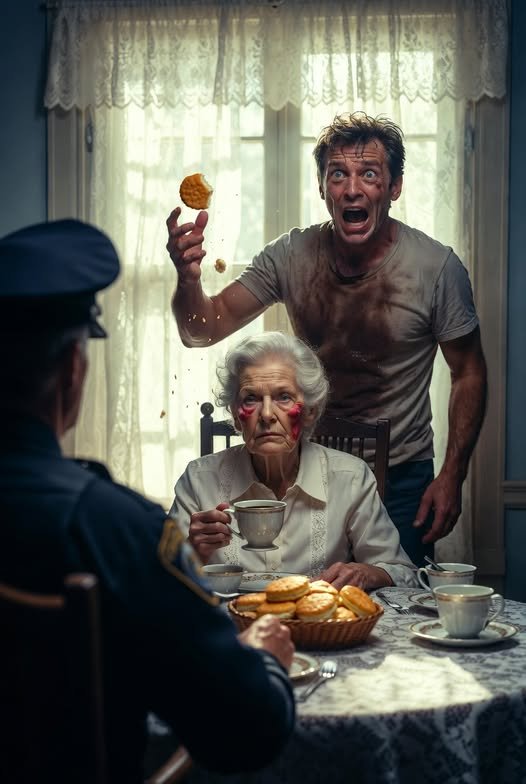
My son laid a hand on me inside my own kitchen, and I didn’t say a word. But the next morning, when he came downstairs thinking I just accepted his disrespect, he froze in sheer terror when he saw who was sitting at my dining room table. I was sitting at the head of the table, smoothing out the lace tablecloth, when Jeremiah walked into the room with that air of his, like he owned the world. He hadn’t even noticed the swelling on my lip. He was so focused on himself. He grabbed a biscuit, took a bite, and started talking about how things were going to change in this house. But the words died in his throat when the chair next to me moved. His face, which had been flushed from the liquor, turned gray, like he’d seen a ghost. The biscuit fell from his hand and crumbled on the floor. He knew in that one second that my silence the night before hadn’t been fear. It had been a verdict.
But for you to understand how we got to this breakfast that felt more like a courtroom, let me introduce myself properly. I’m Gwendelyn Hayes. I’m sixty-eight years old, a widow, and I live in an old neighborhood in Savannah, Georgia. You know, the kind of houses with the big porches and the old oak trees out front? Well, that’s me. I’ve always been a peaceful woman. I raised my son on my own after my Robert passed. Worked two jobs so he’d never want for anything. But until about six hours ago, I didn’t know I was sleeping with the enemy right under my own roof.
Chapter 1: The Storm Inside
It all happened—or maybe it all finally fell apart—around 3:00 in the morning. Jeremiah came home. I was in the kitchen, sitting in my rocking chair, listening to a hymn on the radio, playing real low to calm my nerves. It was raining hard outside, but the sound that startled me was the key scraping in the front door, all rough-like.
He stumbled in, smelling of cheap bourbon and cigarettes. I stayed quiet. He threw his keys on the hall table, and I heard something break. It was my ceramic vase, the blue one my grandmother gave me. He didn’t even look back. He walked into the kitchen, and when he saw me, his anger just seemed to swell up. He started yelling, saying it was my fault his life was a mess, that I cared more about the house and my “old junk” than I did about him.
I got up slowly and said, “Son, go to bed. You’re not well.”
That’s all it took. That was the trigger. He came at me. A forty-one-year-old man, strong against his own mother. He grabbed me by my arms and shook me so hard I felt my teeth rattle. And then he shoved me. I went flying into the china cabinet. The hardwood hit my back, and my head cracked against the glass.
And it didn’t stop there. He raised his hand and slapped me across the face. The sound was loud. The pain was hot. I tasted iron in my mouth right away. My lip was split. I didn’t scream. I didn’t cry. I just stayed there, crumpled up, looking at him.
And him? He just huffed, turned his back, and went upstairs, leaving his mother bleeding in the kitchen.
The silence in the house after that was heavy. You know, the kind of quiet after something breaks, and there’s no fixing it. I went to the little half-bath mirror. I washed my face with cold water. I saw the cut on my lip, the start of a bruise on my cheek. In that moment, looking into my own eyes, I didn’t see a victim. I saw the Gwendelyn who survived too much to put up with that.
I decided right then and there. That was the last time.
I went back to the kitchen, cleaned up the blood, and instead of going to bed to cry, I started cooking. It was the only thing I could do to keep from losing my mind. I got out the flour, the butter, the baking powder. I grabbed that new set of champagne-colored non-stick baking sheets—the ones my sister sent me. She said they were the best because nothing sticks to them. And they are real pretty and sturdy. I used them all night long.
While the world slept and my son snored upstairs, I baked dozens of biscuits on those sheets. Every time I kneaded the dough, I thought about what I had to do. With every batch that came out golden, my plan got clearer. I wasn’t going to fight him with yelling. I was going to use the one language Jeremiah seemed to have forgotten: respect and the law.
I set the table like it was Christmas. Lace tablecloth, fine china, fresh coffee, everything perfect. When the clock hit 7:30, I was ready. The smell of the food went upstairs like bait. I knew he’d come down, and I knew he’d think everything was fine because a mother forgives everything, right?
Little did he know that forgiveness this time was coming with a side of justice.
Chapter 2: The Ghost of Who He Was
The first batch of biscuits came out of the oven at 4:10 in the morning. The smell of butter and buttermilk spread through the kitchen—a smell that should have meant comfort, home, lazy Sunday mornings. But in the pre-dawn hours, it was the smell of my resolve. It was thick, almost suffocating. I set the hot baking sheet on the stove rack, and the metal made a little sound, a ting in the quiet house. My hands, covered in flour, looked like a ghost’s.
I moved around the kitchen with a calm that wasn’t mine. It was a borrowed calm, an armor I’d put on over the trembling woman who’d been on the floor just hours before.
As I started preparing the second batch of dough, my eyes landed on something on the counter next to the sugar bowl. It’s one of those modern digital photo frames, you know, with the sleek black screen. My sister Paulette gave it to me for Christmas.
“No more dusty photo albums, Gwen,” she told me over the phone from Atlanta. “I bought it on some website. It’s beautiful. You just load the pictures, and it cycles through so you can remember the good things.”
And there it was, day and night, cycling through pictures of my life, a loop of happy memories, a constant reminder of everything I’d lost. And right as I looked, a picture popped up. Jeremiah, he must have been about eight, standing on a fishing boat, his hair all messy from the wind, with a smile that showed the gap where a tooth had fallen out. He was holding up a little fish, a bass, with both hands like it was the biggest trophy in the world. Next to him, my Robert, his father, was smiling with so much pride his eyes were nearly shut.
Oh my God, that picture hit me like a punch to the gut. I leaned against the counter, the flour smudging my robe. I closed my eyes, and I wasn’t in my kitchen at 4:00 in the morning with a split lip anymore. I was back on Lake Lanier on that summer day in 1990.
I remember the smell of sunscreen and damp earth. I remember the sound of Robert’s laughter echoing across the water. Jeremiah had spent all morning trying to catch something. He was such a patient, determined little boy. When he finally felt that tug on the line, his shriek of joy scared the birds out of the trees.
“Daddy, I got one! I got one!”
Robert helped him reel it in, calmly, teaching him how to hold it. “Look at that, Gwen!” Robert had yelled to me on the shore where I was setting up our picnic. “We got a fisherman in the family.”
The pride in my husband’s voice, it was the most beautiful thing. And Jeremiah, he just looked up at his father like Robert was a superhero—with an adoration, a respect, a love that felt unbreakable.
Where did that little boy go? Where in God’s name did he get lost?
The photo frame changed the picture. Now it was Jeremiah at his high school graduation. Him in a blue cap and gown holding his diploma. I was next to him, thirty years younger, with a smile so big it felt like it would split my face. He was the first in our family to go to college. The very first. Our church community, the First African Baptist, threw a party for him. Sister Eloise made his favorite carrot cake with cream cheese frosting. Reverend Michael said a prayer for him from the pulpit, calling him “our young scholar, an example to us all.”
I remember sitting there in that church pew and feeling my chest swell with so much pride. Gwendelyn Hayes’s son. The boy Robert didn’t live to see graduate because Robert was gone by the time Jeremiah was twenty-one, in his last year of college. A massive heart attack right there on the shipyard docks. He left for work in the morning, kissed me on the forehead, and never came home.
Robert’s death was an earthquake that shook the foundations of our house, but we survived. I made myself strong for Jeremiah. At the funeral, he held my hand so tight. He didn’t cry in front of anyone, just stood there tall and serious, the spitting image of his father. That night, after everyone had left, he hugged me in the kitchen and just sobbed on my shoulder.
“I’m going to take care of you now, Mama,” he said. “I promise. I’m going to make Daddy proud of me.”
And he did. For a long time, he did. He graduated with honors. Got a good office job at the same port where his father had worked. Bought a nice car. Helped with the bills. On Sundays, he’d take me to church, sit beside me in the pew, and sing the hymns in that deep baritone voice of his, just like his daddy’s. The old folks in the church would look at him and say, “Gwen, you did a fine job. Robert would be so proud of that boy.”
And I believed it. I lived for that pride. It was my sunshine, my light. Seeing my son become a good man, a respected man. It was proof that all my sacrifice had been worth it.
The screen on the frame flickered again. A more recent photo. A Fourth of July barbecue in our backyard maybe three years ago. Jeremiah was at the grill laughing, wearing an apron that said “The Grill King.” He was a little heavier, but he looked happy. Our neighbors were there—Mrs. Bernice, her husband, who was still alive then. It looked like a perfect life straight out of a magazine.
But happiness sometimes is just a photograph, a frozen moment. Because it was right after that barbecue that the cracks started to show.
It started with his job. “Restructuring.” That’s the word they used. The port was modernizing, bringing in new people with new ideas. Jeremiah’s position, which had been secure for nearly twenty years, was suddenly “optimized.” They demoted him, gave him a desk in a corner with far less responsibility, and worst of all, less respect. For Jeremiah, that wasn’t just losing a title. It was like they’d erased his father’s memory. He felt the legacy of Robert, a man who gave his life to that place, had been dishonored.
He didn’t tell me the details at the time. He just got quiet. A different kind of quiet than mine that morning. His quiet was sharp, full of thorns. He started coming home later. I’d smell the liquor on him, but pretend I didn’t.
“Had a long meeting,” he’d lie. And I’d pretend to believe him.
And then the money started getting tight. “Mom, can you lend me $200? I’ll pay you back at the end of the month.”
I’d lend it. And he’d never pay it back. Then it was 500. And on it went.
The first time he raised his voice at me in a way that scared me, I’ll never forget it. It was over something stupid. A faucet in the kitchen was dripping. I’d asked him three times to fix it. That Saturday morning, I asked again.
“Jeremiah, honey, when you have a minute, could you take a look at that faucet?” I was washing some collard greens in the sink. He was at the table reading the paper. He didn’t look up, just said in a low, growly voice, “Let the damn thing drip.”
The rudeness caught me off guard. “But son, it’s wasting water, and the noise bothers me.”
That’s when he snapped. He slammed the newspaper down on the table so hard the coffee cup jumped. He stood up, and for the first time, he loomed over me. Not my boy, not my proud young man, but a big angry man.
“Damn faucet!” he yelled, his voice echoing in the kitchen. “You’re worried about a damn faucet when my life is going down the drain? If Daddy were here, he wouldn’t have let this happen. He was a real man. He would have handled things. But no, I’m stuck with you. A woman who cares more about a dripping faucet than her own son.”
I took a step back. My heart was racing. I held on to the edge of the sink, my hands wet and cold. It wasn’t what he said. It was his eyes. There was a look in them I’d never seen before. A nasty, poisonous resentment. And for the first time in my life, I felt a chill of fear for my own son.
I didn’t answer. I just stood there watching him as he grabbed his car keys and stormed out, slamming the door. I was left in the kitchen listening to the sound of the dripping faucet. Drip, drip, drip. Each drop seemed to be marking the time of a new era in our house: the era of fear.
Chapter 3: The Three Pillars
I sighed, pulling myself back to the cold morning. The smell of biscuits was in the oven again. I pulled the sheet out with an oven mitt, the heat hitting my bruised face.
The grandfather clock in the living room chimed five. The deep melancholic bells rolled through the house, marking another hour of my vigil. I already had three batches of biscuits cooling on the rack, perfectly golden, lined up like little soldiers. My kitchen, which had always been my sanctuary, my place of creation, had become a war room.
I moved with a precision that came from deep in my soul. But my body, oh my body, was starting to feel the toll of the night. My back, where I’d hit the china cabinet, ached with a dull, throbbing pain. My lip was swollen and pulsed, and exhaustion was beginning to seep into my veins, a slow poison.
I needed coffee, strong.
I went to the counter and pressed the button on my coffee maker. It’s one of those programmable ones, you know, a real modern thing I bought a few months ago, a red one, real pretty. I bought it because I thought if Jeremiah woke up to the smell of fresh coffee, maybe his mood would be a little better. Maybe he wouldn’t wake up with that dark cloud already hanging over his head.
What a fool I was trying to use the smell of coffee to sweeten a man’s bitterness.
I went to the little half-bath under the stairs again. I turned on the cold water tap. I cupped my hands and splashed the icy water on my face once, twice, three times. The water stung my cut lip, but it was a good pain. A pain that woke me up. I washed away the blood, the sweat, the tears. I dried my face with a small towel, patting gently at the sore area, and I looked in the mirror again.
The broken woman was gone. The woman staring back now had steel in her eyes. There was pain in them, yes, a deep pain that might never go away. But there was no more fear. The fear had been burned away by that cold anger. In its place was resolve, a deadly calm.
I left the half-bath. I took the cordless phone into the dining room. I sat in my chair at the head of the table. I took a deep breath, and I made the first call.
The night was still dark, but my mind had never been so clear. The plan began to form piece by piece. It wasn’t a plan for revenge. It was a plan for survival. I didn’t want to destroy my son. I needed to stop the monster he’d become. And if to do that I had to break his heart and my own into a thousand pieces, then so be it.
Some hearts need to be broken so the light can get in.
I dialed the first number. The sound of the ringing resounded absurdly loud in the quiet house. It was almost 4:00 in the morning. I was calling to wake up a seventy-three-year-old retired federal judge.
On the other end, on the third ring, a sleepy but instantly sharp and authoritative voice answered. “Hello?”
“Bernice. It’s me, Gwen. I’m so sorry to call at this hour, my dear.”
There was a pause. I heard her stirring, the sound of fabric. The sleepiness in her voice vanished, replaced by immediate concern. “Gwendelyn, for heaven’s sake, what’s happened? Are you all right? Is it Jeremiah?”
Mrs. Bernice Johnson, my neighbor for over forty years. If there was anyone in the world who would understand the complexity of my situation, the mix of love and terror, it would be her.
I swallowed hard. The shame burned my throat. “I… I need you, Bernice. It happened again, but this time it was worse.”
I didn’t need to say anything else. I heard her sigh on the other end—a heavy sigh, not of surprise, but of deep sadness, of confirmation. “Did he hurt you, Gwen?”
The tears welled up in my eyes again, but my voice stayed steady. “Yes.”
“Call the police,” she said without hesitation. It wasn’t a question. It was a command.
“I’m going to,” I answered. “But first, I need to ask you something. I know it’s a lot to ask, but could you come over for breakfast at 8:00 sharp?”
Another pause. I could almost feel the gears of that brilliant mind turning. She didn’t ask why I wanted to serve breakfast in a situation like this. She understood. She understood this wasn’t about food. It was about bearing witness. It was about authority.
“Gwen, I’m not coming for breakfast,” her voice turned hard as steel. “I’m coming to hold court. Where is your boy now?”
“Sleeping drunk in his room,” I whispered.
“Good,” she said. “Let him sleep. Don’t talk to him. Don’t make a sound. Just do what you have to do. I’ll be there at 8. And Gwen? Yes, you’re doing the right thing. The hardest and the rightest thing. I’m proud of you.”
When she hung up, I felt a wave of relief so strong my legs went weak. I wasn’t alone anymore. The cavalry was coming, and my cavalry wore an impeccable pantsuit and had the US Constitution memorized.
I took a deep breath, gathered my strength, and dialed the second number. The Savannah Police Department.
After a few minutes, Detective David Miller’s voice came on the line. “Sister Gwen, what’s going on? Are you safe?”
“David… Jeremiah, he assaulted me. He came home drunk and he hit me.”
I told him I didn’t want a scene in the night. I wanted dignity. “I want him to look me in the eye. I want him to look Mrs. Bernice in the eye. And I want him to look you in the eye, David. I want him to understand what he’s done. I don’t want him to be just another drunk being dragged out of his house. I want him to feel the weight of his community’s disappointment.”
He was quiet for a long time. Then he said, “I understand, Sister Gwen. 8:00 sharp. We’ll be there.”
Two calls made. One to go. The most personal one. I dialed my sister, Paulette, in Atlanta.
“Gwen,” she picked up on the first ring. “I felt it. I knew it was you. What did he do?”
I told her everything. When I finished, she didn’t say, “I told you so.” She just said, her voice thick with anger and love, “What are you going to do?”
“I’ve called Bernice and Detective David. They’re coming at 8,” I said, my voice now sounding exhausted. “I’m turning him in, Paulette.”
A sob escaped her. “Oh, Gwen, my dear sister, I’m so sorry.”
“I know,” I said. “I just… I wanted you to know. I wanted someone in our family to know what I’m doing so that if I ever doubt myself, you can remind me of today, of this night.”
“I’ll remember,” she promised. “I’m getting the first bus to Savannah in the morning. I’ll be there by the afternoon.”
The three calls were made. The three pillars of my plan were in place: Moral Authority, The Law, and Family.
Chapter 4: The Feast of Judgment
The gray morning light started to filter through the kitchen windows, revealing the silent chaos of my vigil. The sky outside was pale, washed clean by the night’s rain. It was the calm after the storm, and I felt that same calm inside me—a strange, cold calm, but an unshakable one.
I went to the china cabinet, the very one I’d been thrown against. I ran my hand over the dark wood, feeling the solid texture. I opened the glass doors carefully. Inside was my heritage.
First, the tablecloth. White pure linen with a delicate lace trim handmade by my grandmother. I spread it over the dining room table. Then the china. My wedding set with the little hand-painted blue flowers. I set four places at the table: one at the head for me, one to my right for Mrs. Bernice, one to my left for Detective David, and one at the other end facing me—Jeremiah’s place.
White linen napkins, ironed, crisp, folded neatly. A small crystal vase with a single white camellia from my garden in the center of the table. The table was set for a king—or for a sacrifice. The line between the two, I was discovering, was very thin.
I went upstairs, the steps creaking under my feet. I entered my sanctuary. I went to the bathroom and looked at myself in the large mirror. The bruise under my eye was darker now, an ugly smudge of blue and purple. My lip more swollen.
I took a bath, scrubbing my scalp hard. I put on a Sunday dress made of crepe in a deep, almost navy blue. It had long sleeves, a modest neckline, and fell straight to my mid-calves. It was an elegant, sober dress, the kind of dress you wear to church, or to a funeral, or as I was about to find out, to a judgment.
I sat at my vanity. I dusted my face with rice powder to take away the shine. I didn’t try to hide the bruise. I wanted my wounds to be my witnesses. I put on a wine-colored lipstick, real dark with a matte finish. I wanted my mouth to be firm, strong when I delivered his sentence.
I went downstairs. I poured the fresh coffee into a porcelain pot, the grits into a tureen, the preserves into a crystal bowl. I carried everything to the dining room table. Everything was perfect. Dangerously perfect.
I sat down in my chair at the head of the table. I smoothed the blue dress over my knees. My hands were calm now. My heart was beating in a steady, slow rhythm. I was ready.
And that’s when I heard it. The sound of footsteps upstairs. The creak of the floorboards in Jeremiah’s room. He was awake. The guest of honor was about to come down for his feast.
Chapter 5: The Arrival
The footsteps started coming down the stairs, one step at a time, heavy, deliberate. Now in the front hall, there was a pause. I knew what he was seeing. The hall table and the broken shards of my blue ceramic vase on the floor. I hadn’t cleaned it up. I’d left it on purpose.
But what I heard next wasn’t a sigh of regret. It was a huff, a sound of disdain. And then I heard the sound of the shards being kicked into a corner with the toe of his shoe—carelessly, like it was just trash. In that moment, any lingering shred of pity I might have had for him evaporated.
And then he appeared in the dining room doorway.
He blinked, adjusting to the light. He was dressed in wrinkled khaki pants and a polo shirt that had seen better days. His face was puffy, his eyes red. He took in the scene: the white lace tablecloth, the fine china, the steaming platters of food. He scanned it all, and a look of confusion settled on his face.
And then the confusion morphed into arrogance. A slow, crooked smile spread across his face. He had read it all wrong. In his sick mind, this feast wasn’t a trap. It was a peace offering. A white flag.
“Well, well,” he said, his voice still stiff from the hangover. He walked to the table like a king surveying his domain. “To what do I owe the honor of this grand banquet?”
I didn’t answer. I just watched him.
He pulled out his chair and threw himself into it. He reached out and took a biscuit from the basket, took a huge bite, and chewed loudly. After he swallowed, he pointed what was left of the biscuit at me.
“There you go, Mom,” he said, his voice full of cruel victory. “See? You finally figured out who’s in charge around here, huh? A little discipline and things fall right back into place. That’s how it’s got to be.”
I just stared at him from across the table. The silence stretched.
Ding-dong.
The sound of the doorbell. Sharp, clear, punctual.
Jeremiah stopped. A scowl of irritation formed on his forehead. “Who the hell is it at this time of morning? Did you invite someone?”
“Yes,” I said. My voice came out calm, steady. “I did.”
“You what?” He growled. “I don’t want to see anyone. Send them away, whoever it is.”
I ignored his command. I stood up, smoothed my dress, and walked toward the front hall.
“Mom, didn’t you hear me? Send them away!”
I didn’t look back. I opened the door. On my porch stood the three people I was expecting. Mrs. Bernice Johnson, immaculate. Detective David Miller, imposing in his uniform. And two younger officers.
“Good morning, Gwendelyn,” Bernice said, her voice as firm as a judge’s.
“Please come in,” I said. “The coffee is served.”
They entered in silence. Jeremiah was standing in the doorway of the dining room, annoyed to see what was going on. And that’s when his world fell apart.
When he saw the group walking in, his jaw dropped. The arrogance melted away. His face went from annoyed to confused, and from confused to the purest, most absolute panic. The color drained from his skin.
He looked at me, and for the first time, I saw in his eyes not anger or contempt, but a terrified question. Mom, what have you done?
Mrs. Bernice Johnson took a step forward. She ignored Jeremiah completely and walked to the dining room table. She didn’t go to the place I had set for her. She went straight to the chair at the head of the table facing me—the chair Jeremiah had just abandoned. My Robert’s chair.
She sat down. She looked at Jeremiah. There was no anger in her gaze, no pity. Just the weight of judgment.
“Jeremiah,” she began, her voice low but filling every corner of the room. “I remember when you were just a little boy… Your father would have been so proud of that boy. Where did he go, Jeremiah? Where is that man?”
Jeremiah opened his mouth. “Aunt Bernice, I… I don’t know what you’re talking about. This is just, um, a family misunderstanding.”
“A family misunderstanding?” Bernice repeated, her voice dripping with irony. She gestured to my face. “Look at your mother’s face, Jeremiah. Does that look like a misunderstanding to you?”
He looked at the floor.
“No,” Bernice snapped. “That has a name, and we both know what it is.”
That was Detective David’s cue. He stepped forward.
“Jeremiah Hayes,” David said, his voice grave. “We’ve received multiple complaints… loud noise, late-night music, fighting at the Salty Dog Bar. And then this morning at 4:37 a.m., I received a phone call. A domestic assault complaint from this address. The victim: your mother, Gwendelyn Hayes.”
Every word was a nail being hammered.
I stood up. I walked slowly around the table until I was standing next to Mrs. Bernice’s chair. I looked at my son straight in the eyes.
“Jeremiah,” I began. “I didn’t call them here out of hate. I called them because I love you.”
He snorted. “You love me? You call the cops on someone you love?”
“Sometimes,” I replied. “Sometimes the greatest act of love isn’t protecting someone from the consequences of their actions. It’s delivering them to them.”
Chapter 6: The Sentence
“You call this love?” Jeremiah’s voice rose, bordering on hysterical. “This is betrayal! This is a family matter, Mom!”
“No, Jeremiah.” Mrs. Bernice’s voice cut through the air. “It stopped being a family matter the moment you raised your hand to the woman who gave you life. At that instant, it became a community matter, a legal matter, and if I may say so… it became my matter.”
I took a step closer to him.
“Family is your father, Robert, working from sun up to sun down. Family is me, working as a seamstress until my fingers bled to make sure your college tuition was paid. And you? What did you do with this family? You took your father’s sacrifice and my sacrifice and you spat on it.”
The tears began to stream down my face, but I let them fall.
“Night after night, I pray to be invisible in my own home. You have turned my home into a prison. You have turned my mother’s love into a sentence.”
“I… I didn’t mean to hurt you,” he stammered, tears in his eyes now. “I drank too much. It won’t happen again, Mom. I swear to God.”
“No,” I said, shaking my head. “Don’t you use God’s name in this house. Not today. My forgiveness… my silence… it gave you permission. And last night, they told you that you could hit me.”
I leaned over the table. “I am your mother, and I will always love you. But now I have to love myself more. My love does not require me to be your punching bag. My love does not require me to be an accomplice to your destruction.”
“Mom, please don’t do this. I’ll go to rehab. Anything, but don’t let them take me.”
“The law is clear on domestic assault, Jeremiah,” Detective David said.
“What will the neighbors say?” he whimpered.
And that’s when I picked up my watch—Robert’s gold watch. “I don’t care what the neighbors will say anymore. From today on, I only care about one thing. My peace. And my peace, Jeremiah, begins with your absence from this house.”
I sat down. I served myself a spoonful of grits. I wasn’t going to eat, but the act was symbolic. I was taking back my table.
Mrs. Bernice nodded to Detective David. He stepped forward. “Jeremiah, please stand up and place your hands behind your back.”
“No!” Jeremiah shoved his chair back, jumping to his feet. “Don’t you touch me! Mom, tell them to stop!”
I looked at him, clutching my magnolia scarf so tight my knuckles were white.
“I’ve said everything I have to say, Jeremiah,” I said. “I’m not going to lie for you. Not anymore.”
The handcuffs clicked. Click. The sound of freedom for me.
As they led him away, he stopped. “Mama… you’re going to regret this. You’re going to be all alone in this old house with your old junk, and you’re going to regret it.”
“Maybe, Jeremiah,” I replied steady. “Maybe I’ll regret that it had to come to this. But I will never, ever regret choosing my own life today.”
I heard the door close. I heard the car drive away. And then, sitting there with my best friend beside me, I allowed myself to fall apart.
Chapter 7: Boundaries of Love
The days that followed were strange. The house was cavernous. Silence, at first deafening, slowly became peaceful.
Jeremiah was sentenced to six months in an inpatient rehab program followed by a year of probation. While he was away, I focused on myself. I saw a therapist, Dr. Simone. I rejoined the sewing circle. I installed a security system—my own control.
Three weeks into his sentence, I received a letter.
Mom… I’ve had to look at the man I’ve become. And I didn’t like what I saw… You didn’t do that to me. You did that for me… Thank you for having the courage I didn’t have.
I cried tears of hope.
Six months later, he was out. Sober. Working bagging groceries. He asked for a mediated meeting.
I went. Not for him, for me.
He looked different. Thinner. Clear-eyed. He sat across from me and apologized—truly apologized.
“I believe you, Jeremiah,” I said. “And I forgive you. But forgiving does not mean going back. That Gwendelyn doesn’t exist anymore. You have your home, I have mine. We will not live together again, ever.”
So, a year passed. Every two weeks, we meet at a diner for coffee and pie. We talk about the weather, his job, my garden. It’s a sadder relationship perhaps, but it’s safe.
Today, sitting on my porch, I finally feel peace. My son is alive. He is sober. And at forty-two, he is becoming the man he should have been at twenty-two.
I learned that true love isn’t about enduring everything in silence. True love is having the courage to draw a line in the sand and say, “I love you, but I love myself more.”
And you? What would you have done in my place? Do you think I did the right thing? Let me know in the comments what city you’re listening from. And if you enjoyed my story, please leave a like on the video so I can keep bringing more stories like this. Thank you for your kindness.
Website Disclaimer
The information provided on this website is for general informational and educational purposes only. While we strive to ensure that all content is accurate and up to date, we make no guarantees regarding the completeness, reliability, or accuracy of any information published.
The views and opinions expressed in articles belong to their respective authors and do not necessarily reflect the views of this website. Any action you take based on the information found on this website is strictly at your own risk. We will not be liable for any losses, damages, or inconveniences arising from the use of our content.
Some articles may contain opinions, third-party information, or external links. We do not endorse or guarantee the accuracy of content on external websites and are not responsible for their practices or policies.
All content on this website is provided in good faith and is intended for informational purposes only. Readers are encouraged to verify information independently and seek professional advice where appropriate.