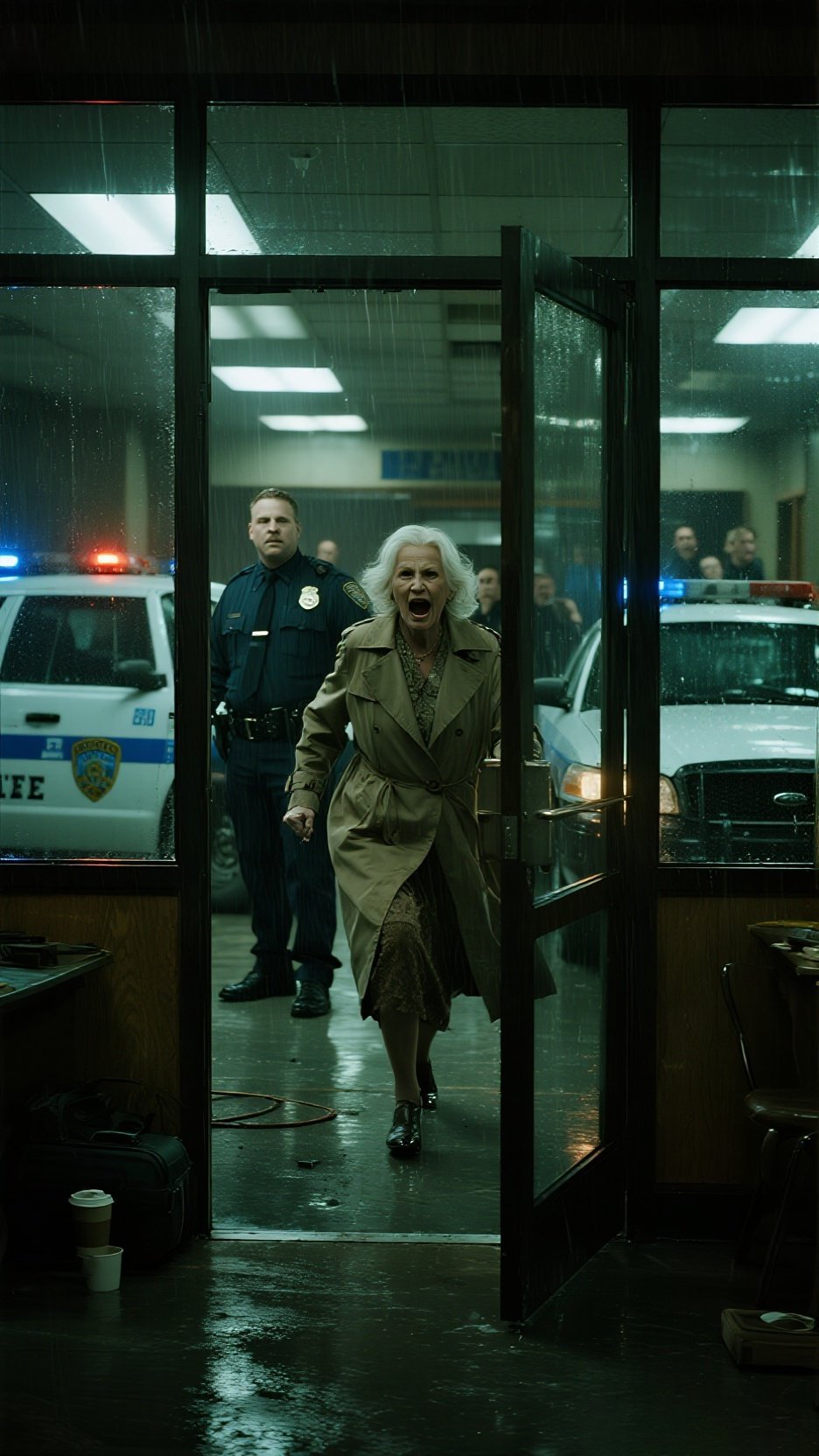
The Verdict of a Mother
The phone call didn’t just break the silence of the Seattle night; it shattered the sanctuary of my retirement like a brick thrown through a glass window. It was 2:00 a.m. The rain was hammering against the roof of my colonial home in Queen Anne, a relentless rhythm that usually lulled me to sleep but now sounded like a warning drum.
I reached for the device on the nightstand, my hand trembling slightly—not from age, but from an instinct honed over forty years in the trenches of the criminal justice system. I knew that calls at this hour never brought news of lottery wins or surprise promotions. They brought tragedy.
When I swiped the screen, the voice on the other end was unrecognizable at first. It was a guttural, wet sound, like someone trying to speak through a mouthful of gravel.
“Mom… I’m at the 4th Precinct.”
My heart stopped, then hammered against my ribs with painful force. It was Clara. My Clara. But the voice was wrong—it was devoid of her usual melodic cadence. It was the voice of a ghost.
“Julian hit me,” she rasped, the words tumbling out in a panicked rush. “He hit me, Mom. But he called 911. He told them I attacked him with a steak knife. They believe him. They locked me in holding.”
I sat up, the duvet falling away from my cold skin. The darkness of the room seemed to press in on me. Julian Thorne. The charismatic tech investor. The darling of the charity circuit. The man who had promised me at an opulent wedding three years ago that he would protect my daughter with his life.
“Mom,” Clara whispered, and the terror in her voice spiked, sending a jolt of electricity down my spine. “There is an officer here. Officer Miller. He’s nervous. He keeps looking at me, then at the computer, then at the door. He knows who I am. Or he knows who you are.”
I was out of bed before she finished the sentence. I moved with a mechanical efficiency that defied the panic rising in my throat. Pants. Blouse. Coat. Keys.
“Don’t say another word to anyone, Clara,” I commanded, my voice dropping into the register I used when sentencing felons to life without parole. “Do not sign anything. Do not answer questions. I am coming.”
I hung up and sprinted to my car. The drive to the precinct usually took twenty-five minutes. I made it in eleven.
Chapter 1: The Lioness
The Mercedes tore through the slick, rain-drenched streets of Seattle, the wipers fighting a losing battle against the deluge. Every red light I ran was a calculated risk, a defiance of the very laws I had sworn to uphold for four decades. But tonight, I wasn’t Evelyn Vance, the retired Supreme Court justice with a reputation for ironclad logic and impartial rulings. Tonight, I was a mother—a lioness whose cub was trapped in a cage with hyenas.
As I drove, my mind replayed the last few months. The subtle signs I had dismissed as marital adjustments. Clara’s excuses for missing Sunday brunch. The turtlenecks she wore in July. The way she flinched when Julian raised his voice to laugh at a dinner party.
Guilt, heavy and suffocating, settled in my chest. I had spent a lifetime recognizing the signs of abuse in strangers, yet I had been willfully blind to them in my own child.
I screeched to a halt in the loading zone in front of the 4th Precinct. The building was a brutalist block of grey concrete stained by years of rain and exhaust. I slammed the car door and marched toward the entrance, the fluorescent lights spilling out onto the wet pavement like spilled milk.
I pushed through the heavy glass doors. The air inside was thick with the smell of stale coffee, floor wax, and human misery. The front desk was manned by a young officer, his uniform crisp, his face pale. He looked up as I approached, annoyance flickering in his eyes before it was replaced by a dawning, terrified recognition.
“Officer,” I said. My voice was not loud, but it carried the weight of a gavel strike. It cut through the hum of the station, silencing the two other officers chatting by the vending machine.
“Ma’am, you can’t park there,” the young man started, his voice wavering.
“I am Justice Evelyn Vance,” I interrupted, leaning over the high counter until I was inches from his face. “You have my daughter, Clara Thorne, in a holding cell. You are going to tell me exactly what is happening, and you are going to do it right now.”
The officer, whose badge read Miller, swallowed hard. His Adam’s apple bobbed. “Justice Vance… I… we didn’t know.”
“Where is she?”
“She’s in holding,” Miller stammered, gesturing vaguely toward a secure steel door. “But ma’am, the protocol… Mr. Thorne, he filed the complaint. He came in with a laceration on his forearm, bleeding heavily. He claims she went psychotic. Said she tried to stab him while he was sleeping.”
I felt a cold sneer curl my lip. Of course. The classic maneuver. DARVO—Deny, Attack, and Reverse Victim and Offender. Julian was smarter than the average batterer. He was calculating. He knew that the first person to call 911 owns the narrative.
“Who is the investigating detective?” I demanded.
“Captain Reynolds,” Miller whispered. “He’s in his office with Mr. Thorne. Taking a statement.”
Reynolds. I knew him. A climber. A man who cared more about his golf handicap and his connections to the city’s elite than actual police work. And Julian Thorne was the kind of man who could buy a new wing for the Police Benevolent Association without blinking.
“Open that gate,” I ordered Miller.
He hesitated for a fraction of a second, looked into my eyes, and saw something that made his training dissolve. He buzzed me in.
I walked down the hallway, my heels clicking on the linoleum like gunshots. I didn’t go to Reynolds’ office first. I went to the holding cell. I needed to see her.
Miller unlocked the door to the small interrogation room where they had stashed her. Clara was sitting on a metal chair, her knees pulled up to her chest, rocking slightly. She looked tiny. Broken. Her expensive silk pajamas were torn at the shoulder. Her hair, usually a cascade of golden waves, was matted with sweat and rain.
When she looked up, the air left my lungs.
Her left eye was swollen shut, a grotesque purple bulb against her pale skin. Her lip was split. But it was the look in her good eye that killed me. It was the look of a wounded animal waiting for the final blow.
“Mom,” she croaked.
I was on my knees in front of her in an instant. I wrapped my arms around her, feeling her tremble violently against me. She smelled of fear and old blood.
“I’ve got you,” I whispered fiercely into her ear. “I’ve got you.”
She pulled back, wincing, and clutched my arm. “Mom, he’s lying. I didn’t attack him. He came home drunk. He started screaming about… about how I looked at the waiter at dinner. He started hitting me. I tried to run to the kitchen. I grabbed the knife to keep him away. Just to keep him away! He laughed. He grabbed the blade with his own hand and pulled it across his arm. He smiled when he did it. He said, ‘Now you’re going to jail, Clara. Now everyone will know you’re crazy.’“
I gently pulled back the sleeve of her pajama top. My breath hitched.
Her arm was a tapestry of violence. There were fresh bruises—purple and angry—but beneath them were older ones. Yellow, green, fading brown. Finger marks shaped like a vice grip. And near her elbow, three small, circular burns.
Cigarette burns.
“How long?” I asked, my voice trembling with a rage so pure it felt like white fire.
Clara looked down, shame flooding her face. “Six months. Maybe eight.”
“Why didn’t you tell me?” I cried softly. “I’ve spent my life putting men like him away.”
“Because you’re Justice Vance,” she sobbed. “You’re the strongest woman in the world. I didn’t want you to know I was weak. I didn’t want to disappoint you.”
I pulled her face to mine, forcing her to look at me. “You are not weak. You survived a monster. And you have not disappointed me. But right now, I need you to be brave for one more hour. Can you do that?”
She nodded, tears spilling over the swelling on her cheek.
I stood up. I wiped the tears from my own face. They were gone instantly, replaced by the stone mask of the judge. I walked out of the holding room and straight toward the office at the end of the hall.
Chapter 2: The Confrontation
I didn’t knock. I threw the door open.
Captain Reynolds was sitting behind his desk, looking tired and annoyed. Sitting across from him, holding an ice pack to a bandaged forearm, was Julian.
Julian looked impeccable, even in chaos. He was wearing a cashmere sweater and dark slacks. His hair was tousled just enough to look distressed but not messy. When he saw me, his face shifted through a complex series of expressions—surprise, calculation, and finally, a sickeningly sympathetic smile.
“Evelyn,” he said, his voice smooth as velvet. “I am so sorry you had to come down here. This is… this is a tragedy. Clara is not well. I’ve tried to get her help, but tonight she just snapped.”
“Shut up, Julian.”
The silence that followed was absolute. Julian blinked, his smile faltering.
Captain Reynolds stood up, puffing out his chest. “Now wait a minute, Justice Vance. I have a victim here with a stab wound. Your daughter is in custody for aggravated domestic assault. You can’t just barge in here and—”
I turned my gaze on Reynolds. It was a look that had made seasoned prosecutors stutter.
“Captain, have you conducted a full forensic examination of my daughter? Have you photographed the defensive wounds on her hands? Have you documented the bruising on her torso, her arms, and her back? Or did you just take the word of a donor to the police gala and lock a battered woman in a cage?”
Reynolds flushed. “We followed protocol. Mr. Thorne had a visible injury. The aggressor was identified.”
“You identified the aggressor based on who could tell the best story,” I spat. “If you process her, if you book her without a full medical workup, I will sue this department. I will sue the city. And I will sue you personally, Reynolds. I will make it my remaining life’s mission to strip you of that badge and your pension. Do you understand me?”
Reynolds paled. He looked at Julian, then back at me. He saw the certainty in my eyes.
“I want a forensic nurse here now,” I ordered. “And I want to see the incident report.”
Julian stood up, shaking his head sadly. “Evelyn, please. You’re emotional. I understand she’s your daughter, but look at my arm. She cut me. She’s dangerous.”
I took a step toward him. He was six-foot-two, towering over me, but he shrank back as I approached.
“I see the cut, Julian. A clean slice. Superficial. On the outside of the forearm. The angle is wrong for an attack. It’s perfect for self-infliction. And I saw Clara’s arms. I saw the burns.”
Julian’s eyes widened. A flicker of genuine fear appeared behind the mask.
“Burns? I don’t know what you’re talking about. She must have done that to herself. She’s a masochist, Evelyn. She’s sick.”
“You are going to rot,” I said, my voice low and lethal.
I turned back to the door and pulled out my phone. I dialed a number I knew by heart. My eldest daughter, Sarah.
Sarah answered on the second ring. “Mom? What’s wrong?”
“Sarah, wake up. I need you to go to your safe. Get the box. The one Clara gave you last Christmas.”
There was a pause on the line. And then, Sarah’s voice shifted from sleepy to steel. “The shoebox? She told me never to open it unless she died.”
“She’s alive,” I said. “But we need it. Bring it to the 4th Precinct. Now.”
I hung up. Julian was staring at me, his face draining of color.
“What box?” he asked, his voice losing its velvet texture.
I didn’t answer him. I sat down in the chair next to the door and crossed my arms. “We are going to wait.”
Chapter 3: The Evidence
The next thirty minutes were a suffocating standoff. The forensic nurse arrived and went into the room with Clara. Flashbulbs popped from behind the closed door, documenting the map of pain written on my daughter’s body. Julian tried to make small talk with Reynolds, tried to re-establish the “bro code,” but the air had shifted. Reynolds was looking at the paperwork, sweating. He realized he had stepped into a minefield.
Then Sarah burst through the precinct doors. She was wet from the rain, wearing a trench coat over her pajamas, clutching a battered Nike shoebox wrapped in duct tape. She ran past the desk sergeant, ignored Miller, and came straight to the office.
When she saw Julian, she stopped. Her eyes narrowed. “You bastard,” she hissed.
She handed me the box. I placed it on Reynolds’ desk.
“What is this?” Reynolds asked nervously.
“This,” I said, pulling a pair of scissors from his pen cup to slice the tape, “is the insurance policy.”
I opened the box. Inside was a passport, a wad of cash, and a silver USB drive.
“Clara is smart,” I said, looking at Julian. “She knew no one would believe her against you. The world loves a rich, charming man. So she started recording.”
Julian lunged. He actually lunged across the desk, his hand reaching for the drive. It was a move born of pure desperation. Reynolds was faster. He grabbed Julian’s wrist and slammed him back into the chair.
“Sit down, Mr. Thorne!”
I plugged the drive into Reynolds’ computer. The folder structure popped up on the screen. Hundreds of files. Audio. Video. Photos. Dated. Organized.
I clicked on a video file dated three days ago. The screen filled with the interior of their penthouse living room. The camera was hidden, likely on a bookshelf. Julian and Clara were in the frame. Julian was screaming. The audio was crisp.
“You are worthless!” he shouted in the video. “You are nothing without me!”
Then, on screen, he struck her. A backhand that sent her sprawling over the coffee table. He stood over her, kicking her in the ribs.
I watched the real Julian in the office flinch as the video played.
I clicked another file. An audio recording. Julian’s voice, calm and terrifying.
“If you ever try to leave me, Clara, I will kill you. I will make it look like an accident or a suicide. And then I’ll cry at your funeral, and everyone will comfort me.”
I paused the recording. The room was deadly silent. Reynolds looked at Julian. The admiration, the camaraderie—it was all gone. In its place was disgust.
“Mr. Thorne,” Reynolds said, his voice heavy. “Stand up.”
Julian remained seated, shaking his head. “This is… that’s deepfake. That’s AI! She manufactured this!”
“Stand up!” Reynolds barked.
Julian stood, trembling.
“Turn around. Hands behind your back.”
Reynolds cuffed him. The metallic click of the handcuffs was the most beautiful sound I had heard in years.
“You’re under arrest for aggravated domestic battery, assault with a deadly weapon, and…” Reynolds looked at the screen. “False imprisonment.”
“I’m calling my lawyer!” Julian screamed as Reynolds shoved him toward the door. “Get me Marcus Sterling! This is a setup!”
As they dragged him out, Julian locked eyes with me. The mask was completely gone now. It was just the face of a cornered rat.
I walked out of the office and back to the holding cell. The forensic nurse was packing up her kit. She looked at me with sad, sympathetic eyes.
“It’s bad,” she murmured. “Multiple fractures in the ribs, healing poorly. Defensive wounds. The burns are second-degree.”
I went to Clara. She was dressed now, sitting on the edge of the cot.
“Is he gone?” she whispered.
I nodded. “He’s in a cell, Clara. And he’s not coming out. We have the drive. We have everything.”
She collapsed into my arms, and for the first time that night, she really cried. Not the panic tears of a victim, but the release of a survivor who realizes the war is over.
Chapter 4: The Courtroom
But the war wasn’t over. It was just moving to a new battlefield.
The bail hearing was set for 9:00 a.m. the next morning. I hadn’t slept. I had spent the remaining hours of the night at the hospital with Clara and Sarah, watching over my daughter as doctors tended to her broken body. But as the sun rose over Seattle, casting a gray light over the wet city, I put on my best suit—a charcoal gray armor—and went to the courthouse.
The courtroom was packed. Julian’s arrest had hit the morning news cycle. The Prince of Tech in Handcuffs was irresistible clickbait.
I sat in the front row. Julian was at the defense table, flanked by Marcus Sterling, the most expensive defense attorney on the West Coast. Marcus looked confident. He was whispering to Julian, patting him on the shoulder.
The judge entered. Judge Harrison. I knew him well. He was fair, but he was a stickler for procedure.
The prosecutor, a young woman named District Attorney Lopez, stood up. “Your Honor, the state requests that bail be denied. The defendant is a flight risk with unlimited resources, and the evidence shows a pattern of extreme violence and witness intimidation.”
Marcus Sterling stood up, smoothing his tie. “Your Honor, this is ridiculous. My client is a pillar of the community. These are allegations from a hysterical spouse during a messy domestic dispute. We have an injured client who was attacked! The video evidence the prosecution cites has not been authenticated. We are prepared to post a bond of two million dollars.”
Judge Harrison looked over his glasses at the defense table. “Two million dollars is pocket change for Mr. Thorne, Mr. Sterling.”
Suddenly, the back doors of the courtroom opened. A woman walked in. Then another. Then a third.
I turned around. I didn’t know them, but I recognized the look in their eyes. It was the same look Clara had in the cell. The thousand-yard stare of survivors. One was young, perhaps twenty-five. Another was older, in her forties. The third was barely out of her teens.
They walked down the center aisle, silent, heads held high despite their trembling hands.
District Attorney Lopez looked surprised. Then she checked her phone. A message had just come through. She stood up straighter.
“Your Honor, if I may… new witnesses have just arrived.”
Sterling jumped up. “Objection! Ambush!”
Judge Harrison held up a hand. “Overruled. Who are these women?”
The oldest woman stepped forward to the bar. “My name is Elena Rostova,” she said, her voice heavily accented but steady. “I was Julian Thorne’s personal assistant five years ago.”
Sterling tried to interrupt, but the judge silenced him with a glare. “Continue, Ms. Rostova.”
“He broke my jaw,” she said simply. She pointed to a scar on her chin. “He told me if I spoke, he would have my visa revoked and my family deported. I saw the news this morning. I saw that Justice Vance’s daughter was the victim. And I knew… I knew that if anyone could stop him, it was her. So I called the others.”
She gestured to the other two women.
“He dated me in college,” the young girl whispered. “He locked me in a closet for two days.”
“He broke my fingers,” the third woman said, holding up a hand that was slightly misshapen.
The silence in the courtroom was suffocating. Julian Thorne was staring at the table, refusing to look at the ghosts of his past. I looked at Marcus Sterling. The confidence had drained out of him. He was packing his briefcase, mentally calculating how to distance himself from the radioactive fallout of his client.
Judge Harrison looked at the women, then at Julian. His face was hard as granite.
“The court finds that the defendant poses a significant and immediate danger to the community. Bail is denied. Remanded to custody until trial.”
The gavel banged. It sounded like thunder.
Julian looked up then. Searching the crowd, he found me. His eyes were full of hate, but for the first time, they were also empty of power. He was just a man in a cheap orange jumpsuit being led away to a cage.
Chapter 5: The Primal Justice
I walked out of the courtroom and found the three women waiting in the hallway. Sarah was with them, holding their hands.
“Thank you,” I said to them.
Elena shook her head. “No, Justice Vance. Thank you. We were afraid. But when we heard it was you… we knew we would be safe.”
The trial took six months to prepare. It was a media circus, but inside the courtroom, it was a slaughter. The evidence from the flash drive was irrefutable. The testimony of the four women—Clara, Elena, and the others—painted a picture of a monster who hid behind money and charm.
I sat in the gallery every single day. I watched my daughter take the stand. I watched her voice shake as she recounted the nights of terror, the gaslighting, the pain. But she finished. She told her truth.
When the verdict came down—guilty on all counts—there was no cheering. Just a collective exhale. A release of tension that had been held for years. Julian was sentenced to twenty-five years in state prison.
Six months after the sentencing, I went to visit Clara. She had moved into a small cottage near the ocean, far away from the glass and steel penthouse in the city. It was a crisp autumn afternoon. We sat on her porch, wrapped in blankets, watching the waves crash against the rocks.
The bruises on her body had faded, leaving only faint silvery lines. The cast was off her arm. But the healing of her mind was a slower process. She was painting—a canvas sat on an easel in front of her, a chaotic mix of dark blues and bright, hopeful yellows.
“Mom?” she asked, not looking up from her brush.
“Yes, honey?”
“Do you miss it? Being a judge? The power?”
I looked out at the gray ocean. I thought about the robes. The respect. The feeling of bringing order to chaos.
“I thought I was protecting the world,” I said softly. “For forty years, I thought justice was something written in books and delivered from a high bench. I thought it was about logic and precedent.”
I turned to look at her. She was beautiful. Scarred, but whole.
“But that night… when I drove to the precinct… I realized I had been wrong. Real justice isn’t abstract, Clara. It’s primal. It’s not about the law. It’s about protection. It’s about standing between the vulnerable and the wolves.”
Clara put down her brush. She reached out and took my hand. Her grip was strong.
“You saved me, Mom. Not because you were a judge. But because you were there.”
I squeezed her hand back.
That was the lesson. The one that took me a lifetime to learn. The system is flawed. Protocols fail. Police make mistakes. Money buys silence. The only thing that truly stands against the darkness is the willingness of one person to answer the call in the middle of the night, to drive through the rain, and to say: Not this one. Not tonight.
We sat in silence as the sun began to dip below the horizon, painting the sky in shades of violet and gold. The nightmare was over. The scars remained, a map of where we had been, but they were no longer open wounds. They were proof that we had survived.
And in the quiet of that evening, listening to the rhythm of the sea, I finally felt at peace. The gavel had fallen, and the verdict was life.
[End of Story]
Website Disclaimer
The information provided on this website is for general informational and educational purposes only. While we strive to ensure that all content is accurate and up to date, we make no guarantees regarding the completeness, reliability, or accuracy of any information published.
The views and opinions expressed in articles belong to their respective authors and do not necessarily reflect the views of this website. Any action you take based on the information found on this website is strictly at your own risk. We will not be liable for any losses, damages, or inconveniences arising from the use of our content.
Some articles may contain opinions, third-party information, or external links. We do not endorse or guarantee the accuracy of content on external websites and are not responsible for their practices or policies.
All content on this website is provided in good faith and is intended for informational purposes only. Readers are encouraged to verify information independently and seek professional advice where appropriate.