The emergency department of Lakeside Regional Medical Center had witnessed countless scenes of human drama, but nothing had prepared the staff for the tableau that unfolded at 7:14 a.m.
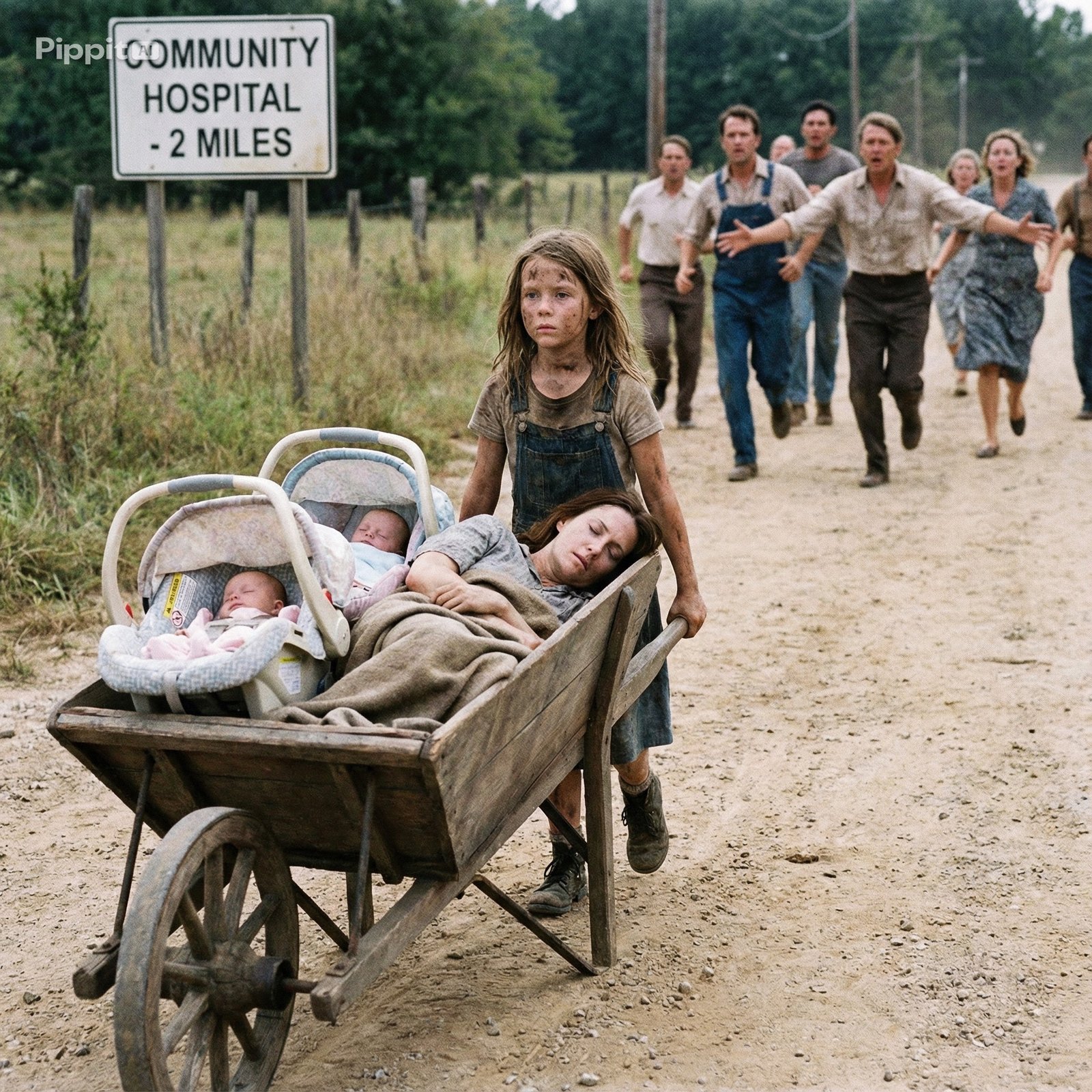
When the automatic doors slid apart, the triage nurse, Cheryl, dropped her pen. A small girl—she looked no older than eight—was steering a dented, rust-orange wheelbarrow through the entrance. Inside, cushioned by a faded crocheted blanket, lay two infants, their complexions waxy but their tiny chests rising and falling in shallow rhythm.
The girl’s blonde hair was plastered to her temples with sweat. The knees of her jeans were torn, and her sneakers were caked with dried mud. Her voice, when it came, was a thin, frayed thread of sound.
“Please… My mama’s been sleeping for too long. I need someone to help us.”
For three heartbeats, the controlled chaos of the ER stilled. Then, it erupted into a new, focused frenzy. Physicians in blue scrubs converged, nurses lifted the newborns with practiced gentleness, and a gurney materialized as if by magic. The girl’s legs buckled, and she crumpled silently onto the sterile, speckled floor.
When consciousness returned hours later, the fluorescence was a physical assault.
A soft, melodic voice cut through the glare. “Hello there, sunshine. You’re in a safe place.”
It was Nurse Irene Walsh, a woman with a crown of steel-grey curls and eyes the color of a calm sea. She smoothed a cool cloth over the girl’s forehead.
The child—Lila—jerked upright, a gasp catching in her throat. “My sisters! Where are Charlotte and Rose?”
“They’re right here, sweet pea,” Irene murmured, gesturing to two clear-sided bassinets stationed like vigilant sentinels beside the hospital bed. “They’re stable. Our doctors are watching over them.”
Lila released a breath—a shuddering exhalation that was part sob, part profound relief.
“You brought them just in time,” Irene added, her voice thick. “You are their hero.”
The Cottage on Hemlock Lane
A few hours later, Dr. Benjamin Clarke, the attending pediatrician, entered the quiet room accompanied by Maya Patel, a social worker whose compassionate demeanor couldn’t quite mask the concern in her eyes. She carried a leather folio, not just a folder.
“Hello, Lila. We need to ask you some questions, okay? It’s to help us help your mama.”
Lila drew her knees to her chest, her gaze wary and old beyond its years. “Are you going to take us away?”
Dr. Clarke lowered himself to one knee, bringing his face level with hers. “We are not here to break up your family. We are here to put the pieces back together. We need to understand, so we can do it right.”
Lila worried her lower lip. “Is someone helping Mama wake up?”
Maya and the doctor exchanged a glance that spoke volumes in its silence—a shared, sorrowful understanding.
“There are very kind people at your home right now,” Maya said, her tone feather-light. “They’re doing everything possible.”
Lila nodded, a slow, solemn motion. From the pocket of her dirty jeans, she extracted a crumpled, sweat-dampened piece of notebook paper. “This is where we live,” she whispered, unfolding it with reverence. It was a child’s drawing: a little yellow house with a lopsided chimney, a towering oak tree, and the number 17 scrawled in uncertain numerals.
“I wrote the number down so I wouldn’t forget how to get back,” she confessed.
Dr. Clarke felt a lump form in his throat. “How far did you have to walk, Lila?”
She considered this, her eyes drifting to the window. “I walked until the moon got tired and the sun started yawning.”
Later that afternoon, Officer Frank Rivera and Detective Sarah Vance used the drawing as a map. They drove down increasingly rural routes until they turned onto a gravel track called Hemlock Lane. And there it was—a weathered yellow cottage with a sagging porch, sitting in a hollow of silence.
Inside, time seemed to have paused. The kitchen counters held empty formula cans, meticulously rinsed and arranged. Baby bottles stood in a neat row on a dish rack. On the refrigerator, held by a strawberry-shaped magnet, was a handwritten chart: columns for times, ounces, and checkmarks made in smudged pencil.
In the bedroom, they found a woman—Elara Vance, 29 years old—unresponsive but alive. Her pulse was thready but present.
Beside the bed was a nightstand tableau of devotion: a damp washcloth, a tiny medicine spoon, and several glasses of water, each only partially consumed.
“She was trying to hold on,” Vance observed, her professional detachment cracking.
“No,” Officer Rivera corrected, his voice husky. “Her daughter was holding her on.”
The Story the Silence Told
Back at Lakeside, Dr. Clarke reviewed Elara’s chart. The diagnosis was severe dehydration, acute malnutrition, and catastrophic complications from untreated postpartum psychosis. He looked across his desk at Irene, his expression grim. “If that child hadn’t kept forcing fluids into her, spoonful by spoonful, we’d be having a very different conversation.”
When Lila awoke the next morning, Irene was waiting with a mug of warm apple cider. “They found your cottage, honey. Your mama is at a special hospital now. The kind that helps people wake up and get strong.”
“She’s still sleeping?” Lila’s voice was small.
“Yes, but when the doctors talked to her, she said your name. She whispered ‘Lila.’”
Lila stared at the acoustic tiles of the ceiling for a long minute. “I counted the days. I stopped at fourteen. I used the little spoon from the medicine kit, like she showed me when the babies had a fever.”
“You did a miraculous thing,” Irene said, the words catching. “You saved all three of them.”
That afternoon, child psychologist Dr. Alisha Chen visited, bringing a small case of sand-tray figurines.
“Can you show me what a normal day looked like in your house?” she asked gently.
Lila selected the figures with careful deliberation—a mother, a girl, two infants. “On the good days, Mama would sing old songs while she fed the babies,” she narrated, placing the mother figure between the infants. “But sometimes… sometimes the rain would get inside her head. It made everything dark and heavy. So I’d make her mint tea, the way she likes it, and I’d keep the babies in the living room so she could have quiet.”
Dr. Chen noted how Lila always positioned her own figurine as a literal bridge, touching both the mother and the sister figures. A tiny guardian.
“That is an enormous weight for such young shoulders,” Dr. Chen said softly.
Lila shrugged, a gesture heartbreaking in its nonchalance. “Mama always said I was born with an ancient soul.”
A Harbor in the Storm
Weeks dissolved into a new routine. Elara began the agonizingly slow climb back to consciousness and health. But the medical reality was stark: she faced months, if not a year, of intensive rehabilitation. The children needed immediate, stable sanctuary.
That night, Irene Walsh lay awake in her quiet, tidy house on Sycamore Drive. The silence had been a companion since her husband, Martin, passed five years ago. She’d spent forty-two years as a nurse, mending other people’s children, other people’s hearts. Now, the image of a little girl with dirt on her face and resolve in her eyes wouldn’t leave her.
The next morning, she stood in Dr. Clarke’s office, her back straight. “My foster care license is still current. I haven’t used it since Martin died, but it’s active. I want Lila and the twins to come home with me.”
Benjamin Clarke looked up from his paperwork, surprised. “Irene, that’s… a profound commitment. They come with significant trauma.”
“I know,” she said simply. “But those children need to stay together. And maybe… maybe this old house needs the sound of life in it again.”
A week later, Lila crossed the threshold of Irene’s home. The spare room had been transformed into a sanctuary of soft yellows and greens, with a writing desk, shelves for treasures, and a window seat overlooking the garden. The twins, Charlotte and Rose, slept in the adjacent room, in matching cribs washed in afternoon light.
For the first fortnight, Lila barely slept. Irene would find her at all hours, standing like a tiny sentry over the cribs, her hand resting lightly on a tiny back to feel its rise and fall. Sometimes, she’d be singing a lullaby Elara used to sing, her voice a fragile thread in the dark.
One evening, as Lila finished tucking the blankets around a sleeping Charlotte, Irene spoke from the doorway. “Your mama is getting stronger every single day.”
“When can I see her?” The hope in Lila’s voice was a physical ache.
“Soon, my love. And she is going to be so incredibly proud of the young woman you are.”
Lila hesitated, her fingers tracing the edge of the crib. “I just hope… I hope she still knows my face.”
Irene crossed the room and knelt, taking Lila’s small hands in her own. “She carries your face in her heart, Lila. You are her first thought and her last prayer.”
The Reunion
The morning of the visit was crisp, the sky a brilliant cerulean. The county car pulled up to Pine Grove Rehabilitation Center, a serene, low-slung building surrounded by gardens. Lila’s hands were icy as she gripped the handles of the double stroller. Irene bent down, her eyes level with Lila’s. “Steady, captain. Ready to go ashore?”
Through the glass atrium doors, Lila saw her. Elara was in a wheelchair beneath a sprawling magnolia tree, its waxy leaves gleaming. She was frail, swimming in her sweater, but her eyes were open—alert, lucid, and desperately searching.
“Mama!”
The word was a burst of pure sound. Lila broke into a run, her braids flying behind her. Elara’s arms, thin but strong, opened wide, and Lila crashed into her, burying her face in the familiar scent of soap and jasmine that still clung to her mother’s skin.
They clung to each other, weeping—tears of loss, of fear, but overwhelmingly, tears of a love that had endured the unimaginable. No words were needed; their embrace was its own language.
“Let me look at you,” Elara finally rasped, her hands cradling Lila’s face, thumbs brushing away tears. “My brave, brave girl. You kept your promise.”
“I did, Mama,” Lila whispered, the words trembling. “I looked after Charlotte and Rose.”
Elara’s hand shook as she pushed a stray hair from Lila’s forehead. “You didn’t just look after them, my love. You saved me. You are the reason I’m here.”
The Words in the Drawer
Later, as Elara rested, Lila sat with Dr. Clarke on a bench in the dappled shade. She pulled a folded sheet of lavender stationery from her jacket pocket. “I found this in Mama’s jewelry box. I think… I think she wrote it for me.”
Dr. Clarke unfolded it with care. The handwriting was elegant but wavering, as if written in a storm.
“My darling Lila, if you are reading this, then the fog has grown too thick for me to see through. Please listen, and believe: None of this is your fault. You are my light in every darkness, my anchor in every storm, the greatest gift of my life. I am fighting with everything I am to come back to you. If the night claims me for a while, remember—it is not for lack of trying. It is never for lack of love. Forever yours, Mama.”
Dr. Clarke took a steadying breath, his vision blurring. “This confirms what your heart already knew, Lila. Your mother never surrendered. Not for a second.”
Lila gazed at the letter, tracing the loops of her mother’s signature. A profound calm settled over her features. “I knew,” she said quietly, finally. “I just needed to hear her say it.”
Building a New Constellation
By the time summer painted the world in bold greens and golds, Elara had graduated to outpatient care. A new Family Preservation Network, inspired in part by their story, provided a subsidized townhouse not far from the hospital—and a short walk from Irene’s house on Sycamore Drive.
On moving day, the porch of the townhouse was a landscape of cardboard boxes: “Lila – Books & Dreams,” “Twins – Adventures Await,” “Kitchen – New Beginnings.” Lila carried her most prized possession: a journal with a cover of pressed flowers, now filled with sketches of their journey—the yellow cottage, the hospital’s soaring windows, Irene’s sun-drenched kitchen, the layout of their new home.
At the farewell on Irene’s porch, the older woman pulled Lila into a hug that smelled of lavender and gingerbread. “You’ll visit this old lady, won’t you? The garden misses its helper.”
“Every Saturday,” Lila vowed, pressing a folded paper into Irene’s hand. On it was a drawing of two houses, connected by a winding path dotted with flowers. At the top, she’d written: “Not dotted lines anymore. Solid ones.”
Irene’s eyes welled up. “You are a wonder, child.”
Officer Rivera and Detective Vance arrived then, smiling. They presented Lila with a simple wooden frame. On the left was her original crayon drawing of the yellow house. On the right, a recent photograph of Elara, Lila, and the twins, all laughing in a pile of autumn leaves.
“From where your courage began,” Rivera said, his voice gentle, “to where it has brought you all.”
A Circle of Light
One year later, a banner hung in the hospital’s main conference room:
“The Lila Vance Resilience Initiative – First Annual Celebration.”
Dr. Benjamin Clarke stood at the podium, his voice resonating with pride. “What began as one child’s extraordinary act of love has blossomed into a program that has supported over seventy families in our county. Tonight, we don’t just celebrate survival. We celebrate the transformation of pain into purpose.”
In the front row sat Elara, her health restored, her eyes clear and bright, a twin balanced on each knee. Irene sat beside her, her hand resting on Elara’s shoulder in a gesture of unwavering solidarity.
And between them—Lila, now nine, clutching a simple cardboard portfolio to her chest.
When Dr. Clarke finished, she walked to the microphone, needing no step stool now. Her voice was clear and carried to the back of the room.
“My mama says family is the circle that holds you when you feel broken,” she began. “But I’ve learned that community is the bigger circle that helps you put the pieces back together.”
She opened her portfolio, revealing a series of her drawings, now matted and preserved: the yellow cottage, the clinical gleam of the ER, Irene’s welcoming doorway, and finally, their sunlit townhouse, windows glowing.
“This is for everyone who helped us find our way,” she said, presenting the pages to Dr. Clarke. “So maybe no other kid ever has to be the grown-up all alone.”
The room erupted, not just in applause, but in a standing ovation—a wave of respect and solidarity that washed over the small, straight-backed girl on the stage.
The Drawing That Held the Future
That evening, in the community park near their townhouse, Lila sat on a checkered blanket, her sketchbook open once more. The twins toddled on the grass, chasing fireflies as Irene watched, her smile softer than the twilight.
Elara leaned over, her shoulder touching her daughter’s. “What’s the masterpiece tonight?”
Lila smiled, a serene, contented expression. “Our family. The whole, big, messy, beautiful family we made.”
The drawing showed a circle of interlocking hands—some large, some small, some wrinkled with age—all joined around two central, cherubic figures. It wasn’t a family tree, but a family wheel.
Elara watched her daughter, this child of impossible strength and gentle soul. For the first time in years, the last shadow of guilt lifted, replaced by a profound, humbling gratitude.
And as the stars began to prick the velvet sky, if you looked very closely at the corner of the page, you could see the faint, subtle outline of a wheelbarrow. Not as a burden, but as a vessel. A reminder of the journey, and of the incredible cargo of love and resilience it had carried, all the way home.
Website Disclaimer
The information provided on this website is for general informational and educational purposes only. While we strive to ensure that all content is accurate and up to date, we make no guarantees regarding the completeness, reliability, or accuracy of any information published.
The views and opinions expressed in articles belong to their respective authors and do not necessarily reflect the views of this website. Any action you take based on the information found on this website is strictly at your own risk. We will not be liable for any losses, damages, or inconveniences arising from the use of our content.
Some articles may contain opinions, third-party information, or external links. We do not endorse or guarantee the accuracy of content on external websites and are not responsible for their practices or policies.
All content on this website is provided in good faith and is intended for informational purposes only. Readers are encouraged to verify information independently and seek professional advice where appropriate.