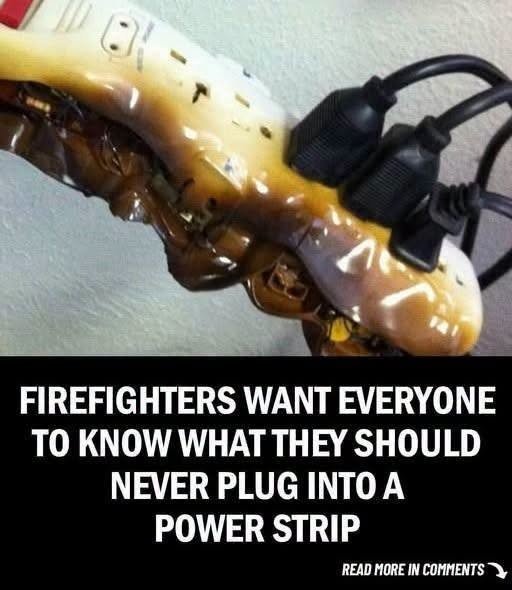
When we think of the past, it’s hard to imagine life without electricity. Today, nearly everything we use depends on it. Yet, most homes don’t have enough outlets for all our devices, leading many to rely on power strips.
While convenient for charging phones or powering entertainment setups, power strips aren’t designed for high-wattage appliances. Plugging the wrong devices into them can create serious fire hazards.
Appliances like air conditioners, space heaters, and toasters draw too much power for a strip to handle. Always check the wattage supported by the strip, which is typically printed on the product.
1. Ovens require significant power and should be connected to their own dedicated wall outlet.
2. Refrigerators frequently cycle on and off and need a steady power source, not a shared one.
3. Washing machines use up to 1,400 watts and run for long periods, increasing the risk of overheating.
4. Space heaters often run continuously at 1,500 watts, which is far too much for a strip to handle safely.
5. Microwaves are also energy-intensive and should never be plugged into a power strip.
6. Coffee makers and 7. toasters might seem harmless but draw high amounts of energy when in use.
8. Never plug one power strip into another. This can easily overload circuits and violate safety codes.
9. Sensitive electronics like computers and TVs should only be plugged into surge protectors, not basic strips, to guard against surges.
Share this information to help others use electricity safely at home.
Website Disclaimer
The information provided on this website is for general informational and educational purposes only. While we strive to ensure that all content is accurate and up to date, we make no guarantees regarding the completeness, reliability, or accuracy of any information published.
The views and opinions expressed in articles belong to their respective authors and do not necessarily reflect the views of this website. Any action you take based on the information found on this website is strictly at your own risk. We will not be liable for any losses, damages, or inconveniences arising from the use of our content.
Some articles may contain opinions, third-party information, or external links. We do not endorse or guarantee the accuracy of content on external websites and are not responsible for their practices or policies.
All content on this website is provided in good faith and is intended for informational purposes only. Readers are encouraged to verify information independently and seek professional advice where appropriate.