I still think about that morning more often than I should, especially when I pass bridges or hear the dull echo of water moving under concrete. It wasn’t supposed to stay with me. That’s the strange part. Nothing about it started like something important. If anything, it began like one of those half-forgotten weekdays that slip out of your mind before lunch. I had stopped for coffee near the riverwalk because the machine at my apartment building had broken again, and I remember standing there more out of habit than intention, watching people move past like the city had somewhere better to be. The air had that thin, early brightness that makes everything look cleaner than it actually is, and I was already thinking about work emails I hadn’t answered when I first noticed him.
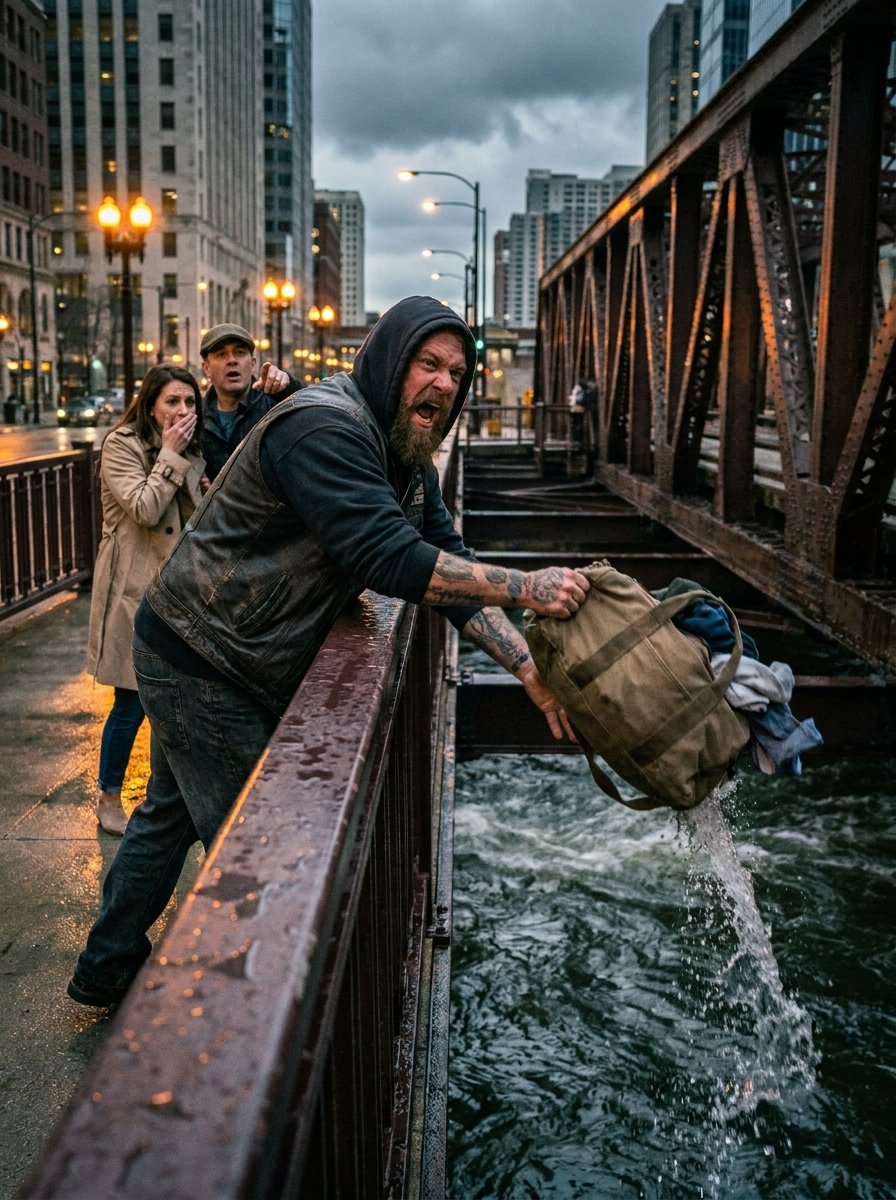
He was standing on the bridge above the river, not pacing, not hesitating, just positioned there in a way that made him stand out without trying to. A heavily tattooed man, maybe late thirties or early forties, wearing a worn leather vest that looked like it had lived a longer life than most of us ever would. There was nothing theatrical about him, no exaggerated posture, no aggression. If anything, he looked contained, like something had been sealed inside him and was only now starting to press outward.
At first, I assumed he was just another passerby leaning over the railing, maybe lost in thought. People do that all the time. But then he reached into his jacket and pulled out a wallet.
No hesitation. No performance. Just a simple motion, like discarding something that no longer needed to exist.
He dropped it.
The sound it made when it hit the water was smaller than it should have been, almost delicate, but it carried across the bridge anyway. A few people nearby stopped walking. Not because they understood what was happening, but because humans instinctively recognize when something breaks the expected pattern of reality. A wallet doesn’t belong in a river. It belongs in a pocket. In a hand. On a counter. Not disappearing beneath dark moving water.
And yet, he didn’t react at all.
He didn’t look for a response from anyone. He didn’t check for witnesses. He just reached back into his jacket again.
That was when the phone came out.
Another drop. Another quiet impact. Another object disappearing as if it had never mattered in the first place.
Someone behind me muttered something about drugs or breakdowns or maybe just attention-seeking. That was the first instinct people had, because it’s easier to categorize strange behavior than it is to sit with uncertainty. But even from a distance, even without hearing his voice, I could tell that wasn’t it. His movements weren’t chaotic. They were structured. Almost… practiced.
Like he was following instructions only he could see.
Then came the duffel bag.
That one changed the air around the scene.
It wasn’t just heavier physically. You could see it in the way his body adjusted before he lifted it, the slight shift of weight, the controlled breath, like he was preparing for something final rather than impulsive. When he threw it over the railing, the splash wasn’t just louder—it felt final in a way I can’t fully explain. Like something had crossed a point of no return.
Voices began to rise around us. Phones came out. People started forming opinions faster than understanding could keep up. Someone said we should call the police. Someone else said he was about to jump. That became the dominant assumption almost immediately, because once people decide on a narrative, everything else gets forced to fit it.
But he didn’t jump.
He didn’t even flinch.
Instead, he reached into his pocket again and pulled out a small red cloth. Folded carefully. Worn at the edges. It didn’t look like much at first, but the moment he held it, everything about him changed subtly. Not outwardly, but in the way his attention narrowed, like everything else in the world had temporarily been reduced in importance.
He didn’t throw it.
That detail mattered more than anything else.
He just held it.
Then tucked it away again.
That’s when the sense of unease finally settled in for me. Not because of what he was doing, but because of the order in which he was doing it. Wallet, phone, bag—then hesitation. Then the cloth. It wasn’t random. It wasn’t emotional chaos. It was structured removal, like stripping layers from a life in reverse.
Behind me, someone said it out loud before I could fully articulate it in my own head.
“He’s doing it in order.”
And once that idea entered the space, everything shifted. You could feel it happen collectively, like a group mind recalibrating. Suddenly it wasn’t a breakdown. It was a sequence. A deliberate dismantling.
The man stood there for a few seconds longer, hand resting near the railing where the cloth had been pressed moments before. That was when I noticed how worn it was—softened by time, edges frayed, as if it had been carried far longer than anything else he owned. It didn’t belong to the same category as the objects he had thrown away. It belonged to memory, not utility.
Someone tried calling out to him. Asking what he was doing. Asking if he needed help.
He didn’t respond.
Not once.
Then I noticed the older man standing near one of the benches behind the crowd. He wasn’t reacting like the rest of us. No confusion, no alarm. Just a quiet, almost tired focus, like he was watching something he already understood too well.
I moved closer and asked him, without thinking too much about it, if he knew what was going on.
He didn’t answer immediately.
Just watched the biker for a moment longer.
Then said something that didn’t make sense at first.
“He’s not throwing anything away,” he said. “He’s returning it.”
Returning it to what? I remember thinking.
But he didn’t elaborate. Instead, he nodded toward the river.
“That’s where it happened.”
And just like that, the situation stopped being abstract.
Before I could press him further, the biker stepped onto the lower part of the railing. Not high enough to suggest a jump, but high enough to make the entire crowd react at once. Phones rose. Voices sharpened. Someone shouted for him to get down.
And then he spoke.
For the first time.
“I’m not leaving anything behind this time.”
The tone wasn’t emotional. It wasn’t unstable. It was resolved. That was the most unsettling part.
Because it didn’t feel like an ending.
It felt like correction.
Like something that had once gone wrong and was now being fixed, regardless of who was watching.
By the time sirens started to echo faintly in the distance, people had already decided what they were seeing. A man unraveling. A man preparing to end his life. A man at the edge.
But assumptions are sticky things. They stick because they’re simple.
And simplicity always wins in a crowd.
Except this didn’t feel simple.
The cloth was still in his hand.
Still untouched by the river.
That detail wouldn’t leave me alone.
The officer who arrived approached carefully, speaking in calm, practiced tones. Asking him to step down. To move away. To talk.
The biker didn’t comply.
Instead, he unfolded the red cloth completely for the first time.
And that’s when everything changed again.
Because it wasn’t just fabric.
It was a container.
Something had been sewn into its folds with precision, hidden deliberately. When he opened it, there was a collective shift in attention so sharp it felt physical. Everyone realized at once that we hadn’t been watching destruction.
We had been watching retrieval.
“What’s in your hand?” the officer asked.
No answer.
The biker reached inside the cloth and pulled out a small object, carefully wrapped.
A woman in the crowd whispered something under her breath. Someone else asked if it was possible what we were thinking.
But no one wanted to say it first.
The biker looked down at it, and when he spoke again, his voice was quieter than before, but heavier.
“She didn’t get to come back.”
And that was the moment the story broke open.
Because “she” changed everything.
It stopped being about objects.
It stopped being about a man.
It became about loss.
About something missing.
About something unfinished.
The officer stepped closer again, but before anything could escalate further, a voice cut through from behind us.
A woman.
Shaking, but steady enough to hold the space.
“Stop,” she said. “You don’t understand.”
She pushed through the crowd with urgency that didn’t feel like panic, but familiarity. Like she had already been living inside this story long before we arrived.
And when she spoke again, everything fractured further.
“If you stop him now,” she said, “you’ll make him lose her again.”
That sentence didn’t clarify anything.
It complicated everything.
Because now there was history.
Something we couldn’t see.
Something still unresolved.
She looked at the biker not like a stranger, but like someone who had survived something she understood.
“He’s not erasing himself,” she said. “He’s restoring what was taken.”
And slowly, piece by piece, the narrative shifted again.
The objects weren’t belongings.
They were fragments.
Recovered pieces of something that had been lost in an accident years ago—misplaced, mishandled, separated across systems that didn’t care enough to keep them together.
The duffel bag, the phone, the wallet—they weren’t random. They were traces of identity, of presence, of what had been scattered and left incomplete.
And the red cloth?
It was the only thing he had been using to keep it all together.
The officer lowered his hand.
The crowd went silent in a way that felt different from before.
Not fear.
Not confusion.
Recognition.
The biker stepped down from the railing.
Slowly.
And walked toward the river’s edge.
No urgency. No performance.
Just completion.
When he finally released the last item into the water, it wasn’t like the others. There was no sound that carried. Just disappearance.
Afterwards, he stood there for a long time.
Empty-handed.
Not broken.
Not lost.
Finished.
The cloth fell from his fingers, and I don’t fully know why I picked it up. Maybe because I needed something tangible to hold onto after watching something so intangible reshape itself in front of me.
Inside, faint stitching revealed a name I didn’t recognize, partially worn away by time.
I never asked him what it meant.
I didn’t need to.
Because some stories don’t belong to the people who witness them.
They belong to the ones who carry them.
When he finally walked away with the woman, there was no dramatic ending. No resolution announced. Just distance growing between them and the place where everything had been held together long enough to be understood.
And what stayed with me wasn’t the river.
Or the objects.
Or even the moment itself.
It was how quickly I had been certain of something I completely misunderstood.
Lesson from the Story
We tend to trust the first story our minds construct, especially when something looks dramatic or unfamiliar. But certainty built in seconds often collapses under context we don’t yet have. What looks like destruction might actually be repair. What looks like chaos might be order we haven’t learned to read yet. And what looks like an ending might just be someone finally putting something back where it belongs. The real danger isn’t what we don’t know—it’s how quickly we decide we already understand.
Website Disclaimer
The information provided on this website is for general informational and educational purposes only. While we strive to ensure that all content is accurate and up to date, we make no guarantees regarding the completeness, reliability, or accuracy of any information published.
The views and opinions expressed in articles belong to their respective authors and do not necessarily reflect the views of this website. Any action you take based on the information found on this website is strictly at your own risk. We will not be liable for any losses, damages, or inconveniences arising from the use of our content.
Some articles may contain opinions, third-party information, or external links. We do not endorse or guarantee the accuracy of content on external websites and are not responsible for their practices or policies.
All content on this website is provided in good faith and is intended for informational purposes only. Readers are encouraged to verify information independently and seek professional advice where appropriate.