If you saw Rex at a gas station outside Lebanon or parked beside a diner off old Route 66, you would make your decision about him in under five seconds.
Most people did.
They saw the leather cut first.
Then the beard.
Then the bike.
Then the eyes.
He rode a dark charcoal Harley-Davidson Road Glide with highway miles burned into every part of it. The engine note came low and hard, not flashy, just final. When he killed the motor, the metal ticked as it cooled. His boots hit concrete heavy. His vest gave off that dry leather rasp when he moved. He smelled like road dust, machine heat, black coffee, and rain that had dried on old hide.
Women with kids shifted their carts a little wider around him.
Men straightened up without meaning to.
Teenagers stared too long, then pretended they hadn’t.
He had tattoos climbing both forearms.
A broken nose that never healed straight.
A pale scar along his right cheek.
The kind of posture that said he had spent years bracing for impact and forgot how to stop.
He did not look safe.
That was the first contrast.
The second was smaller.
His nails were always trimmed close and clean.
There was a tiny children’s hair tie looped around the zipper pull of his saddlebag, faded pink, so old it had nearly turned white.
And if he thought no one was looking, he touched the inside pocket of his vest before every ride, like checking for something fragile.
I noticed those things because I was new enough to still pay attention.
I was a support volunteer then, not patched, not road crew, not family yet. I handled logistics when cases came in, made coffee, printed court schedules, sat in training rooms, and learned very quickly that BACA was not about optics. It was about presence. Structured, disciplined, nonviolent presence.
And Rex was one of the men children trusted fastest, which made no sense until it made perfect sense.
You could hear fear in him if you knew what to listen for.
BACA work looks different from the outside than people imagine.
They picture loud bikes, dramatic escorts, men forming walls in court parking lots, engines rumbling to intimidate monsters. Sometimes there is some of that. But most of the work is slower. Repetitive. Controlled. Showing up when a child testifies. Riding by a house to make sure the child knows somebody is near. Sitting through hearings. Meeting social workers. Learning names, routines, triggers, favorite stuffed animals, what color night-light helps, which songs calm panic fastest.
It is patient work.
And patience is a strange skill in men who had to survive early by hardening.
Rex had it.
The little girl’s case name was Birdie. Four years old. White. Thin as kindling. Brown curls always half-brushed in the first photos. She had been removed from her mother’s boyfriend after a neighbor called in repeated screaming and a daycare worker noticed bruises that did not match any child’s normal chaos.
She would not sleep alone after placement.
Would not let lights go fully off.
Would not allow a man in the room unless he stayed near the door where she could see both his hands.
And at night, right around 8:30, she spiraled.
Her foster mother, Denise, tried everything. Warm milk. Cartoons. Soothing music. Stuffed animals. Weighted blanket. Child therapist suggestions written in careful bullet points on index cards. Nothing held.
Then during one supervised support visit, Birdie had heard Rex talking to another kid in the chapter room.
Not reading.
Just talking.
But his voice stayed even. No sudden jumps. No false cheer. No baby-talk. He sounded like a man anchoring himself while speaking.
Birdie looked up from the floor and asked, “Can that one stay on the phone?”
That one.
That was how it started.
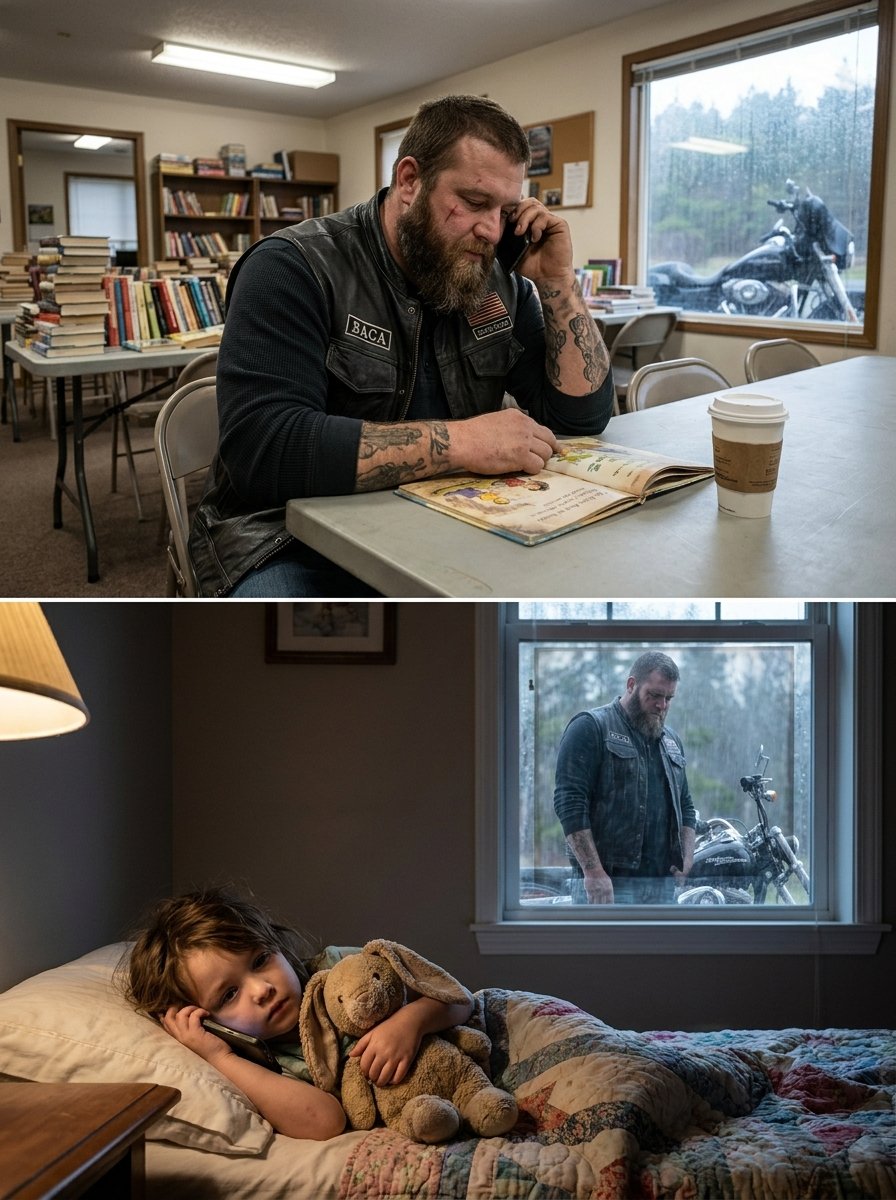
Every night after that, unless he was in court support or on a run, Rex called. Same time. Same ritual. First safety check. Then a book. Sometimes Goodnight Moon. Sometimes Where the Wild Things Are. Sometimes, when Birdie was too activated to follow a story, he just narrated boring things in the room around him.
“My coffee’s cold.”
“The soda machine is making that broken buzzing sound again.”
“Bear’s boots are too loud because he walks like a horse.”
“You hear that rain? Means nobody’s mowing tomorrow.”
Ordinary things. Predictable things.
Children who live in terror do not need magic first.
They need pattern.
I saw him one night during a storm when the power flickered in the chapter office. Everybody was moving around, checking chargers, securing paperwork, making calls. Rex stayed seated at the end of the folding table, the phone pressed to his ear.
“No, baby,” he said, still and level. “That thunder ain’t in your room. That’s out in the sky where it belongs.”
A long pause while she spoke.
He closed his eyes.
“Yeah,” he said. “I know footsteps sound different at night.”
That line hit the room like a dropped wrench.
Nobody commented.
Men in BACA are good at pretending not to notice when another man’s past leaks through a sentence.
But we all heard it.
Later, I learned more in pieces.
Rex had grown up in Arkansas, outside Fort Smith, in a house with too much beer, too many broken cabinet doors, and a father who rode with an outlaw club and believed fear was the same thing as respect. He wore his cut home like armor and brought road rage, liquor, and humiliation through the front door with him. Rex’s mother disappeared when he was eight. Nobody knew if she ran or was driven off by damage. After that it was just the father, the bike, the smell of smoke and grease, and whatever mood came in from the garage.
Rex learned young how to read bootsteps.
How to hear the level of danger in the way keys hit the kitchen counter.
How to stand between a slammed door and his little sister.
How to make his body the target so hers wouldn’t be.
The sister did not survive adolescence.
Not because of one event.
Because some damage takes years to finish.
He almost became his father after that.
That was the second seed.
He bought a bike young. Found his way around rough men because roughness felt like fluency. Fought too fast. Drank too much. Broke two jaws in one summer and wore that as proof of something he could no longer explain. He started talking like his old man. Started slamming doors. Started seeing fear in other people’s eyes and mistaking it for control.
Then one night in a motel outside Joplin, he caught his reflection in a dark television screen while yelling at a woman who had every right to leave him.
He saw his father.
Not a resemblance.
A continuation.
He quit drinking three weeks later.
Joined BACA two years after that.
Not because he was good.
Because he was scared of what staying the same would cost.
He once told Bear, our chapter president, “I didn’t join to feel noble, brother. I joined because I know exactly what monsters sound like through a bedroom door.”
That was Rex.
No speeches.
Just one line that stayed in the room.
The men trusted him because he never performed compassion. He simply practiced it until it looked like instinct. He fixed Denise’s porch light without mentioning it. He carried juice boxes in his saddlebag. He remembered which kids liked dinosaur stickers and which ones flinched at loud laughter. He always sat so children had the path to the door, never him.
And every night, he read to Birdie.
Not because it was assigned.
Because once he started, he could not bear the idea of her listening to darkness alone.
The case against Birdie’s abuser was moving slower than anybody liked.
That happens more than the public understands. Paperwork stalls. Witness timelines slip. Defense attorneys pull procedural nonsense. Children get tired. Foster placements wobble. The system asks fragile people to stay organized while they are still bleeding invisibly.
Birdie had been progressing anyway. Small signs, but real.
She was sleeping half the night without a call-back.
She had started drawing suns again instead of locked doors.
At a chapter event in a church lot near Springfield, she let three bikes idle in the distance without covering her ears.
The first time Rex read to her in person, she handed him the book herself.
He took it with both hands like it was a relic.
Then came the night the call did not connect.
8:30.
Voicemail.
Rex redialed.
Voicemail again.
No visible reaction at first. He just lowered the phone, stared at the screen, and tried once more.
Still nothing.
Denise usually texted if Birdie fell asleep early or was with the therapist late. Nothing came. Outside, rain tapped the chapter room windows. A vending machine hummed. Somebody in the garage laughed too loud at something not funny enough to justify it.
Rex stood.
That was all.
But every head in the room turned.
“Denise?” Bear asked.
“No answer.”
He was already reaching for his cut.
I offered what any normal person would. “Maybe the battery died.”
Rex looked at me, not mean, not sharp, just empty of patience. “Kids like her don’t miss routine unless something broke it.”
We moved fast after that.
Bear called county contacts.
I called the foster agency emergency line.
Another member pulled up the placement file.
No one was panicking out loud. BACA men know panic makes children do all the carrying again.
But Rex’s body told the truth.
His hands shook once while zipping his vest.
His jaw locked hard enough to flatten the beard at the sides.
He picked up his helmet, put it down, then picked it up again.
No swearing. No shouting. Somehow that was worse.
We rode out in a cold Missouri rain, engines cutting through wet road air, headlights smeared by the dark. Route 66 looked half-abandoned, all puddles and truck glare and old signs leaning into weather. Rex led. Not reckless, but hard. Efficient. His bike moved like purpose had weight.
I thought that was the climax.
The dangerous ride.
The child maybe in trouble.
The man rushing toward a scene that was waking up all his old ghosts.
We reached Denise’s small rental outside Marshfield in under forty minutes.
Porch light on.
Truck in the driveway.
No signs of forced entry.
Rex was off the bike before the engine fully died. Denise opened the door already apologizing, tears in her eyes, phone dead in her hand, Birdie finally asleep in the back after a therapy session that had ripped open old memories.
No new abuse.
No abuser returned.
No emergency in the way we feared.
False climax.
Everybody exhaled at once except Rex.
Because when Denise said, “She asked for you until she fell asleep,” something inside him gave way in a direction no one else could see.
He sat down on the wet porch step instead of going inside. Helmet hanging from one hand. Rain dripping off the roof behind him. Denise kept talking, apologizing, explaining the dead charger, the meltdown, the hour-long crying jag.
Rex nodded once, twice.
Then said very quietly, “Can I just hear her breathing?”
Denise brought the phone from the bedroom. She had called her own voicemail and set it near Birdie’s bed to record the sound because the therapist once suggested familiar breathing noises could ground her during night terrors. It was a small thing. Random. Practical.
Rex held the phone to his ear on that porch while rainwater ran past his boots.
And the big biker everybody crossed the street to avoid sat there listening to a child sleep like it was oxygen.
That should have been the emotional peak.
It wasn’t.
Because Denise, half-crying, half-apologizing, said one more sentence.
“She kept saying, ‘Tell Rex I was brave tonight. Tell him I didn’t hide under the bed this time.’”
Rex shut his eyes so hard the muscles in his forehead twitched.
Then I saw it.
Not tears.
Not exactly.
Recognition.
Like bravery from a small girl in a dark room had just reached back through time and touched a little boy he buried alive years ago.
The main twist came three nights later.
Birdie had settled after the missed-call scare. Routine restored. Book back at 8:30. Her caseworker even used the word “progress” in a room where people usually speak more carefully than that.
That night after the call, Rex stayed behind while the rest of us cleaned up folding chairs from a chapter training at a VFW hall outside Springfield. The smell of old coffee, rain-damp leather, and floor wax hung in the air. Someone had left a stack of donated children’s books on the far table.
Rex was packing his saddlebag when a laminated card slipped from the inner pocket of his cut and hit the floor.
I bent to grab it before it got stepped on.
It wasn’t a membership card.
It wasn’t court paperwork.
It was a photo.
Old, worn at the edges, re-laminated at some point to keep it from falling apart. In it stood a white boy maybe nine years old, skinny, bruised at the cheekbone, wearing a shirt too big for him. Behind him was a motorcycle garage. Beside him, half cut off by the frame, was a man in a biker vest whose hand was gripping the back of the boy’s neck like ownership.
Rex took the photo from me fast but not angry.
Just tired.
Bear saw it too.
He didn’t ask what it was.
He asked, “You good?”
Rex looked at the picture a long time. Then he said the sentence that unlocked the whole story.
“That’s the only photo I got where he’s touching me and not hitting me.”
No one moved.
Not me.
Not Bear.
Not the old fluorescent lights buzzing overhead.
Rex slid the photo back into the pocket.
Then he gave us the rest in the biker way: short lines, no decoration, no self-pity.
His father had been a biker. Real cut. Real club. Real terror inside the house. The man taught him that leather could mean danger before Rex was old enough to spell the word. For years he hated every engine note because it meant his father was home.
Later, he bought a Harley anyway.
Not to copy him.
To take the sound back.
That was twist number one.
Twist number two was worse.
The first bedtime book Rex ever read to Birdie had been a copy of Goodnight Moon with tape on the spine. It had belonged to his little sister, Lacey. The same sister he used to read to through a cracked bedroom door when their father was drunk and prowling the hallway, because reading out loud was the only thing that made her stop shaking.
Birdie didn’t just remind him of himself.
She reminded him of the child he could not save.
And BACA was not merely his redemption arc.
It was his refusal to let his father be the final author of his life.
“I joined,” he said, “because if I didn’t put something good in the same space he put fear, then he still wins.”
That line stayed in the hall long after he left.
After that, all the small details I had noticed rearranged themselves into truth.
The trimmed nails.
Because hands around children must never look careless.
The pink hair tie on the saddlebag zipper.
Lacey’s.
The touch to the inner pocket before every ride.
The photo.
The careful way he always asked children where they wanted him to stand.
The way he never blocked a doorway.
The way he read in a voice so steady it felt measured with a ruler.
None of that was instinct.
It was study.
A man spending years learning how to become the opposite of what raised him.
I started seeing more because now I knew what I was looking at.
During courtroom support, Rex would sit nearest the aisle, giving the child open sightlines and clear exit. He always kept his boots planted flat, never bouncing a knee, because jittery movement spikes nervous kids. At chapter houses he lowered his height before speaking to any child, but not too abruptly. He’d place both hands on the table or his thighs where they stayed visible. When a kid flinched, he didn’t say “you’re okay” too soon. He waited for their body to decide whether that was true.
People like to romanticize healing because it makes good social media.
Actual healing looks more like repetition.
Disciplined gentleness.
Choosing the right tone over and over until it becomes muscle memory.
One evening Birdie came by the chapter room before a family-court hearing. She had a tiny denim jacket, one pink sneaker lace untied, and a stuffed rabbit whose left ear had been mended badly with thick white thread. Denise tried to fix the lace. Birdie pulled back.
Rex crouched a few feet away and said, “You want me to do it or you want the rabbit to watch me do it first?”
Birdie considered this like a serious contract.
“Rabbit watches.”
So Rex tied the rabbit’s imaginary shoe first, then hers.
That was when I understood another thing. He did not comfort children by asking them to trust him. He gave them structure they could test.
Later that same day, after testimony, Birdie walked out pale and exhausted. Court hallways smell like stale air and panic. Adults were speaking in legal code around her like she wasn’t there. Rex offered no speeches. He just held out a juice box and said, “You did the hard thing. Now we do the boring thing.”
“What boring thing?”
“Chicken nuggets.”
She nodded like that sounded holy.
That is how some people are saved.
Not by grand language.
By someone keeping the next ten minutes simple.
The revelation spread beyond me too. The chapter already knew parts of Rex’s past, but not all of it. Once they understood the full weight, nobody treated him differently in the way outsiders might expect. No pity. No soft-focus admiration. Just a different kind of respect. The kind men reserve for someone who had every excuse to become dangerous and chose discipline instead.
Bear told him one night in the garage, while rain tapped the metal roof and someone was wrenching on a Sportster in the next bay, “You ain’t breaking the cycle, brother. You already broke it. This is what building after looks like.”
Rex didn’t answer right away.
He cleaned a streak of road grit off his windshield with the edge of a shop rag. Thought about it.
Then said, “Still gotta break it every day.”
That was the most honest line in the whole story.
Because men like him do not wake up healed and stay that way by accident. They choose differently in small moments. Tone. Posture. Doorways. Silence. Books. Phone calls. The whole thing is built out of repeated refusals to pass pain downstream.
Birdie never knew the full history, of course. She didn’t need to. Children do not owe adults understanding. Adults owe children safety.
But one night, near the end of summer, after three pages of Goodnight Moon, Birdie interrupted and asked, “Rex?”
“Yeah, baby.”
“Were you scared when you were little?”
The room around him went dead still.
He could have lied.
Could have redirected.
Could have offered some polished therapeutic line.
Instead he gave her the truth in a shape a child could hold.
“Yeah,” he said. “But I’m not little now.”
A pause.
Then Birdie asked, “Me either?”
Rex swallowed once. Hard.
“No,” he said. “Not the way that counts.”
That was the moment everything he had rebuilt met everything she still had a chance to become.
Ritual is how people like Rex keep from drifting.
Every night at 8:30, unless court or weather or a chapter emergency makes the world bend, he calls. Same opening questions. Blanket. Rabbit. Door locked. Then the book.
Every Saturday morning, he rides an old stretch of Route 66 west of Springfield before the traffic wakes up, stops at a diner that still pours terrible coffee into thick white mugs, and reads whatever new children’s book he plans to use that week, quietly, once through, so there are no surprises in the rhythm.
He keeps Goodnight Moon in the left saddlebag.
Lacey’s copy. Taped spine. Water stain on the back cover.
Next to it sits a small flashlight, extra charger, two juice pouches, and the pink hair tie.
He never removes the photo from the inside pocket of his cut unless he is alone.
Sometimes after difficult court days, he parks in his garage, kills the Harley, and just sits there while the engine clicks itself cooler in the dark. No music. No TV. Just metal settling and a man remembering that the sound of a motorcycle no longer belongs to the person who weaponized it first.
Birdie is doing better now. Not perfect. Better. She still startles at slammed doors. Still hates boots left outside a bedroom. Still sleeps with the rabbit. But now she sometimes falls asleep before the book ends.
Rex keeps reading anyway for another page or two.
Not because she can hear every word.
Because the little boy he used to be probably can.
Last month, I saw him outside a county courthouse just after sunset.
The hearing had gone long. Everybody looked wrung out. Denise was buckling Birdie into the back seat of her car while traffic hissed by on the wet road. The sky over the parking lot had gone the color of old steel. Rex stood beside his Road Glide with his helmet in one hand and his cut half-open.
Birdie rolled down the window before they pulled away.
“You gonna read tonight?”
Rex leaned down, big as a storm, careful as glass.
“Wouldn’t miss it.”
She held up the rabbit to the window like a witness.
Rex nodded at it once, dead serious.
“Tell him eight-thirty.”
Denise drove off.
Rex stood there another second watching the taillights disappear, then touched the inside pocket of his vest where that old photo lived. After that he put on his helmet, thumbed the starter, and the Harley came alive under him with that deep, familiar thunder.
The sound filled the lot.
Not threatening.
Not anymore.
Just a man taking something back.
He rolled onto the highway as the light went down, one red taillight pulling into the long Missouri dusk.
The monster never got the last word.
Website Disclaimer
The information provided on this website is for general informational and educational purposes only. While we strive to ensure that all content is accurate and up to date, we make no guarantees regarding the completeness, reliability, or accuracy of any information published.
The views and opinions expressed in articles belong to their respective authors and do not necessarily reflect the views of this website. Any action you take based on the information found on this website is strictly at your own risk. We will not be liable for any losses, damages, or inconveniences arising from the use of our content.
Some articles may contain opinions, third-party information, or external links. We do not endorse or guarantee the accuracy of content on external websites and are not responsible for their practices or policies.
All content on this website is provided in good faith and is intended for informational purposes only. Readers are encouraged to verify information independently and seek professional advice where appropriate.