“In This House, I Give the Orders,” the Colonel Said—Until I Quietly Opened a Small Box on the Kitchen Table and Showed Him the Two Silver Stars He Never Bothered to Ask About
Part One — The Visit That Didn’t Feel Like Coming Home
My name is Rachel Mercer, and by the time this story unfolded I had already spent most of my adult life in uniform. Twenty-seven years in the Navy had a way of rearranging your sense of time, because deployments blur together, oceans begin to look the same after a while, and the only constant becomes the people beside you and the quiet understanding that someone, somewhere, depends on the decisions you make when no one else is watching.
I grew up in a small, aging house outside Norfolk with my mother, Linda Mercer, who worked longer hours than anyone should and somehow still managed to show up at every school event I ever had, even if it meant she arrived with tired eyes and a fast-food coffee balanced in one hand. We didn’t have much, but we had a rhythm—her stubborn optimism, my determination to build something bigger than the limits we’d been handed—and that rhythm carried me from the Naval Academy all the way through a career that gradually stacked more responsibility onto my shoulders than the teenage version of me would ever have believed possible.
Despite all of that, despite the ships and the command postings and the endless travel that had become the background noise of my life, the house where I grew up had always remained the one place where rank and titles didn’t mean anything. It was simply home.
Or at least it had been.
The shift happened quietly enough that if you didn’t know the place the way I did, you probably wouldn’t have noticed it. I noticed the moment I stepped through the front door that Thursday afternoon in early October, dragging a rolling suitcase behind me after a week of meetings in Washington.
The furniture had been rearranged. Not drastically, but enough that the couch sat angled toward the windows instead of the television. The lamp that used to live in the corner beside my mother’s reading chair now stood near the hallway, its cord stretched awkwardly along the wall. Even the photographs had been shifted—frames that once held pictures of my academy graduation and my first ship assignment were now tucked along the edge of the mantel instead of the center.
Someone else had begun organizing my mother’s life.
“Rachel?” my mother called from the kitchen.
Her voice held excitement, though there was something else underneath it too, something slightly breathless, like a person trying to keep several fragile things balanced at once.
“I’m here,” I answered, stepping farther into the house.
The man standing near the dining room table turned as I spoke.
He was tall in the solid, square-shouldered way that military careers often shape men over time, his posture so straight it seemed almost deliberate. His hair was clipped short, silver threaded through dark strands in a way that suggested both discipline and age, and even though he was wearing civilian clothes—khakis and a dark button-down shirt—the way he carried himself made it obvious that uniforms were his natural habitat.
My mother appeared behind him with a dish towel in her hands.
“Rachel, sweetheart,” she said, smiling brightly. “I want you to meet Gregory Dalton.”
The name clicked immediately.
I had heard it dozens of times over the past six months during phone calls that were often interrupted by his voice in the background or shortened because “Greg just got home from work.”
Colonel Gregory Dalton.
United States Air Force.
He stepped forward and extended his hand with the sort of firm confidence that many career officers develop after years of commanding rooms and conversations.
“So you’re the famous daughter,” he said, smiling politely.
“I don’t know about famous,” I replied, shaking his hand.
His grip was strong, measured, the kind that tries to quietly establish hierarchy before a word has been spoken.
“Your mother tells me you’re Navy,” he said.
“Yes, sir.”
“What ship are you stationed on?”
The assumption behind the question hung in the air for half a second longer than it should have.
“I’m not currently assigned to a ship,” I said evenly.
He frowned slightly.
“So what do you do?”
Before I could answer, my mother jumped in quickly.
“Greg recently transferred here,” she explained. “He’s been helping me fix things around the house.”
Gregory nodded, smiling as if that were a generous act worthy of recognition.
The conversation drifted away from me.
But the moment stayed.
Part Two — Dinner That Felt Like a Briefing
That evening my mother prepared an elaborate dinner, the kind she only made when she wanted everything to go perfectly.
Roast chicken, mashed potatoes, roasted carrots, a salad that had far too many ingredients for a weeknight meal.
Gregory talked through most of it.
Some people tell stories the way they might offer a memory or two to the conversation. Gregory told stories the way officers deliver operational briefings—structured, confident, and very clearly centered on himself.
There were anecdotes about deployments in the Middle East, recollections of joint exercises with NATO forces, and a long explanation about the leadership philosophy he had developed over the years, which he summarized with the phrase, “Order and discipline make everything run smoothly.”
My mother listened attentively, nodding, occasionally adding a supportive comment.
When she mentioned her volunteer work at the veterans’ hospital—something she had devoted nearly ten years of her life to—Gregory smiled politely and said, “That’s admirable,” before redirecting the conversation back to his own experiences.
Halfway through dinner he turned his attention toward me.
“You know,” he said thoughtfully, “your mother says you travel constantly.”
“Comes with the job.”
He leaned back slightly in his chair.
“You ever think about slowing down? Starting a family?”
I nearly laughed.
“I’m forty-eight.”
“Exactly,” he said calmly. “Time moves quickly. Careers are important, but they’re not everything.”
My mother shifted in her seat.
“Greg…”
“I’m just saying,” he continued, “people sometimes focus so much on professional success that they forget about the rest of life.”
I set my fork down.
“I’ll keep that in mind.”
He nodded, satisfied.
Part Three — Small Fractures
Over the next two days, a pattern began to emerge.
Gregory corrected my mother frequently—sometimes gently, sometimes with an edge that suggested he believed he was helping her improve.
He rearranged kitchen cabinets because he thought a different layout made more sense.
He moved a stack of mail from the counter because he believed “clutter invites chaos.”
Individually, none of these actions were dramatic.
But they accumulated.
And my mother adjusted around them in ways that were subtle but unmistakable.
Part Four — The Argument
The real confrontation happened late Saturday night.
It was close to eleven.
My mother had already gone upstairs, exhausted from the quiet tension hanging around the house.
I sat at the kitchen table answering messages on my tablet.
Gregory walked in.
He noticed the porch light.
“Still on,” he muttered.
Then his eyes shifted to the chair I was sitting in.
“That’s my seat.”
I assumed he was joking.
“I’ll move in a minute,” I said.
“You’ll move now.”
The tone changed the room instantly.
I looked up slowly.
“This is my mother’s house.”
His jaw tightened.
“And I’m the one giving orders here.”
The words came out sharp enough to echo slightly in the quiet kitchen.
My mother appeared in the hallway.
“What’s going on?”
Gregory pointed at me.
“Your daughter has a respect problem.”
I closed my tablet.
“I’m not moving.”
He stepped closer.
“I outrank you, young lady.”
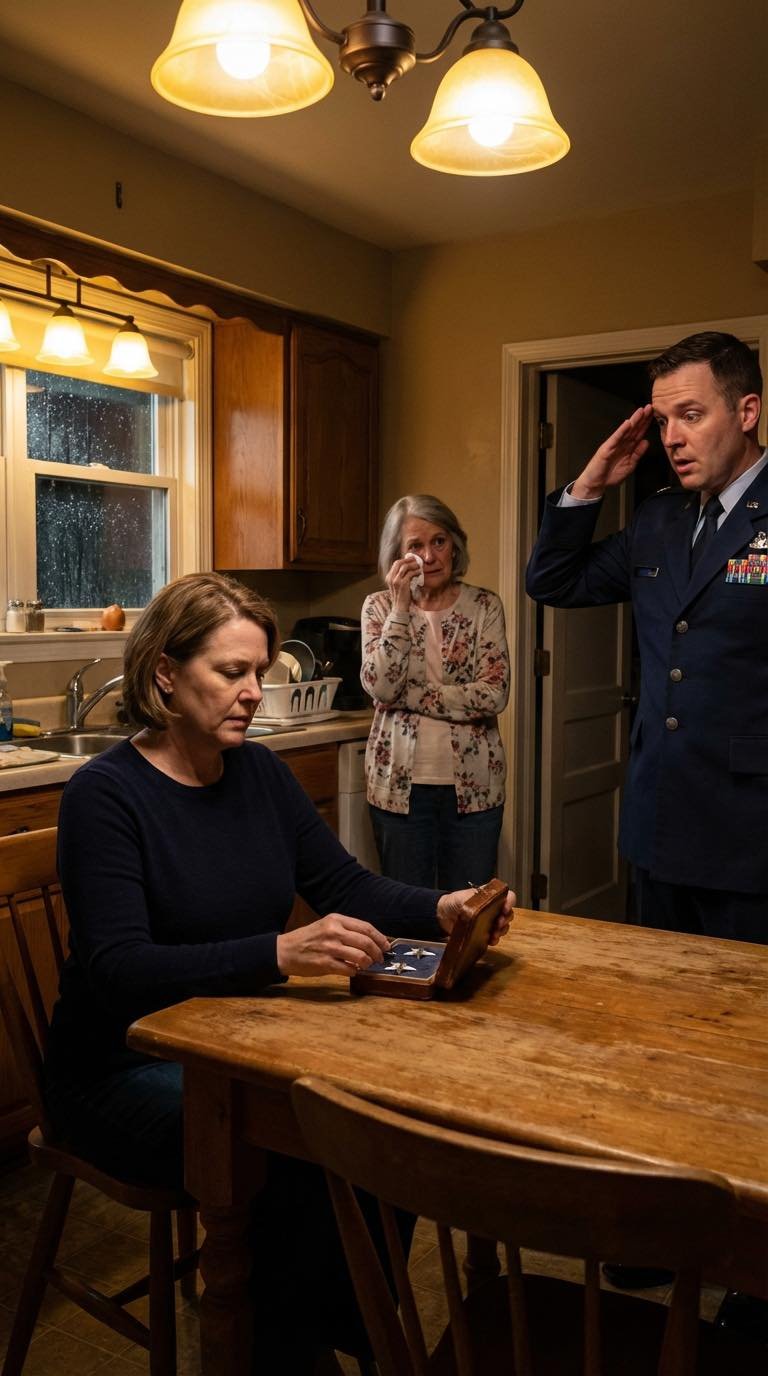
And that’s when I reached into my travel bag.
Part Five — The Moment Everything Changed
The small leather case clicked softly as I opened it.
Two polished silver stars caught the light from the overhead fixture.
For a moment Gregory didn’t move.
Then his expression shifted from irritation to confusion… and finally to stunned realization.
“Actually,” I said quietly, “you don’t.”
Training kicked in before pride had time to argue.
His back straightened automatically.
His hands moved to his sides.
He stood at attention.
“Ma’am,” he said slowly.
My mother stared between us in disbelief.
“You’re…?”
“Vice Admiral,” I said.
The kitchen went completely silent.
Part Six — Truth in the Quiet
Gregory struggled to recover.
“You should have said something,” he muttered.
“I did,” my mother said quietly. “Several times.”
He looked embarrassed.
Then defensive.
“You can’t use rank in a civilian home.”
“You’re right,” I replied calmly.
“But respect isn’t limited to uniforms.”
Then I asked my mother the question that mattered.
“Does he talk to you like this when I’m not here?”
She hesitated.
And that hesitation answered everything.
Part Seven — The Choice
The next morning my mother asked Gregory to leave.
He tried arguing.
He tried apologizing.
But something had shifted in her.
“I want a partner,” she told him quietly. “Not a commander.”
He packed that afternoon.
Part Eight — Months Later
Three months later I came home again for Thanksgiving.
The house felt different.
Lighter.
My mother had started painting again.
She laughed more easily.
That night she said something I’ve never forgotten.
“The moment he said he was giving orders,” she told me, “he revealed exactly the kind of man he was.”
She smiled.
“Real leaders don’t need to announce themselves.”
Lesson of the Story
True leadership isn’t about asserting authority over others.
It’s about understanding that respect must be earned through humility, empathy, and the ability to lift people up instead of pushing them down.
The loudest voice in the room rarely belongs to the strongest leader.
Sometimes the strongest leader is the one who stays calm… and lets the truth speak for itself.
Website Disclaimer
The information provided on this website is for general informational and educational purposes only. While we strive to ensure that all content is accurate and up to date, we make no guarantees regarding the completeness, reliability, or accuracy of any information published.
The views and opinions expressed in articles belong to their respective authors and do not necessarily reflect the views of this website. Any action you take based on the information found on this website is strictly at your own risk. We will not be liable for any losses, damages, or inconveniences arising from the use of our content.
Some articles may contain opinions, third-party information, or external links. We do not endorse or guarantee the accuracy of content on external websites and are not responsible for their practices or policies.
All content on this website is provided in good faith and is intended for informational purposes only. Readers are encouraged to verify information independently and seek professional advice where appropriate.