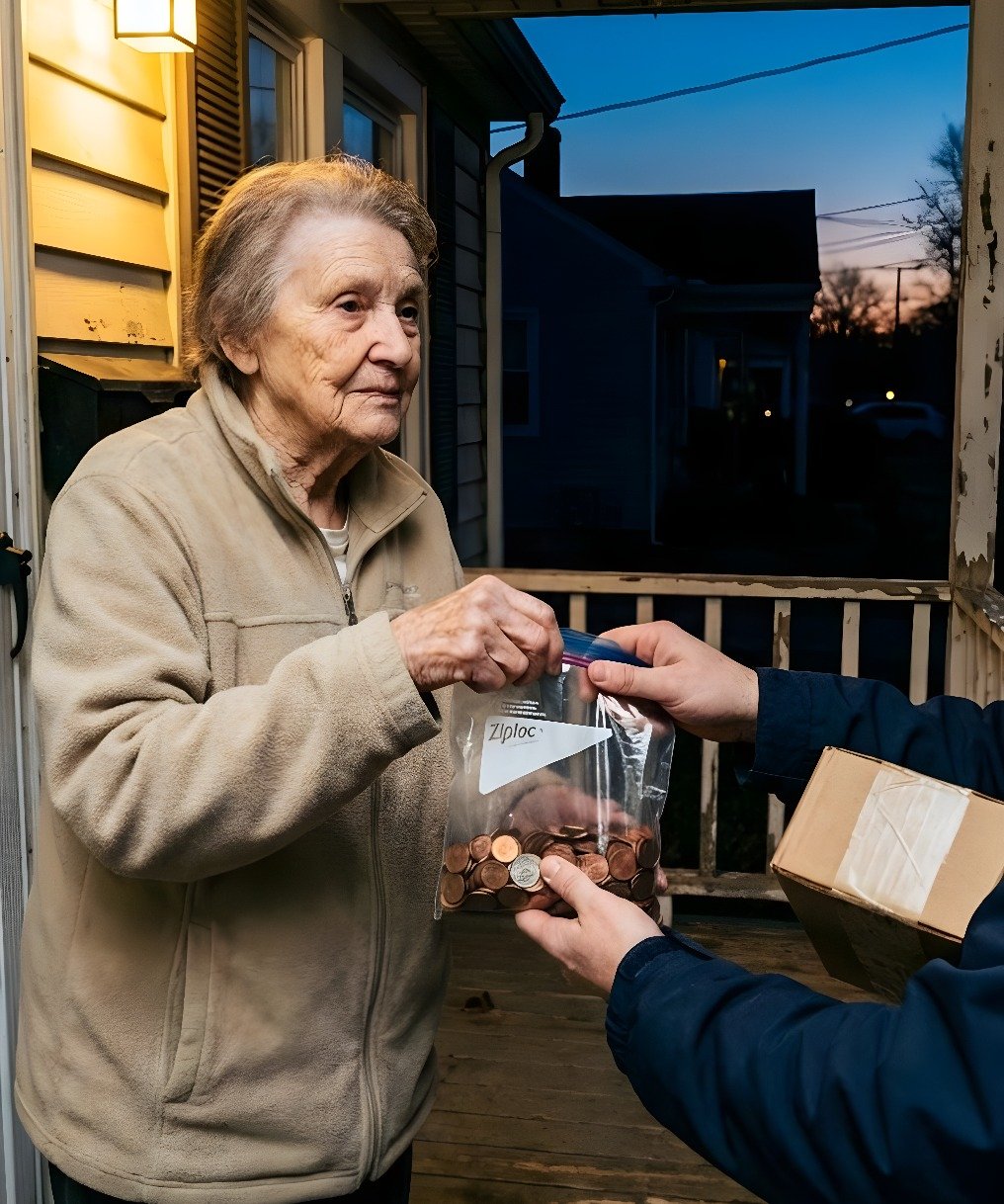
She held out a small sandwich bag that clinked as it moved, then leaned in and murmured, “I think it’s enough.” All of it was for a pizza that cost $14.50.
I had pulled up to a little house on the edge of town, the kind with tired siding and a porch that dipped under your shoes. The delivery note was short and specific: back door, knock loud.
The wind cut through my jacket as I climbed the steps. What struck me first was the darkness—no porch light, no warm glow from inside windows, nothing that said “someone’s awake.”
I knocked hard, the way the note asked.
A thin voice answered from somewhere deeper in the home. “Come in!”
When I pushed the door open, the air inside felt even colder than outside. The house was quiet in a way that made every small sound feel too big.
No TV humming in the background
No radio playing softly
Only a dim lamp and the slow rhythm of someone breathing
An elderly woman sat bundled under layered quilts in a worn recliner. She looked at the pizza box like it was more than dinner—like it was relief.
“I’m sorry it’s so cold,” she told me, her hands shaking as she reached for the bag beside her. “I try to keep the heat off as long as I can. My heart medicine has to come first.”
Then she offered the bag of coins again. It was heavy, mostly pennies, with a few nickels mixed in.
“I counted it twice,” she said quietly. “I even found some coins in the couch. Is it enough?”
I glanced down at my receipt: $14.50.
But I didn’t take the bag.
My eyes drifted toward the kitchen, where the refrigerator door sat just slightly ajar. I don’t know why, but that small detail pulled me in. I looked inside.
There wasn’t a mess. There wasn’t even food. Just emptiness.
A jug of tap water. A box of baking soda. A small pharmacy bag folded and stapled shut. Nothing else.
In that moment, it clicked: this wasn’t someone ordering pizza for fun, or because it was easier than cooking. This was the cheapest hot meal she could get brought to her door. And it felt like she didn’t have the energy—or the strength—to do much more.
On the mantle, dusty picture frames showed her decades earlier, smiling in a nurse’s uniform that looked straight out of the 1970s.
She had spent her life taking care of people. Now she was sitting in the dark, measuring out her comfort in pennies and priorities: medicine, heat, food. Pick two.
Medicine so she could keep going
Heat to make the house bearable
Food to quiet the ache in her stomach
I swallowed the lump in my throat and tried to steady my voice.
“Actually, ma’am,” I said, putting on the most casual smile I could manage, “our system had a glitch. You’re the hundredth order today, so it’s on the house.”
She blinked, uncertain. “I don’t want you getting in trouble.”
“I’m the manager tonight,” I said—an untrue thing said for a true purpose. “It’s handled.”
I set the box carefully on her lap. When she opened it, steam rose up and brushed her face. She closed her eyes for a second and breathed in like she was trying to memorize the warmth. A single tear traced down her cheek.
I walked back to my car and sat there without starting it. My hands stayed on the steering wheel longer than they needed to.
Then I sent a message to dispatch: Flat tire. Need 45 minutes.
And I drove to the big store down the road.
I didn’t fill a basket with treats. I didn’t wander aisles for anything extra.
I bought what would actually help.
Milk and eggs
Soft bread
Canned soup with easy-open tabs
Oatmeal
Bananas
A warm rotisserie chicken
When I returned, she was already on her second slice, eating slowly but with the focus of someone who hadn’t had a real meal in too long.
I carried the bags into her kitchen and began setting everything on the small table.
She stared at the groceries as if I’d unpacked something impossible.
“What is all this?” she asked, barely above a whisper.
“My grandmother lives alone too,” I said, placing the milk into the refrigerator. “If she were sitting in the dark somewhere, I’d want someone to show up for her.”
She tried to stand and come toward me, but the rug caught her steps and she hesitated, unsure of her balance.
So I stepped closer instead.
She took my hand in both of hers, pressed it to her forehead, and began to cry—deep, tired sobs that sounded like they’d been waiting a long time for permission.
“I worked my whole life,” she said through tears. “I did everything right. I don’t understand how it came to this.”
I stayed for a while. Not in a heroic way—just in a human way.
I checked the windows for drafts. I replaced a burned-out light bulb in the hallway. And I turned the thermostat up enough to take the edge off the cold.
She started to protest, her voice catching on the word that mattered most. “The bill…”
“Tonight doesn’t need to be about bills,” I told her gently.
When I finally left, I had less cash in my wallet than I’d had at the beginning of the shift.
But I carried something heavier than money—something that doesn’t let go easily.
We live surrounded by convenience
We talk about progress and innovation every day
And still, someone who cared for others can end up counting pennies for warmth and dinner
If there’s one thing worth taking from this, it’s simple: check on the people around you.
Especially the quiet ones. The ones whose porch lights stay off. The houses that look dark at dinner time, not because they’re sleeping, but because they’re trying to stretch what little they have.
Looking away doesn’t make hardship disappear. It only makes it lonelier.
In the end, a warm meal helped for one night—but what matters most is remembering that small kindness can be a lifeline, and that noticing someone may be the first step toward helping them feel seen again.
Website Disclaimer
The information provided on this website is for general informational and educational purposes only. While we strive to ensure that all content is accurate and up to date, we make no guarantees regarding the completeness, reliability, or accuracy of any information published.
The views and opinions expressed in articles belong to their respective authors and do not necessarily reflect the views of this website. Any action you take based on the information found on this website is strictly at your own risk. We will not be liable for any losses, damages, or inconveniences arising from the use of our content.
Some articles may contain opinions, third-party information, or external links. We do not endorse or guarantee the accuracy of content on external websites and are not responsible for their practices or policies.
All content on this website is provided in good faith and is intended for informational purposes only. Readers are encouraged to verify information independently and seek professional advice where appropriate.