PART 1 — The Voice Beneath the Metal
Rope-Bound Refrigerator Mystery started on a morning that felt too quiet to be safe, the kind of silence that settles over places where people stop asking questions. On the outskirts of Red Mesa, Nevada, a landfill stretched endlessly beneath a pale sky, steaming gently as the desert sun warmed layers of discarded lives. To most people it was a place to avoid. To eight-year-old Savannah Reed, it was the only place that ever offered a chance to eat.
Savannah had learned survival long before she learned multiplication. She knew which trucks dumped grocery waste and which carried construction debris. She knew how to move quickly before older scavengers arrived, and she knew never to trust smiles from strangers. Hunger sharpened her instincts more effectively than any adult guidance ever could. That morning, her stomach felt hollow enough to ache with every breath, and she moved faster than usual, digging through black plastic bags with a bent metal rod she had claimed as her tool weeks earlier.
The air smelled worse than usual — sour milk, burning rubber, and something metallic underneath. She ignored it. Smell meant nothing; survival meant everything. A crushed cereal box gave her brief hope before she realized it was empty. A broken cooler held only melted ice and dirt. She wiped sweat from her forehead and kept moving, whispering quietly to herself the way she always did when fear crept too close.
“Just one thing today,” she murmured. “Just one.”
That was when she heard it.
A dull, uneven thump.
Savannah froze instantly. The landfill never stopped making noise — engines roared, cranes groaned, birds screamed overhead — but this sound slipped between those noises like it didn’t belong there at all. She waited, holding her breath.
Another sound followed.
A scrape. Then a faint gasp.
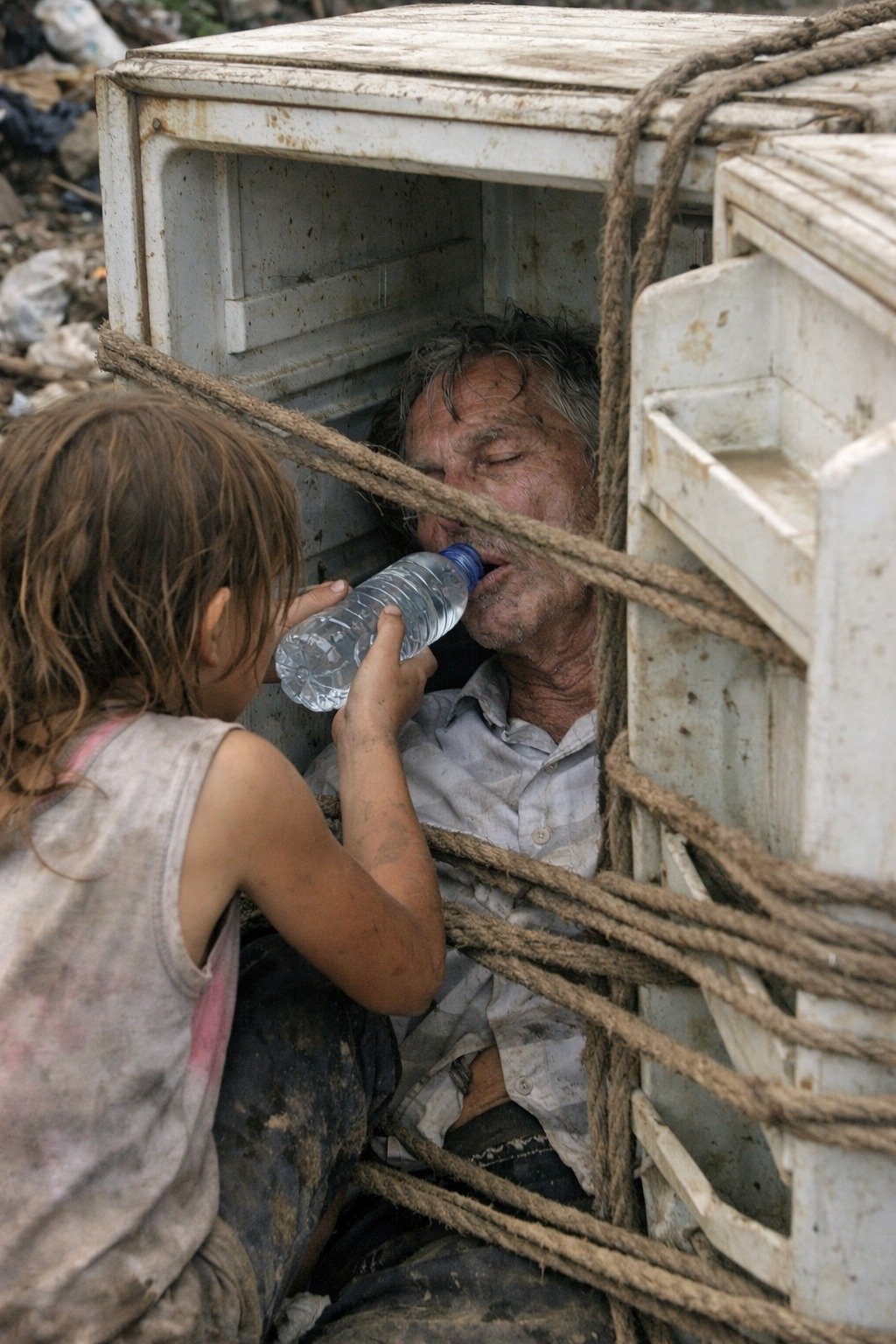
Her skin prickled. Every survival instinct told her to leave immediately. Sounds inside abandoned objects usually meant danger — animals trapped, unstable metal, sometimes worse. She slowly turned toward a pile of discarded appliances stacked near a collapsed wooden wardrobe. Half buried beneath debris lay an old refrigerator tipped onto its side, its surface rusted and sunburned, thick rope wrapped around it several times like someone had wanted to make absolutely sure it never opened again.
Savannah stared.
The sound came again.
Not mechanical.
Human.
She took one cautious step forward, then another, each movement careful to avoid broken glass. Her heartbeat thundered louder than the machines in the distance. She crouched near the refrigerator and noticed scratches along the inside edge of the door — fresh scratches.
Someone had been trying to get out.
“Hello?” she called softly.
For a long moment nothing happened. She almost convinced herself she imagined it.
Then a voice emerged, barely stronger than a breath.
“…please…”
Savannah stumbled backward, fear surging through her chest. The voice sounded dry, desperate, fading.
“I can’t… breathe…”
She hesitated, memories flashing — adults who lied, shelters that weren’t safe, promises that ended badly. Helping strangers had never helped her before. Yet something about the voice felt different. It didn’t sound angry or dangerous.
It sounded defeated.
She leaned closer to a small gap where the door seal had warped. Inside the darkness, she saw movement — then an eye opened slowly, swollen and red from exhaustion.
A man.
Not homeless. Not a scavenger. Even covered in grime, his clothes looked expensive, torn but unmistakably high quality. His wrists were bruised, and a strip of tape clung to one sleeve.
Savannah’s voice trembled. “How long have you been in there?”
“I… don’t know,” he whispered. “Hours… maybe longer.”
“Who did this?”
The man swallowed painfully before answering.
“My partner,” he said. “He needed me gone.”
Savannah didn’t understand business betrayals or wealth, but she understood being abandoned. She stared at the tight knots around the refrigerator.
If she walked away, nobody would ever know he existed.
The landfill buried everything eventually.
She knelt beside the rope.
“I’ll try,” she said quietly.
And in that moment, the Rope-Bound Refrigerator Mystery truly began.
PART 2 — A Man the World Thought Was Gone
The knots refused to move beneath Savannah’s small hands. She pulled until her fingers burned, but the rope barely shifted. Inside, the man’s breathing became uneven, each inhale sounding thinner than the last.
“Stay awake,” she said urgently. “Talk to me.”
“My name is Caleb Whitaker,” he murmured weakly.
“I’m Savannah.”
“That’s… a strong name.”
She almost smiled, though fear pressed heavily on her chest. She realized quickly she couldn’t free him alone. Running for help meant risking everything — adults might chase her away or blame her — yet doing nothing meant watching him die.
“I’ll be back,” she said.
“No police,” Caleb rasped suddenly. “Not yet.”
She frowned. “Why?”
“They might… belong to him.”
The seriousness in his voice convinced her. Savannah ran across the landfill toward a maintenance shack where an older truck driver named Frank Doyle sometimes shared leftover sandwiches without asking questions. She burst inside, breathless, words tumbling over each other.
“There’s a man trapped in a fridge!”
Frank stared at her, confused — until he saw tears in her eyes. Without another question, he grabbed heavy cutters and followed her back.
When the refrigerator came into view, his expression hardened instantly.
“That’s deliberate,” he muttered. “Someone wanted him dead.”
The cutters snapped through the rope. Together they pulled the door open.
Caleb collapsed forward, gasping violently as fresh air flooded his lungs. He coughed uncontrollably, shaking as though his body had forgotten how to exist outside confinement.
Frank froze, recognition dawning.
“Holy hell,” he whispered. “You’re Whitaker Industries.”
Savannah looked between them, confused.
Sirens suddenly echoed across the landfill, approaching fast.
Caleb’s face drained of color.
“They found me too quickly,” he said. “That means someone’s watching.”
Savannah turned toward the horizon where police lights flashed through dust clouds. For the first time, she realized rescuing him might have placed them both in danger.
The mystery wasn’t ending.
It was expanding.
PART 3 — The Secret No One Could Bury
Within days, the Rope-Bound Refrigerator Mystery dominated national headlines. News outlets called it miraculous survival. Reporters described Savannah as the “Landfill Angel,” though she felt uncomfortable hearing strangers speak her name.
From his hospital bed, Caleb revealed the truth piece by piece. His business partner had orchestrated a takeover, staging financial fraud and kidnapping Caleb to eliminate the final obstacle. Leaving him in the landfill ensured slow death without evidence — heat, suffocation, and anonymity would erase him completely.
But the plan failed because of one unpredictable factor: a hungry child who listened.
Investigators uncovered hidden accounts, falsified contracts, and hired accomplices. Arrests followed quickly. The story transformed from attempted murder into one of the largest corporate crime cases in state history.
Caleb never forgot who saved him.
Weeks later, he visited Savannah at her new foster home arranged by social services. She sat nervously at the kitchen table, unsure how to act around someone the world now called powerful.
“You didn’t just save my life,” he told her gently. “You gave me back my future.”
She shrugged. “I just heard you.”
He shook his head.
“No,” he said softly. “You cared enough to stop.”
Caleb established a foundation supporting homeless children across the country, naming Savannah its first ambassador. The landfill where they met was eventually transformed into a public park — green grass replacing mountains of waste.
Years later, journalists still retold the Rope-Bound Refrigerator Mystery as proof that history sometimes changes through the smallest decisions. Not through wealth or influence, but through courage found in unlikely places.
Standing at the park’s overlook one evening, Savannah asked Caleb quietly, “Do you think anyone else would’ve helped?”
He watched the sunset before answering.
“Maybe,” he said. “But you were the one who listened when the world decided not to.”
And sometimes, the difference between disappearance and survival is simply one person refusing to walk away from a voice everyone else ignores.
Website Disclaimer
The information provided on this website is for general informational and educational purposes only. While we strive to ensure that all content is accurate and up to date, we make no guarantees regarding the completeness, reliability, or accuracy of any information published.
The views and opinions expressed in articles belong to their respective authors and do not necessarily reflect the views of this website. Any action you take based on the information found on this website is strictly at your own risk. We will not be liable for any losses, damages, or inconveniences arising from the use of our content.
Some articles may contain opinions, third-party information, or external links. We do not endorse or guarantee the accuracy of content on external websites and are not responsible for their practices or policies.
All content on this website is provided in good faith and is intended for informational purposes only. Readers are encouraged to verify information independently and seek professional advice where appropriate.