I used to think I had a decent instinct for people, not in the naive, everyone-has-a-good-heart sort of way, but in the quieter, survival-based sense you develop when you’ve spent years balancing bills against paychecks and weighing every decision against the question of whether it will keep the lights on one more month, and yet the night my son asked if a stranger could sleep on our couch because “he looks colder than we are,” I realized that instinct is often just fear dressed up as wisdom, and sometimes it takes an eight-year-old with chapped hands and a stubborn conscience to expose the difference.
My name is Marissa Doyle, I’m thirty-seven years old, a single mother, an accounts payable coordinator for a mid-sized logistics company on the south side of Milwaukee, and if you had asked me three months ago whether I would ever open my apartment door to a man I met outside a grocery store who wore a metal leg brace and carried everything he owned in a weather-faded backpack, I would have said no without hesitation, because I have worked too hard to maintain even the fragile stability we have, but that was before I watched my son stand in front of him like a small, defiant shield against the wind.
It was late November, the kind of cold that doesn’t announce itself with drama but seeps quietly into your bones, and we had just left the discount grocery store with two reusable bags—one filled with canned soup and rice, the other with generic cereal and the cheapest ground turkey I could find—when Oliver stopped so abruptly that I nearly collided with him.
“Mom,” he whispered, tugging at my coat sleeve.
The man was sitting near the cart return, back pressed against the brick wall, his right leg extended stiffly in front of him, a gray metal brace running from mid-thigh to ankle; he wasn’t holding a sign, wasn’t calling out, wasn’t making eye contact with passing shoppers, he was just there, shoulders hunched, breath visible in short bursts, as if he had resigned himself to invisibility.
“Please,” Oliver said softly, “can we at least ask if he’s okay?”
I felt the familiar tightening in my chest, the internal inventory of risk—What if he’s unstable? What if he follows us home? What if I misjudge this and regret it?—and yet when I looked at the man’s hands, red and raw from cold, resting uselessly on the pavement, I heard myself say, “We can ask.”
Up close, he looked younger than I expected, maybe mid-forties, though exhaustion has a way of distorting age. His beard was untrimmed but not wild, his jacket thin for the temperature, his eyes alert despite the weariness etched around them.
“Sir,” Oliver said before I could formulate a more cautious opening, “do you need somewhere warm?”
The man blinked, as if recalibrating to being addressed directly. “I’ll be fine,” he replied, voice low but steady. “Thank you.”
“You’re shaking,” Oliver insisted, because children notice what adults pretend not to see.
I crouched down, grocery bags digging into my wrists. “There’s a church two blocks east,” I said. “They open the basement overnight when it drops below freezing.”
He nodded faintly. “They’re full tonight.”
There was no self-pity in his tone, just fact.
Oliver looked at me then, eyes wide and pleading in a way that bypassed logic and went straight to something more primitive. “Mom,” he said, “we have a couch.”
We have a couch.
Not a guest room. Not savings to absorb a mistake. Just a couch in a two-bedroom apartment on the third floor of a building that had seen better decades.
I hesitated long enough that the silence stretched thin.
“One night,” I heard myself say finally, the words tasting like both generosity and recklessness. “You can stay one night. We’ll figure out something more stable in the morning.”
He studied me, not with opportunism but with what felt like caution on his end, as if he too was measuring risk. “My name is Leonard,” he said after a moment. “I don’t want trouble.”
“I’m Marissa,” I replied. “And this is Oliver.”
The walk back to the apartment was quiet, the wind slicing between buildings, and I was hyper-aware of every sound—the scrape of Leonard’s brace against pavement, the soft wheeze of his breathing on the stairs, the click of our door unlocking. I half expected neighbors to peer out suspiciously, to mark the deviation from routine.
Inside, the apartment felt smaller than usual. The radiator clanked as it struggled to circulate heat. The kitchen light flickered once before steadying. I set the groceries down and turned toward him.
“The bathroom’s down the hall,” I said. “There are clean towels under the sink. We’ll make up the couch.”
He nodded, setting his backpack carefully by the door, as if unwilling to let it stray from sight.
That night, after Oliver had peppered him with cautious but earnest questions—Do you like baseball? Do you know how to fix bikes? Does the brace hurt?—and after we had eaten simple turkey sandwiches at the small laminate table that wobbled slightly on one leg, I lay awake longer than usual, listening for movement, every creak of the building amplified by my own unease.
In the morning, I left for work before sunrise, slipping on my shoes quietly so as not to wake either of them, and as I paused at the door I saw Leonard already sitting upright on the couch, brace secured, hands folded, as if he had been awake for hours.
“I’ll be gone by the time you get back,” he said, and there was something resolute in the way he spoke it, as if he intended not to leave a trace.
I nodded, unsure whether to feel relieved or oddly disappointed. “There’s coffee,” I said. “Help yourself.”
The day at work was relentless—quarter-end reconciliations, a supplier dispute that required three separate conference calls, my supervisor hovering because corporate was trimming budgets again—and by the time I clocked out, my head throbbed and my patience had worn thin.
I expected to return to the familiar signs of our life in progress: dishes in the sink, Oliver’s sneakers abandoned near the couch, the faint smell of last night’s dinner lingering in the air.
Instead, when I opened the door, I was greeted by the scent of lemon cleaner and something warm and yeasty.
I froze, keys still in my hand.
For a disorienting second, I wondered if I had misjudged the floor and entered the wrong apartment, but Oliver’s crooked watercolor painting of a dragon was still taped to the fridge, curling slightly at the edges, and my chipped green coffee mug sat precisely where I had left it that morning.
The difference was not aesthetic. It was intention.
The counters gleamed—not polished to showroom shine, but wiped with care. The trash can was empty. The stack of unopened mail had been arranged neatly, not opened, just squared. The living room blanket was folded into a rough rectangle instead of the usual heap.
I heard the faint clink of a spoon against metal.
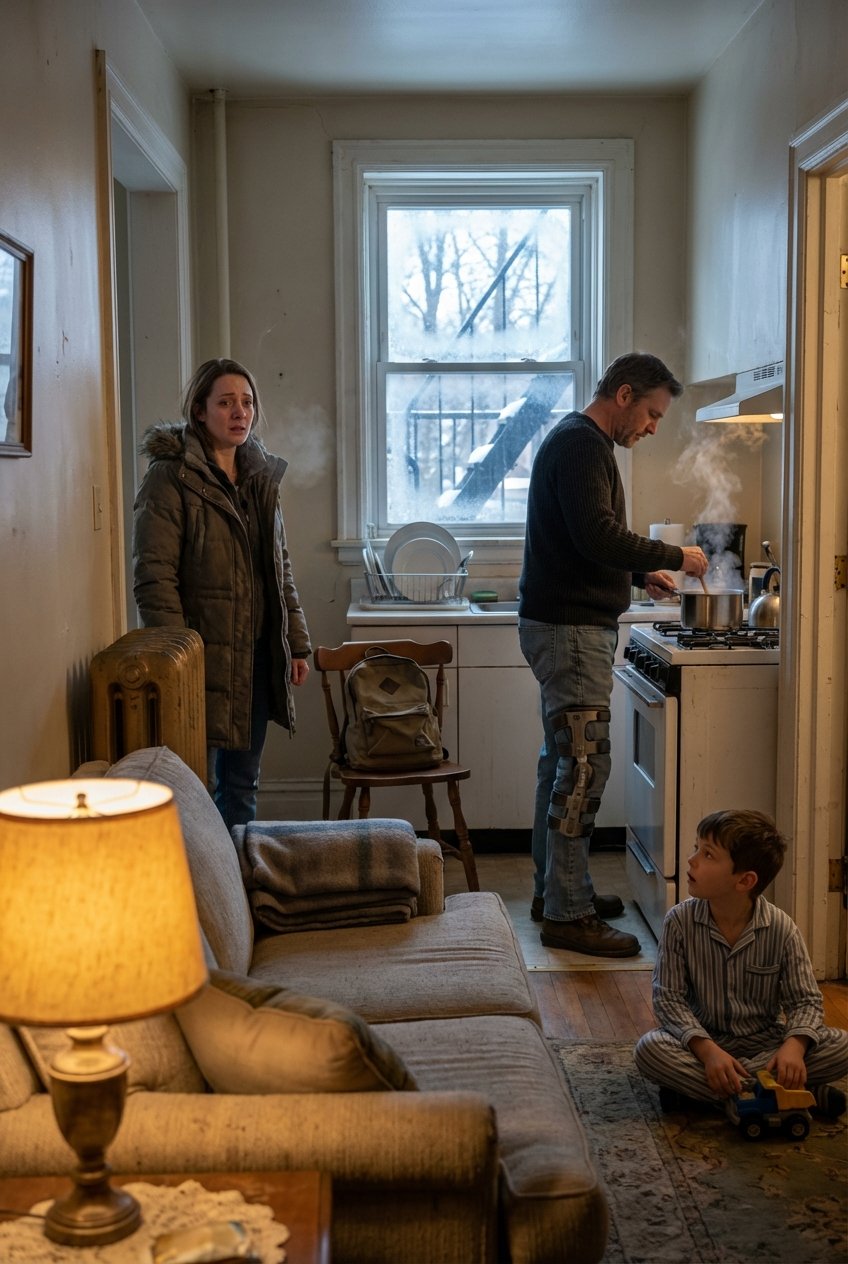
Leonard stood at the stove, wearing one of Oliver’s old sweatshirts that I had offered him the night before, his brace visible beneath worn jeans, his movements careful but practiced as he stirred a pot. When he saw me, he straightened slightly.
“I hope this is okay,” he said quickly. “I found lentils in the cabinet. And some carrots.”
On the small kitchen table were two plates already set, grilled cheese sandwiches cut diagonally, a bowl of what looked like homemade soup flecked with herbs I hadn’t realized we even owned.
My first reaction was not gratitude. It was suspicion.
“You went through my cabinets,” I said, sharper than intended.
“I checked what you had,” he admitted. “I left a note.”
Sure enough, beside the mail was a folded piece of paper in deliberate handwriting:
Used: lentils, carrots, onion, bread, cheese. Will replace.
Replace them how? I thought, the reflexive cynicism surfacing before I could suppress it.
Oliver barreled out of his room then, nearly colliding with me. “Mom! He fixed the door!”
“The door?”
“It doesn’t scrape anymore! And he made me finish my spelling before we played cards.”
Leonard gave a small, almost embarrassed shrug. “He’s bright. Just needed a timer.”
I stepped back into the hallway and tested the front door. The frame no longer stuck. The deadbolt slid smoothly. The hinge that had squealed for months was silent.
“Where did you learn to do that?” I asked, returning to the kitchen.
“Facilities maintenance,” he replied. “Municipal contracts. Schools, clinics, low-income housing units. Before the accident.”
The word accident hung there, heavy but undefined.
“How did you end up out there?” I asked, gesturing vaguely toward the street.
He exhaled slowly. “Scaffold collapse,” he said. “Leg shattered in three places. Workers’ comp got tied up in appeals. Company restructured. My position evaporated. Savings drained faster than pride.” He paused, eyes lowering. “Then my sister needed money. Then I needed more surgery. It stacks.”
I folded my arms, defensive reflex returning. “I said one night.”
“I remember,” he said calmly. “I just didn’t want to leave without leaving it better.”
Then he picked up the small stack of mail. “I didn’t open anything sealed,” he added quickly. “But the eviction notice was already unfolded.”
My throat tightened despite myself.
“You’ve got ten days,” he said quietly.
“I know.”
He looked around the apartment again, not with judgment but with analysis, the way someone trained to diagnose structural weaknesses might scan for stress points.
“I can’t hand you cash,” he said. “But I can offer leverage.”
Leverage.
From a man who had slept on concrete.
That night, after Oliver had gone to bed, Leonard asked to see the lease agreement. I hesitated, then handed it over. He read carefully, tracing lines with a finger calloused and scarred.
“Your landlord’s violating code on at least two things,” he said. “The stairwell lighting and the dryer vent. And this clause about late fees isn’t enforceable under current ordinance.”
“You’re sure?”
“I’m not guessing,” he replied. “I used to fix what landlords ignored.”
The next morning, instead of disappearing, he was up before us, brace tightened, my old toolbox spread out on the kitchen floor.
“I won’t stay if you don’t want me to,” he said. “But if I leave, I’ll leave something solid.”
We went down to the building office, a cramped space near the laundry room where Mr. Hargrove conducted business from behind a metal desk scarred with cigarette burns. He barely glanced up when we entered.
“Rent’s late,” he muttered.
“I’m aware,” I said, bracing for humiliation.
Leonard stepped forward, posture straight despite the brace. “There are maintenance issues you’ve neglected.”
Hargrove’s eyes narrowed. “And you are?”
“Someone who knows the difference between wear and violation,” Leonard replied evenly. He listed them calmly: the loose third-floor railing, the faulty stairwell light, the clogged vent that could spark under strain.
Hargrove scoffed. “That’s not your concern.”
“It will be if code enforcement gets curious,” Leonard said, not threatening, just factual. “Or if a tenant falls.”
The room stilled.
“And what do you want?” Hargrove asked finally.
“Thirty days,” Leonard said. “In writing. In exchange, I handle the repairs at no labor cost.”
Hargrove’s gaze dropped briefly to the brace, as if calculating whether this was bluff or competence.
“Thirty,” he muttered at last. “But if you break anything—”
“I won’t,” Leonard said.
By dusk, the stairwell light was replaced, the railing reinforced, the vent cleared of lint so dense it could have fueled a bonfire. He even tightened the wobble in our kitchen table and patched a crack in the bathroom tile I had learned to ignore.
The twist came not from the repairs themselves but from what followed.
A week later, a certified letter arrived addressed to Leonard. He stared at it for a long moment before opening it at the table.
His disability appeal had been approved retroactively. Months of withheld compensation were being released. Not a fortune, but enough to recalibrate a life.
He looked up at me, eyes reflecting something like disbelief. “I was going to leave once it came through,” he said.
“And now?” I asked carefully.
“Now I’d like to do something I should have done months ago,” he replied.
Two days later, he met with Hargrove again—not to negotiate for himself, but to propose a formal maintenance contract for the building at a reduced rate, leveraging his certification and the fact that he had already corrected multiple violations. Hargrove, pragmatic to the core, agreed.
Which meant Leonard had income. Which meant stability.
But the true climax unfolded on a Thursday afternoon when Hargrove cornered me in the hallway, voice oily with newfound politeness.
“You didn’t mention you had someone who knows code,” he said. “That could’ve cost me.”
“That wasn’t my objective,” I replied evenly.
He leaned closer. “You still owe back rent.”
Before I could respond, Leonard appeared at the top of the stairs, brace glinting under fluorescent light.
“She owes what’s legally enforceable,” he said calmly. “Nothing more.”
There was no aggression in his tone, just certainty.
For the first time in months, I watched Hargrove retreat.
That evening, as Oliver sat cross-legged on the floor showing Leonard a math worksheet, I realized the apartment no longer felt like a space on the verge of collapse. It felt tended, not because it had been rescued by charity, but because someone who had lost nearly everything still recognized its value.
“Are you staying forever?” Oliver asked one night.
Leonard looked at me before answering.
“I’m staying until I can stand on my own again,” he said. “And until you two don’t need me.”
I shook my head gently. “We didn’t need a savior,” I said. “We needed a partner.”
Because that was the truth.
The surprise wasn’t that a man with a brace could fix a door or cook a meal. It was that the world had mistaken temporary misfortune for permanent worthlessness, and I had almost done the same.
The lesson, if I must draw one from this without reducing it to a slogan, is that value does not evaporate when circumstances shift; the skills, discipline, and integrity a person carries do not vanish simply because a system fails them, and when we reduce someone to their lowest moment, we reveal more about our own fear than their capacity; kindness is not blind trust, it is measured risk paired with accountability, and sometimes the person you allow in for a single night becomes the catalyst for rebuilding not just a broken doorframe, but the fragile architecture of your own assumptions.
Website Disclaimer
The information provided on this website is for general informational and educational purposes only. While we strive to ensure that all content is accurate and up to date, we make no guarantees regarding the completeness, reliability, or accuracy of any information published.
The views and opinions expressed in articles belong to their respective authors and do not necessarily reflect the views of this website. Any action you take based on the information found on this website is strictly at your own risk. We will not be liable for any losses, damages, or inconveniences arising from the use of our content.
Some articles may contain opinions, third-party information, or external links. We do not endorse or guarantee the accuracy of content on external websites and are not responsible for their practices or policies.
All content on this website is provided in good faith and is intended for informational purposes only. Readers are encouraged to verify information independently and seek professional advice where appropriate.