The first thing Eleanor Whitmore noticed that morning was the silence, the kind of silence that settles over the woods in early autumn when the cicadas have grown tired and the birds haven’t yet decided whether to commit to migration, and she remembered thinking, as she adjusted the strap of her woven basket against her hip, that quiet could be a blessing or a warning depending on the day, and she had lived long enough—seventy-eight years, to be precise—to know the difference.
She had been a widow for nearly seven of those years, and in that time the forest behind her farmhouse had become less a backdrop and more a companion, the trees like old parishioners who had listened to her grief without interruption, who had witnessed the way she would sometimes pause mid-path and press her palm against the rough bark of a cedar as if it were a shoulder she could lean on, whispering small confessions into the wind about how much she still missed Harold’s laugh, how strange it felt to sleep in a bed that had once held two bodies and now held only one, how some evenings she still turned her head to comment on the news before remembering that there was no one there to answer.
That morning she was gathering sage and late-blooming thyme, her basket already fragrant, when she heard it—a sound that did not belong to wind or branch or bird, but something raw and human, a strained groan dragged through clenched teeth—and she stopped so abruptly that the dried leaves at her feet crackled like paper set aflame.
She stood still for a long breath, her heart knocking hard against her ribs, and when the sound came again, sharper this time, edged with pain, she felt the familiar tug between caution and conscience, a tug she had spent a lifetime navigating first as a schoolteacher, then as a wife, and now as a woman who lived alone but refused to let solitude turn her heart to stone.
“Oh, Lord,” she murmured, not because she expected an answer, but because she needed courage.
The noise came from beyond the narrow deer trail, deeper into the thicket where the sycamores grew tall and pale like old ghosts, and she stepped off the path despite the way her sensible shoes sank into damp soil, despite the warning voice in her head that said you are too old for this, that said you do not know what waits in shadow.
She pushed past brambles that tugged at her cardigan, and then she saw him.
He was bound to a tree not with rope, as she first assumed, but with a thick, industrial chain looped around his torso and threaded through a heavy steel collar fastened to the trunk, the metal cutting into leather and skin alike, and for a moment she could not reconcile the sight of such brutality with the stillness of the forest around it, because violence, she had always believed, left a stain in the air, yet here the sunlight filtered through leaves as if nothing were amiss.
He was enormous, broad-shouldered even in collapse, his dark hair matted with blood near the temple, a jagged cut crusted over, and the torn vest he wore bore the unmistakable winged skull insignia of the Black Vultures Motorcycle Club, a name she had heard in town more than once spoken in lowered voices near the hardware store counter.
His arms were a gallery of ink—serpents, flames, a faded American flag, and a name etched across his forearm in script so delicate it looked almost out of place: Mateo.
He lifted his head when he sensed her, eyes bleary but alert enough to narrow in suspicion.
“Don’t come closer,” he rasped, though the warning lacked strength.
Eleanor swallowed her fear, which prickled like cold sweat down her spine, and set her basket on the ground.
“If I don’t come closer,” she said carefully, “you’re going to bleed into my forest, and I’d prefer not to have that on my conscience.”
He blinked, perhaps startled by her tone, which held neither hysteria nor pity, only practicality.
“Who sent you?” he demanded, though the words dissolved into a cough.
“No one,” she replied. “I was picking thyme.”
That answer, simple and absurd in its honesty, seemed to disarm him more than any elaborate explanation could have.
She crouched beside him, her knees protesting, and examined the chain, noting the padlock at its center.
“This isn’t a random assault,” she said quietly. “Someone wanted you to stay put.”
He laughed, a humorless sound that scraped his throat. “That’s the idea.”
Up close, she could see the swelling along his jaw, the bruises blooming like dark watercolors beneath his skin, and she felt something inside her shift—not naïveté, not recklessness, but the old reflex of a woman who had once bandaged scraped knees and stitched Halloween costumes and sat through nights of fever with cool cloths pressed to foreheads.
“You’ll die out here,” she said, as if stating the weather forecast.
“Maybe that’s what they wanted.”
“And what do you want?”
The question hung between them, heavier than the chain.
He didn’t answer.
Instead, his eyes slid shut as if exhaustion had claimed the last of his defenses.
Eleanor reached into her cardigan pocket and withdrew the small bolt cutter she carried for stubborn fencing wire, a habit Harold had once teased her about, and she wedged its jaws around the lock.
Her hands shook, whether from arthritis or adrenaline she couldn’t tell, but she pressed down with all the strength left in her thin arms, and after a strained second that felt like an eternity, the lock snapped with a metallic crack that echoed through the trees.
The chain loosened.
He slumped forward, barely catching himself.
“You’re either brave,” he muttered, “or you’ve lost your mind.”
“I’ve lost my husband,” she corrected, looping his arm over her shoulders. “My mind is still intact.”
The walk back to her farmhouse was slow and uneven, his weight nearly double hers, yet she did not falter, because there was something in the way he leaned on her—not entitlement, not dominance, but reluctant trust—that steadied her resolve.
When they reached her porch, she guided him inside, past the crocheted afghan draped over the sofa and the framed photographs lining the mantle, and sat him down at the kitchen table where sunlight pooled warmly.
“Name,” she said, filling a bowl with warm water.
“Ronan Vale.”
“Well, Ronan Vale,” she replied, dipping a cloth and pressing it gently to his wound, “you look like hell.”
He almost smiled.
Over the next hours, as she cleaned and bandaged and fed him broth spoonful by spoonful, the story unraveled in fragments.
He had been with the Black Vultures for six years, joining after returning from his second deployment overseas where three of his closest friends had died in an ambush he still replayed nightly.
The club had offered brotherhood, purpose, noise loud enough to drown memory, but he had discovered too late that loyalty in that world was conditional, that leaving was betrayal punishable by humiliation—or worse.
“I tried to walk,” he admitted, staring at the table. “They don’t like that.”
“And so they chained you to a tree?”
“They wanted me found,” he said quietly. “As a warning.”
Eleanor absorbed that, feeling the weight of it settle in her chest.
Days passed.
She gave him Harold’s old flannel shirts and set up the spare bedroom with crisp sheets.
He fixed the loose hinge on her gate, then the sagging fence, then the porch step that had wobbled for years.
Neighbors noticed.
So did her daughter, Claire.
When Claire arrived that Friday afternoon, her car door slamming with the force of indignation, Eleanor knew confrontation was inevitable.
“Mother,” Claire hissed in the kitchen, “do you have any idea who that man is?”
“Yes,” Eleanor replied evenly. “He’s someone trying to leave a bad place.”
“And you believe that?”
“I believe in what I’ve seen.”
Claire’s eyes darted to the hallway where Ronan’s boots rested neatly by the door.
“He could bring danger here.”
“Danger,” Eleanor said softly, “was already in the woods when I found him.”
The tension simmered but did not boil over.
Until the night the motorcycles came.
It began with a low rumble, distant at first, then growing until the windows vibrated in their frames.
Ronan went still.
“They found me.”
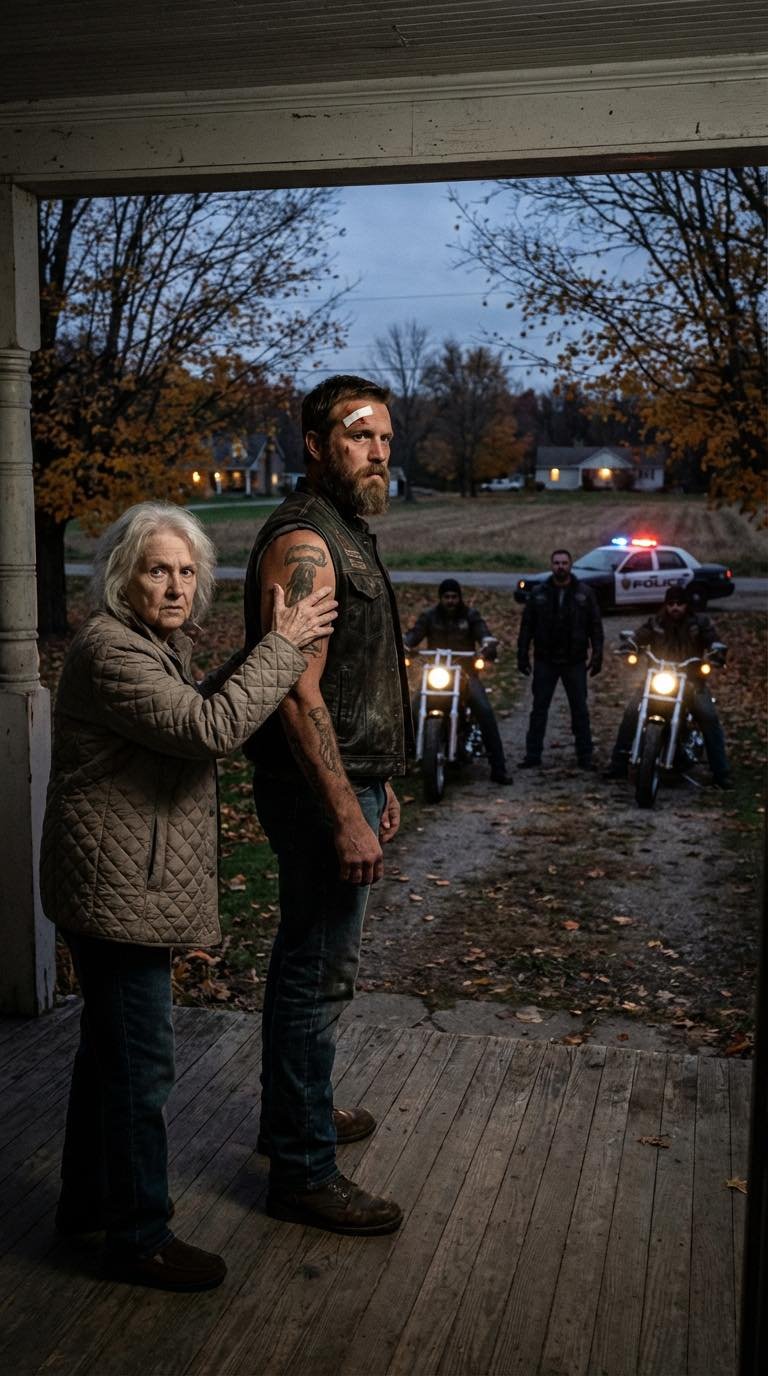
Headlights flooded the yard, three bikes cutting engines in unison.
The leader, a man with a scar splitting his eyebrow, stepped forward.
“Evening, Grandma,” he called mockingly. “We’re here for our property.”
Eleanor stepped onto the porch before Ronan could stop her.
“He’s not property,” she said, her voice steady despite the tremor in her hands.
The man laughed. “You don’t get it. He signed blood.”
“Then he can bleed his way out,” she shot back.
The confrontation thickened the air, neighbors’ porch lights flickering on one by one like silent witnesses.
The leader advanced a step.
“Move aside.”
Ronan moved to shield her, but she raised her chin.
“You chain men to trees,” she said, loud enough for the watching houses to hear. “You threaten widows on their own land. And you call that brotherhood?”
Murmurs rippled through the darkness.
Then came the twist no one expected.
Sheriff Dalton’s cruiser rolled into the yard, lights off but presence unmistakable.
He stepped out slowly.
“Evening, boys,” he drawled. “Funny thing about this property—it’s under surveillance.”
The leader’s smirk faltered.
“You see,” Dalton continued, “Ms. Whitmore’s late husband donated the back forty acres to the county as protected land. Cameras were installed last spring after some illegal dumping. Footage shows exactly who chained a man to a tree.”
Silence fell like a guillotine.
Ronan’s head snapped toward Eleanor.
“You knew?”
She didn’t look at him.
“I suspected,” she admitted softly. “And I called Dalton yesterday.”
The leader cursed under his breath.
“You set us up?”
“No,” she replied. “You set yourselves.”
Handcuffs clicked in the night air.
Engines remained silent.
And in that suspended moment, as the forest watched and the neighbors leaned forward from their porches, Eleanor felt not triumph but clarity.
She had not simply saved a man.
She had forced a reckoning.
Months later, the farmhouse was quieter again, though not empty.
Ronan worked at the veteran outreach center in town, helping men who hovered at the same edge he once had.
Claire visited more often, her suspicion softened into cautious respect.
And Eleanor returned to her forest walks, basket in hand, aware that courage is rarely loud and almost never convenient.
The lesson she carried, the one she shared with Ronan on evenings when doubt crept back in, was simple yet hard-earned: compassion without discernment is recklessness, but discernment without compassion is cowardice; the balance between them is where true strength lives.
And sometimes, when the woods fall silent, she smiles, remembering the day she chose not to walk away.
Lesson of the Story:
Kindness is not naïve when it is paired with wisdom. Real courage is not the absence of fear, but the decision to act despite it. And redemption, though fragile, becomes possible the moment someone chooses to believe that a person is more than their worst mistake.
Website Disclaimer
The information provided on this website is for general informational and educational purposes only. While we strive to ensure that all content is accurate and up to date, we make no guarantees regarding the completeness, reliability, or accuracy of any information published.
The views and opinions expressed in articles belong to their respective authors and do not necessarily reflect the views of this website. Any action you take based on the information found on this website is strictly at your own risk. We will not be liable for any losses, damages, or inconveniences arising from the use of our content.
Some articles may contain opinions, third-party information, or external links. We do not endorse or guarantee the accuracy of content on external websites and are not responsible for their practices or policies.
All content on this website is provided in good faith and is intended for informational purposes only. Readers are encouraged to verify information independently and seek professional advice where appropriate.