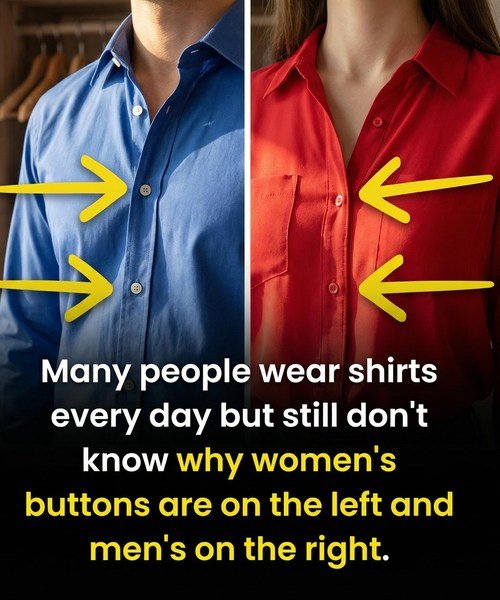
If you have ever noticed that buttons on women’s shirts are placed on the left while men’s buttons are usually on the right, you may have wondered why such a small difference exists. It is an easy detail to overlook, yet it has survived for centuries. This simple design choice is not random or modern; it reflects layers of history shaped by social customs, class distinctions, and practical needs. What began as a functional decision slowly became a tradition that still influences how clothing is made today.
The origins of this difference can be traced back to Europe in the eighteenth and nineteenth centuries, when fashion was closely tied to social class. Wealthy women often did not dress themselves. Instead, they relied on attendants or household staff to help them put on elaborate garments. Because most assistants were right-handed, clothing was designed to make their work easier. Buttons were placed on the left side of women’s garments so an assistant facing the wearer could fasten them comfortably with their dominant hand. Although this design was practical at the time, it was never meant for the convenience of the person wearing the clothes, but rather for the person helping them dress.
Over time, this button placement also became a subtle marker of status and identity. Being dressed by someone else was once a visible sign of wealth and social standing, and the design of women’s clothing reflected this reality. During the Victorian era, fashion reinforced cultural ideals that portrayed women as refined and elegant, while men’s clothing emphasized utility and independence. Button placement helped distinguish these roles. For men, buttons on the right side made sense for everyday function. Most men were right-handed, and many wore clothing influenced by military or work uniforms. The right-side placement allowed for easier movement and practicality, especially when coats or jackets needed to be opened quickly.
As centuries passed, the original reasons for these differences faded. Women began dressing themselves, and men no longer wore clothing designed around weapons or uniforms. Still, the button tradition remained. Fashion tends to preserve familiar patterns, even when their original purpose no longer applies. Today, the placement of buttons serves more as a symbol of tradition than a necessity. It reminds us that clothing is not just about style or comfort, but also about history. Small design details can quietly carry stories from the past, connecting modern wardrobes to social customs that shaped earlier generations. The next time you button a shirt, you may find yourself holding a piece of history woven into everyday fabric.
Website Disclaimer
The information provided on this website is for general informational and educational purposes only. While we strive to ensure that all content is accurate and up to date, we make no guarantees regarding the completeness, reliability, or accuracy of any information published.
The views and opinions expressed in articles belong to their respective authors and do not necessarily reflect the views of this website. Any action you take based on the information found on this website is strictly at your own risk. We will not be liable for any losses, damages, or inconveniences arising from the use of our content.
Some articles may contain opinions, third-party information, or external links. We do not endorse or guarantee the accuracy of content on external websites and are not responsible for their practices or policies.
All content on this website is provided in good faith and is intended for informational purposes only. Readers are encouraged to verify information independently and seek professional advice where appropriate.