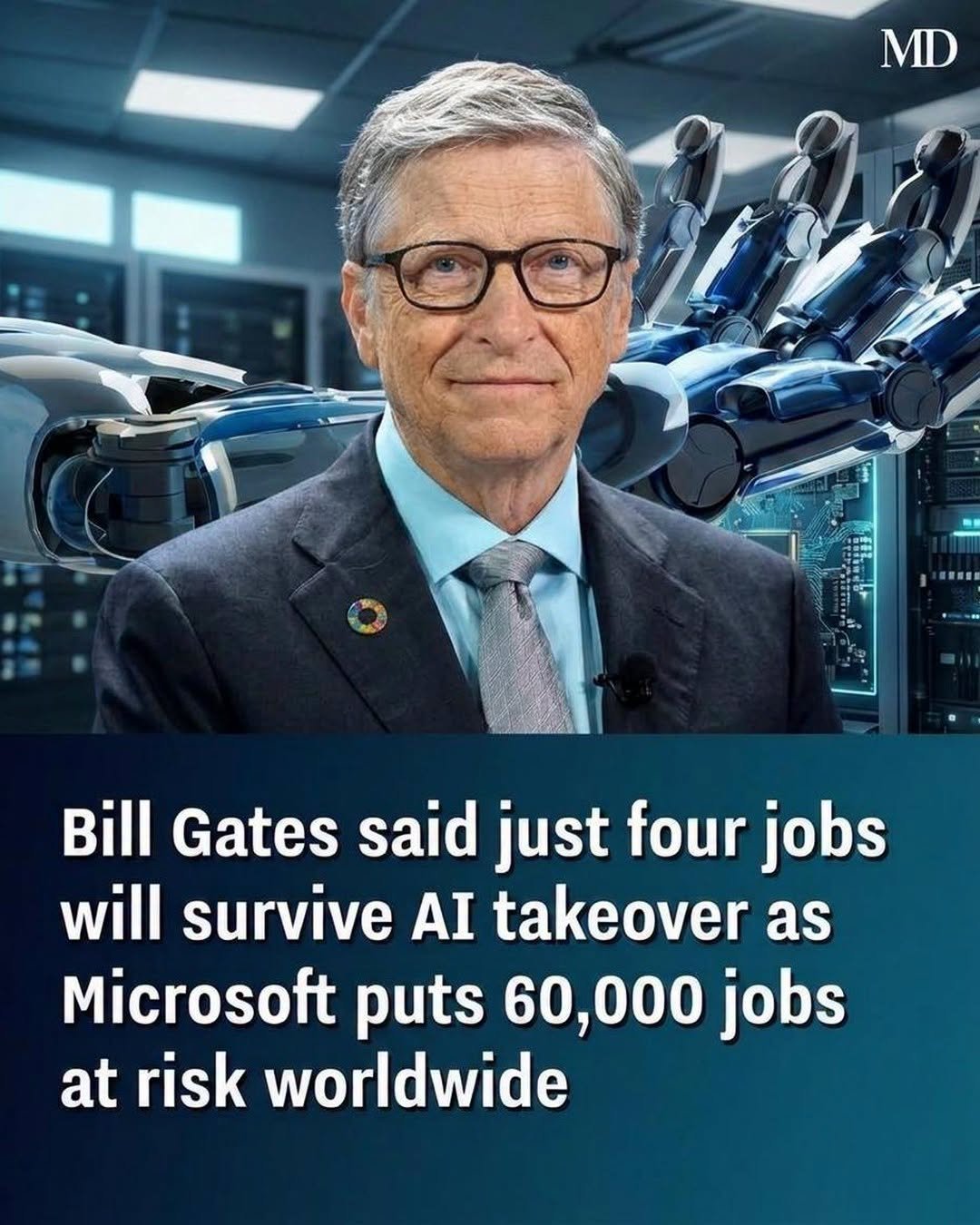
# Microsoft Offers Buyouts to 60,000 Employees as AI Raises Fears About the Future of Work
A major announcement from one of the world’s largest technology companies has renewed concerns about the future of employment.
Microsoft is offering voluntary exit packages to approximately 60,000 employees, giving eligible workers an opportunity to leave their jobs with financial assistance as the company reshapes its workforce and increases investment in artificial intelligence.
The announcement affects roughly 27% of Microsoft’s global workforce of approximately 223,000 employees.
The move comes as technology companies invest billions of dollars in AI systems, data centers, and automation. While these investments are creating new opportunities, they are also raising difficult questions about the future of traditional jobs.
For employees who have spent decades building careers in the technology industry, the announcement represents a significant moment.
### Who Is Eligible for the Buyout?
According to reports, Microsoft’s voluntary exit program is available to eligible employees at level 70 and below across participating teams in the United States, Canada, the United Kingdom, and India.
The program covers several areas of the business, including finance, human resources, gaming, Windows, and AI-related teams.
Some departments, including certain sales, marketing, and security operations, are excluded.
Employees who accept the offer will receive financial support based on factors such as their seniority and length of service. The program is designed to give workers an opportunity to transition away from the company rather than facing an immediate compulsory dismissal.
Microsoft’s chief people officer, Amy Coleman, described the initiative as another way for employees to make career transitions while allowing the company to adapt to changing business needs.
### Why Is Microsoft Making This Move?
Microsoft is investing heavily in artificial intelligence, particularly its Copilot products, cloud computing services, and data-center infrastructure.
The company has forecast approximately $175 billion in capital expenditures for 2026, much of it connected to AI development and infrastructure.
The financial pressure of these investments has encouraged Microsoft to reconsider how its workforce is structured and where its resources should be directed.
Importantly, the 60,000 figure represents employees eligible for the voluntary offer, not 60,000 confirmed job losses.
### Bill Gates Issues a Warning About the Future of Jobs
The concerns extend beyond Microsoft.
Company co-founder Bill Gates has also warned that artificial intelligence could rapidly transform the American job market.
In an essay published in August 2026, Gates discussed how AI could affect professions including law, medicine, customer service, software development, and manufacturing.
He warned that AI could eventually perform many professional tasks with little human supervision, potentially reducing the need for workers in certain occupations.
He also expressed concern about younger people entering the workforce, particularly as companies become capable of completing more work with fewer employees.
### What Does This Mean for American Workers?
The changing employment landscape has created difficult questions for people at different stages of their careers.
For older employees approaching retirement, a voluntary buyout may provide an opportunity to leave the workforce earlier than planned. However, accepting such an offer requires careful consideration of retirement savings, healthcare coverage, taxes, and future living expenses.
Younger employees face a different challenge: developing skills that remain valuable as technology evolves.
Experts increasingly recommend focusing on abilities that complement artificial intelligence, including:
– Critical thinking and problem-solving.
– Communication and leadership.
– Creativity and decision-making.
– Technical knowledge and AI literacy.
– Emotional intelligence and interpersonal skills.
These abilities can help workers adapt as businesses introduce new technologies.
### Will Artificial Intelligence Replace Human Workers Completely?
Not necessarily.
Although AI can automate repetitive tasks and improve productivity, many occupations still require human judgment, responsibility, creativity, and personal interaction.
Even technology leaders disagree about how quickly automation will eliminate existing jobs.
Nvidia CEO Jensen Huang, for example, has argued that AI will automate many individual tasks without necessarily eliminating entire professions. He believes the technology will also create new opportunities and change how people perform their work.
### A New Chapter for the American Workplace
Microsoft’s announcement represents another major development in the growing relationship between artificial intelligence and employment.
For some workers, the financial assistance may offer a welcome opportunity to begin a new chapter. For others, it may create uncertainty about careers they spent decades building.
The larger question is no longer simply whether artificial intelligence will change the workplace. That transformation is already underway.
The real challenge will be ensuring that workers have enough time, financial support, and access to education to adapt.
Technology may shape the future of work, but behind every job announcement are real people, families, retirement plans, and years of dedication. As artificial intelligence continues advancing, protecting workers and preparing them for change will be just as important as developing the technology itself.
Website Disclaimer
The information provided on this website is for general informational and educational purposes only. While we strive to ensure that all content is accurate and up to date, we make no guarantees regarding the completeness, reliability, or accuracy of any information published.
The views and opinions expressed in articles belong to their respective authors and do not necessarily reflect the views of this website. Any action you take based on the information found on this website is strictly at your own risk. We will not be liable for any losses, damages, or inconveniences arising from the use of our content.
Some articles may contain opinions, third-party information, or external links. We do not endorse or guarantee the accuracy of content on external websites and are not responsible for their practices or policies.
All content on this website is provided in good faith and is intended for informational purposes only. Readers are encouraged to verify information independently and seek professional advice where appropriate.