I stopped my car in the middle of our driveway, unable to believe what my headlights revealed. The enormous barn that had stood on our Minnesota farm for a century looked completely different. For 37 years of marriage, I had known every weathered board of that building, and now its familiar red exterior had disappeared beneath fresh gray paint.
My name is Carol Jensen, I’m 58, and my husband, Arlo, and I have spent decades working our 320-acre farm near Tracy, Minnesota. I had just returned from spending eleven exhausting days beside Arlo’s hospital bed after he suffered a serious heart attack. The doctors had warned us that his recovery would take time, and although he was finally stable enough to come home soon, I knew he would have to make major changes to the way he worked.
What I never expected was that our son, Daniel, would make a major change of his own while his father was away.
The barn had always been Arlo’s pride and joy. His grandfather had built it in the 1920s, and generations of our family had stored hay, repaired machinery, and sheltered livestock beneath its massive wooden beams. Arlo often said that the barn was more than a building. It was a piece of our family’s history, something we had a responsibility to preserve.
Over the years, the red paint had faded, the doors had begun to sag, and the roof needed repairs. We had talked about restoring it many times, but there was always another bill to pay or another field that needed attention. Arlo refused to consider anything that might change its original appearance.
“Someday, we’ll fix it properly,” he would tell me. “But we’re not going to turn it into something it isn’t.”
Now, standing in the driveway, I could hardly recognize the place.
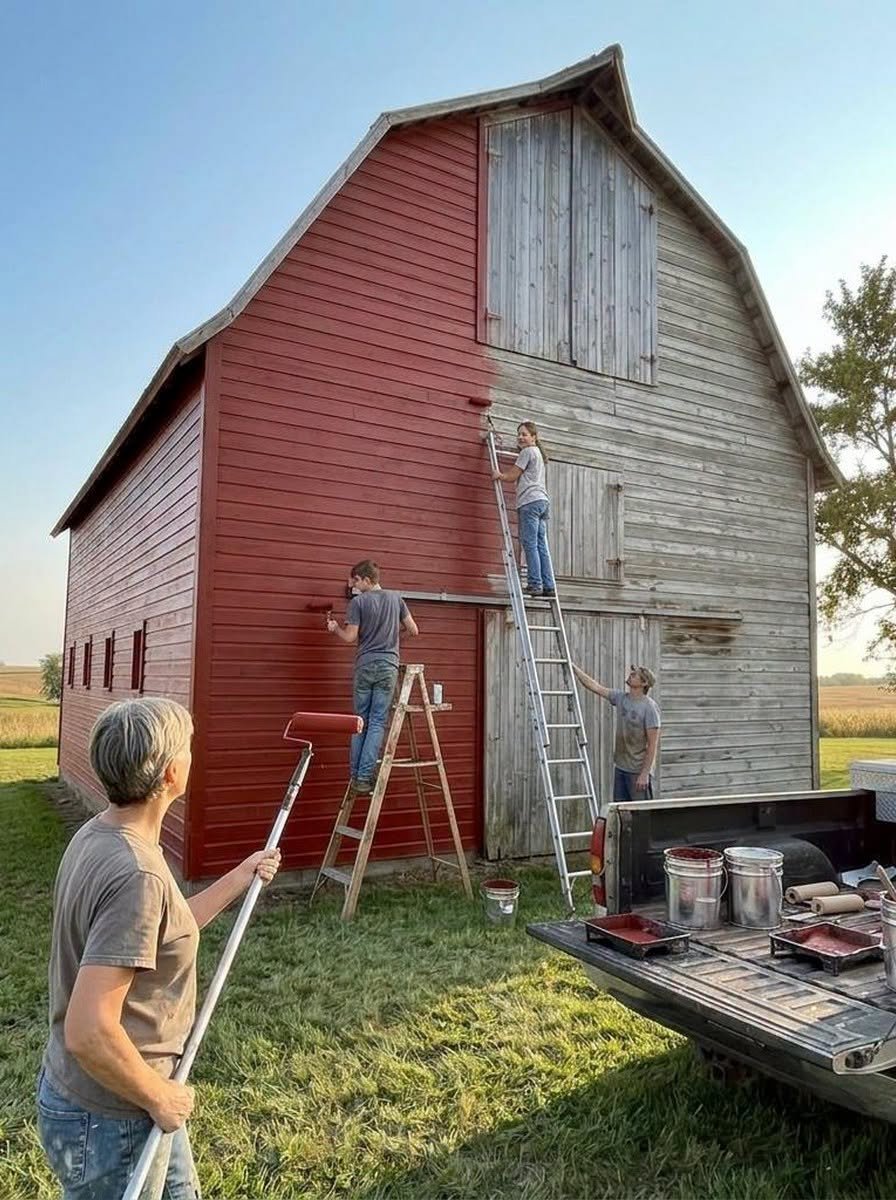
The barn’s exterior was a soft shade of gray, with crisp white trim around the windows and doors. New wooden panels covered the sections that had begun to rot. The old sliding doors had been repaired, and warm lights glowed beneath the roofline. Even the small windows near the loft had been cleaned and restored.
It looked beautiful.
But my first reaction wasn’t happiness. It was fear.
Arlo had been gone for eleven days, and Daniel knew how strongly his father felt about that barn. I imagined the arguments that might follow when Arlo discovered what had happened. After nearly four decades of marriage, I knew that sometimes the smallest unexpected change could hurt more than anyone intended.
I parked the car and stepped out into the cold Minnesota evening.
Daniel emerged from the barn wearing an old sweatshirt, his hands covered in paint. At 34, he was a grown man with a family of his own, but when he saw my expression, he looked suddenly like the little boy who used to follow his father around the farm.
“Mom,” he said quietly. “You’re home.”
I pointed toward the barn.
“Daniel, what have you done?”
He glanced over his shoulder at the building, then back at me.
“I know Dad is going to be upset,” he admitted. “But please, Mom. Just give me a chance to explain.”
I folded my arms, waiting.
Daniel told me that he had been visiting the farm every day while I was at the hospital. At first, he had come to feed the animals, check the equipment, and make sure I wouldn’t have to worry about anything while I stayed with his father.
But one afternoon, he had climbed into the barn loft to look for a spare part. There, he discovered how much damage the years had caused. Several beams needed attention, rain had seeped through parts of the roof, and some of the old boards had become dangerously weak.
He had taken photographs and shown them to a local carpenter.
The estimate had frightened him.
“Dad would never spend that kind of money on himself,” Daniel explained. “You know that. He’d rather keep working until something finally breaks.”
I did know that. Arlo had spent his entire life putting the farm, his family, and everyone else’s needs ahead of his own.
Daniel continued.
“When Dad had his heart attack, I realized something. We keep talking about how we’re going to repair things someday. But what if someday never comes?”
His words settled over me more heavily than the evening air.
He explained that he had contacted a small crew of local contractors and organized the repairs while Arlo was recovering. He had paid for the paint and materials with money he had been saving for a new truck. A few neighbors had volunteered their time, and Daniel had spent his evenings helping them.
The gray paint was his idea.
“Dad always says the barn should be strong enough to protect the next generation,” he said. “I wanted it to look strong again, too.”
I looked at the barn more carefully. Beneath the fresh paint, I could still see its familiar shape, its original roofline, and the old stone foundation that had supported it for a hundred years.
Daniel hadn’t torn it down.
He had saved it.
Still, one question remained.
“Why didn’t you ask your father first?”
Daniel lowered his eyes.
“Because I knew he’d tell me not to spend the money. And because I was afraid he would try to do the work himself as soon as he got home. Mom, the doctors said he needs to rest. I didn’t want him climbing ladders or lifting heavy boards just to prove he could still do everything alone.”
I felt the anger drain from my chest, replaced by something far more complicated.
For eleven days, I had watched my husband lie in a hospital bed, surrounded by machines and monitors. I had listened to doctors explain how fragile his recovery might be. And I had wondered how we would return to our ordinary lives when the man who had always seemed indestructible could no longer work from sunrise to sunset.
Daniel had been worrying about the same thing.
He simply had found a way to do something about it.
That night, I walked through the barn alone. The scent of fresh paint mixed with the familiar smell of old timber and hay. Someone had repaired the wooden staircase to the loft, replaced broken windowpanes, and reinforced the sections of the floor that had begun to weaken.
On one wall, Daniel had carefully preserved an old wooden sign bearing his grandfather’s name.
I ran my fingers over the lettering and remembered Arlo telling me how his grandfather had built the barn with help from neighbors who arrived carrying tools, food, and whatever supplies they could spare.
Back then, people understood that a farm was rarely sustained by one person’s strength alone.
Somewhere along the way, Arlo had forgotten that lesson. He had become so determined to protect the farm that he rarely allowed anyone else to help him.
And now our son was quietly reminding him what family was supposed to mean.
Two days later, Arlo came home.
I was nervous the entire drive from the hospital. He was tired, pale, and moving carefully, but his spirits had improved. He talked about the animals, asked whether the machinery had been checked, and wondered if the weather would hold long enough for us to finish the remaining fieldwork.
Then we turned into the driveway.
He saw the barn.
His words stopped in the middle of a sentence.
For several seconds, he simply stared through the windshield.
“What happened to my barn?” he finally asked.
I glanced at him. “Daniel has something he wants to tell you.”
Arlo opened the truck door slowly and stepped onto the gravel. He studied the gray walls, the repaired doors, and the clean white trim. His expression was impossible to read.
Daniel came out of the house.
“Dad,” he began, “before you say anything, I know I should have talked to you. I just wanted to make sure the barn would still be standing when you were ready to come back to work.”
Arlo didn’t answer.
Daniel explained the repairs, the contractors, and the money he had spent. He told his father about the damaged beams and the leaking roof. He admitted that he had been afraid of making the wrong decision, but he had been even more afraid of waiting until it was too late.
When he finished, the entire farm seemed silent.
Then Arlo walked toward the barn.
He placed one hand against the freshly painted wall and slowly moved it across the smooth boards. He looked up at the roof, then toward the loft windows.
Finally, he turned to Daniel.
“You spent your truck money on this?”
Daniel nodded.
Arlo shook his head, and for one terrible moment, I thought he was angry.
Instead, his eyes filled with tears.
“When I was your age,” he said, his voice breaking, “I thought taking care of this farm meant doing everything myself. I thought if I ever needed help, it meant I hadn’t worked hard enough.”
He paused, looking at the barn.
“Your grandfather would have told me I was wrong.”
Daniel stepped closer.
Arlo reached out and pulled his son into a long embrace. Daniel wrapped his arms around his father, and both men stood there crying in the cold afternoon light.
I turned away for a moment, unable to hold back my own tears.
After everything we had endured over those eleven days, the sight of my husband standing beside our son, safe and home, felt like a gift I could never have imagined.
But Arlo wasn’t finished.
He stepped back and studied the gray paint again.
“I always wanted to keep this barn looking the way my grandfather left it,” he said. “I thought changing it meant losing a piece of him.”
He looked at Daniel.
“Now I think he’d be proud that you cared enough to save it.”
That evening, we sat together at the kitchen table, eating the supper I had prepared before bringing Arlo home. For the first time in weeks, the conversation wasn’t about hospital appointments, medical instructions, or everything we were afraid might happen next.
We talked about the barn.
Daniel told us how the neighbors had helped. Arlo asked questions about the repairs and listened carefully to the answers. Before long, he was planning small projects he could supervise without putting his recovery at risk.
For once, he was willing to let someone else do the heavy lifting.
In the months that followed, the barn became a different kind of gathering place. Daniel brought his children over on weekends, and Arlo taught them how their great-grandfather had built the original structure. They learned to identify the old wooden beams, recognize the marks left by generations of farm tools, and understand why their family had worked so hard to preserve the building.
The gray paint gradually became part of the landscape.
At first, I thought Daniel had changed our barn.
Eventually, I understood that he had helped us see what had always been there: a family history worth preserving, a future worth preparing for, and a love that sometimes expresses itself through actions rather than words.
Our marriage had lasted 37 years, through good harvests and bad seasons, financial worries, family arguments, and more ordinary days than I could count. I had always believed that commitment meant standing beside someone and helping them carry their burdens.
But that autumn taught me something else.
Sometimes love means recognizing when the people you care about are carrying too much. Sometimes it means stepping forward before you’re asked. And sometimes it means accepting that the people who love you deserve the chance to protect you, too.
Arlo still calls it his barn, and Daniel still teases him about the gray paint.
But every time I pull into our driveway and see that old building standing beneath the Minnesota sky, I remember the night my headlights revealed something I wasn’t prepared to understand.
I thought I was looking at a barn that had been changed without permission.
What I was really looking at was a son trying to save his father’s legacy, a husband learning that he didn’t have to face everything alone, and a family discovering that the strongest things we build are not always made of wood.
Sometimes, they are made of love, sacrifice, and the courage to let the next generation carry the story forward.
And after 37 years of marriage, I learned that even a century-old barn can teach you something new about love.
Because the greatest legacy we leave our children isn’t a building, a farm, or even the land beneath our feet. It’s the example we set when life reminds us that we need one another.
Website Disclaimer
The information provided on this website is for general informational and educational purposes only. While we strive to ensure that all content is accurate and up to date, we make no guarantees regarding the completeness, reliability, or accuracy of any information published.
The views and opinions expressed in articles belong to their respective authors and do not necessarily reflect the views of this website. Any action you take based on the information found on this website is strictly at your own risk. We will not be liable for any losses, damages, or inconveniences arising from the use of our content.
Some articles may contain opinions, third-party information, or external links. We do not endorse or guarantee the accuracy of content on external websites and are not responsible for their practices or policies.
All content on this website is provided in good faith and is intended for informational purposes only. Readers are encouraged to verify information independently and seek professional advice where appropriate.