The paper sat between us on the kitchen table, with one number circled twice: $800. My daughter, Michelle, and her husband, Todd, wanted me to pay that amount each month to live in their basement, along with watching their two children four days a week. At 67, I was a widow living on $1,640 a month in Social Security, so the arrangement would have consumed nearly half my income. I had recently lost the right to remain in the farmhouse where my husband, Dale, and I had lived for 31 years because the property belonged to his former employer, who had allowed us to live there during Dale’s employment. After his death, the arrangement ended, and I found myself facing a future I had never imagined.
Michelle called their proposal a practical solution. She said I would have a roof over my head, the children would have their grandmother nearby, and everyone would benefit. Todd explained that $800 was a fair contribution toward household expenses. Then he slid another sheet of paper across the table. It listed my expected childcare hours, beginning at 7 a.m. and ending when they returned from work.
Four days a week.
No additional payment.
I stared at the paper, trying to understand how a family arrangement had become a contract in which I was expected to pay for the privilege of providing free childcare. I loved my grandchildren more than anything, but love had never meant that my time, independence, and financial security were worth nothing.
“Mom, you’re making this sound worse than it is,” Michelle said when I asked whether I would have any say in the arrangement.
She explained that the basement would be my private space, although I would share the laundry room and kitchen. There was a small bathroom, a narrow window, and enough room for a bed, a dresser, and the few belongings I had managed to keep after leaving the farmhouse.
“You won’t have to worry about finding an apartment,” she continued. “At your age, that would be difficult.”
Her words hurt more than I wanted to admit. I had spent decades raising my daughter, supporting my husband, cooking meals, managing a home, and helping neighbors whenever they needed me. I had never thought of myself as helpless. Yet my own child was speaking as though I should be grateful for whatever arrangement she offered.
I looked again at the circled $800.
After paying that amount, I would have $840 left each month for food, transportation, clothing, medication, telephone service, and every unexpected expense that comes with growing older. If I needed to visit a doctor or replace a broken appliance, there would be little room to manage it.
And I would be working four days a week without receiving a dollar.
“Have you considered what happens if I become sick?” I asked. “Or if I need to visit a friend? What if I want to go somewhere for a few days?”
Todd leaned back in his chair.
“We both work, Mom. We need someone reliable. Daycare costs a fortune, and we thought this would be good for everybody.”
That was when I finally understood the arrangement from their perspective. They were not simply offering me a place to live. They were trying to solve two expensive problems—housing and childcare—by combining them into one arrangement that placed most of the financial burden on me.
Perhaps they genuinely believed it was fair. Perhaps they had become so accustomed to my willingness to help that they no longer recognized the difference between asking for help and expecting it.
Either way, I knew I could not agree.
“I need some time to think about it,” I said.
Michelle sighed as though I had disappointed her.
“Fine, Mom. But we need an answer soon. We can’t keep rearranging our lives around uncertainty.”
I took the paper home with me.
That evening, I sat on the edge of my temporary bed in my friend Linda’s spare room and cried. I wasn’t crying because I had lost the farmhouse. I was crying because I had begun to fear that losing my home meant losing my place in my own family.
Dale had always told me that a person should never confuse being needed with being valued. When he was alive, I thought I understood what he meant. That night, for the first time, I understood it completely.
The next morning, I called the local senior services office and asked about affordable housing options. I had assumed that finding a small place of my own would be impossible on Social Security, but a counselor explained that there were income-based apartments and housing assistance programs worth investigating. The waiting lists could be long, she warned, but applying was a start.
I gathered my Social Security statements, bank records, and identification. Then I began calling landlords who advertised modest studios and small cottages.
Most were too expensive. A few never returned my calls.
Then, three days later, I found a little house on the edge of town.
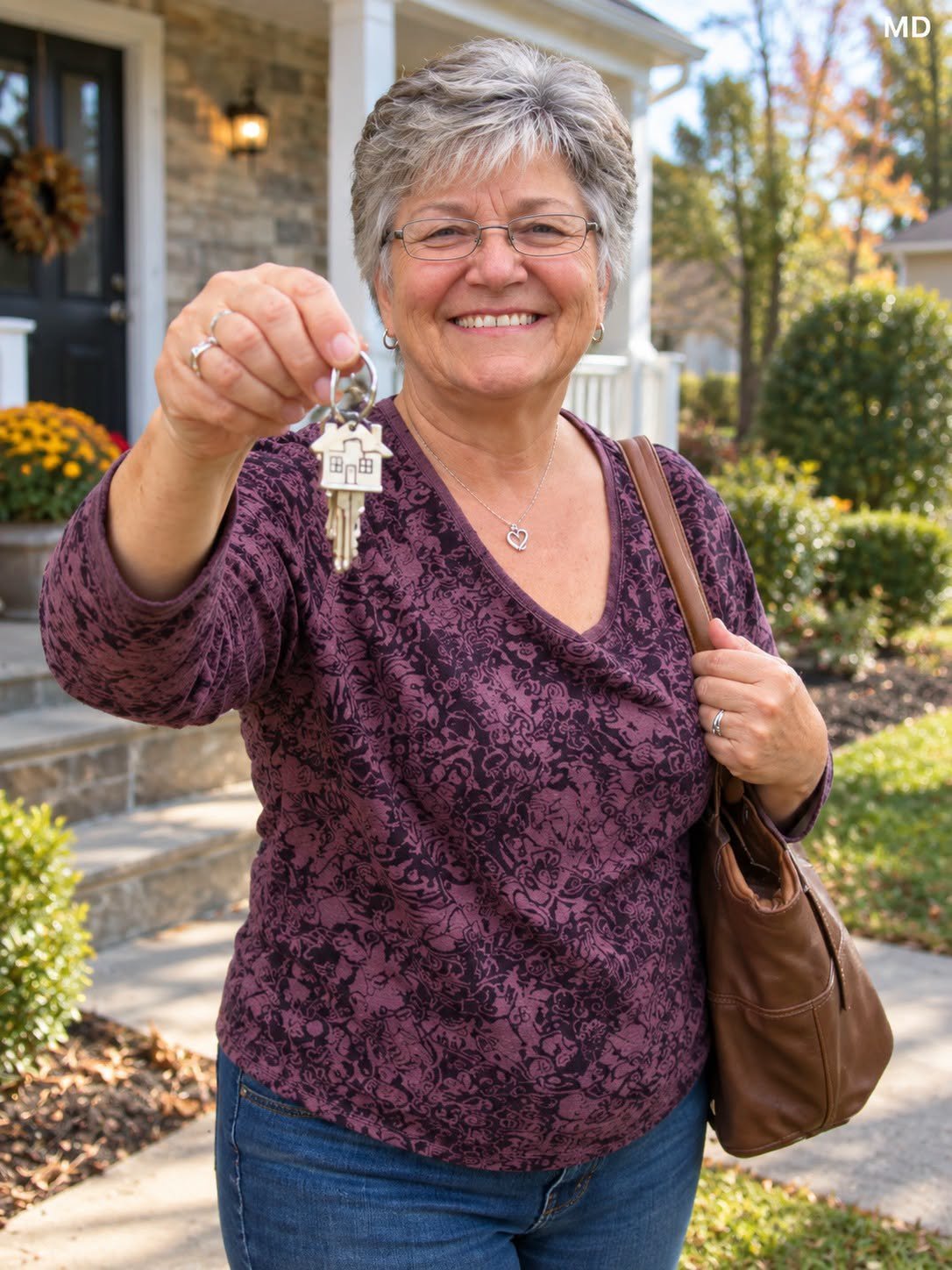
It wasn’t much to look at. The paint on the front porch was peeling, the kitchen cabinets were old, and the bedroom was barely large enough for a double bed. But the house had two things I desperately wanted: a front door I could lock with my own key and a small patch of garden where I could plant flowers.
The rent was $650 a month, including water. Electricity and heating would cost extra, and I would have to budget carefully. The landlord, an older man named Mr. Harris, was willing to consider my application after reviewing my income and references.
I visited the house twice before making a decision.
On the second visit, I stood in the empty kitchen and imagined Dale sitting at the table, reading the newspaper while I prepared breakfast. I could almost hear his familiar laugh.
For the first time in weeks, the future didn’t feel like a dark hallway with no exit.
I submitted my application and contacted the local housing office to ask whether I qualified for any assistance. I knew I would need to be careful with money, but I also knew that living alone would allow me to make decisions without having to negotiate the value of my time.
When I told Michelle that I wouldn’t be moving into her basement, the silence on the telephone lasted several seconds.
“What do you mean?” she finally asked.
“I found a little house. I’m going to rent it.”
“But we already discussed everything,” she said. “Todd has been counting on you helping with the children.”
“I love those children,” I replied. “I’ll still be their grandmother. I’ll help when I can, but I can’t promise four days every week, and I can’t pay $800 a month for the arrangement you proposed.”
Michelle’s voice grew sharper.
“So you’d rather live alone than be with your own family?”
I closed my eyes.
“No, sweetheart. I’d rather live somewhere I can afford without having to give up my independence.”
She accused me of being stubborn. She said I was making a mistake and that I would eventually regret turning down their offer.
I let her finish.
Then I said something I had never imagined saying to my own daughter.
“I raised you to build a life of your own, Michelle. Please allow me to do the same.”
We ended the call without resolving anything.
For several days, Michelle barely contacted me. When she did, the conversations were brief and strained. I missed my grandchildren terribly, and I wondered whether my decision would permanently change our relationship.
But I also knew that agreeing to an arrangement I couldn’t afford would not guarantee closeness. It would only guarantee resentment.
Two weeks later, I moved into the little house.
Linda helped me carry my boxes, and a neighbor lent me a small table and two chairs. I brought Dale’s old coffee mug, our wedding photograph, a quilt my mother had sewn, and the gardening tools he had left behind.
That first night, I made soup in my own kitchen and ate at my own table.
There was no television playing in another room, no schedule taped to the refrigerator, and no one waiting for me to prepare breakfast or supervise homework. The silence felt unfamiliar, but it was peaceful.
I began learning how to stretch my money. I cooked simple meals, tracked every bill, and looked into local programs that might reduce my utility costs. I planted marigolds beside the porch and bought a secondhand armchair from a charity shop.
Little by little, the house began to feel like home.
About a month after I moved in, Michelle called.
This time, she wasn’t angry. She sounded tired.
“Mom, could the children come over on Saturday?” she asked. “They keep asking when they’re going to see you.”
“Of course,” I said. “I’d love that.”
The children arrived with drawings, stories, and enough energy to fill every corner of the little house. We baked cookies, played cards, and spent the afternoon in the garden. When Michelle came to collect them, she stood at the doorway looking around.
“It’s small,” she said.
“It is,” I answered with a smile. “But it suits me.”
She looked at the flowers beside the porch and then at the framed photograph of her father on the shelf.
For a moment, I thought she might apologize. Instead, she asked whether I was managing financially.
“It’s tight,” I admitted. “But I’m making it work, and I’m looking into assistance to make sure I can keep up with the expenses.”
She nodded, and for the first time in weeks, we spoke without arguing.
Our relationship didn’t transform overnight. We still had difficult conversations, and Michelle still occasionally asked for more help with the children than I could provide. But I began setting clear boundaries. I would babysit when I was available, not whenever I was expected to. I would help my family when I could, without sacrificing the money I needed to live.
Gradually, Michelle began to understand that my decision wasn’t a rejection of her or her children. It was a recognition that I still had a life of my own.
At 67, I had lost my husband and the home we had shared for three decades. I couldn’t change either of those things. But I could decide what happened next.
I learned that starting over later in life can be frightening, especially when the people you love believe they know what’s best for you. I also learned that independence doesn’t mean refusing help or turning your back on family. Sometimes, it means finding a solution that allows love to exist without obligation, guilt, or financial hardship.
I still love my daughter. I still adore my grandchildren. And I still hope that, one day, Michelle and I will look back on that kitchen-table conversation and understand each other’s perspective a little better.
But I no longer measure my worth by how much I can do for other people.
My little house isn’t perfect. The roof creaks when the wind blows, the kitchen floor needs replacing, and the garden requires more work than my knees sometimes appreciate.
Yet every morning, I open my front door, step onto my porch, and look at the flowers growing in the sunlight.
And I remind myself that I am not a burden simply because I am getting older. I am not selfish because I need financial security. And I do not have to purchase my place in my family’s life with money and unpaid labor.
I can love my family deeply without giving up the right to live my own life.
At 67, I thought my story was ending when I lost the farmhouse. Instead, I discovered that a new chapter could begin with a small house, a modest income, and the courage to say no.
Sometimes, the most important home we build isn’t the one we share with other people. It’s the one where we finally learn to respect ourselves.
Website Disclaimer
The information provided on this website is for general informational and educational purposes only. While we strive to ensure that all content is accurate and up to date, we make no guarantees regarding the completeness, reliability, or accuracy of any information published.
The views and opinions expressed in articles belong to their respective authors and do not necessarily reflect the views of this website. Any action you take based on the information found on this website is strictly at your own risk. We will not be liable for any losses, damages, or inconveniences arising from the use of our content.
Some articles may contain opinions, third-party information, or external links. We do not endorse or guarantee the accuracy of content on external websites and are not responsible for their practices or policies.
All content on this website is provided in good faith and is intended for informational purposes only. Readers are encouraged to verify information independently and seek professional advice where appropriate.