Part 2: The Hand Signals
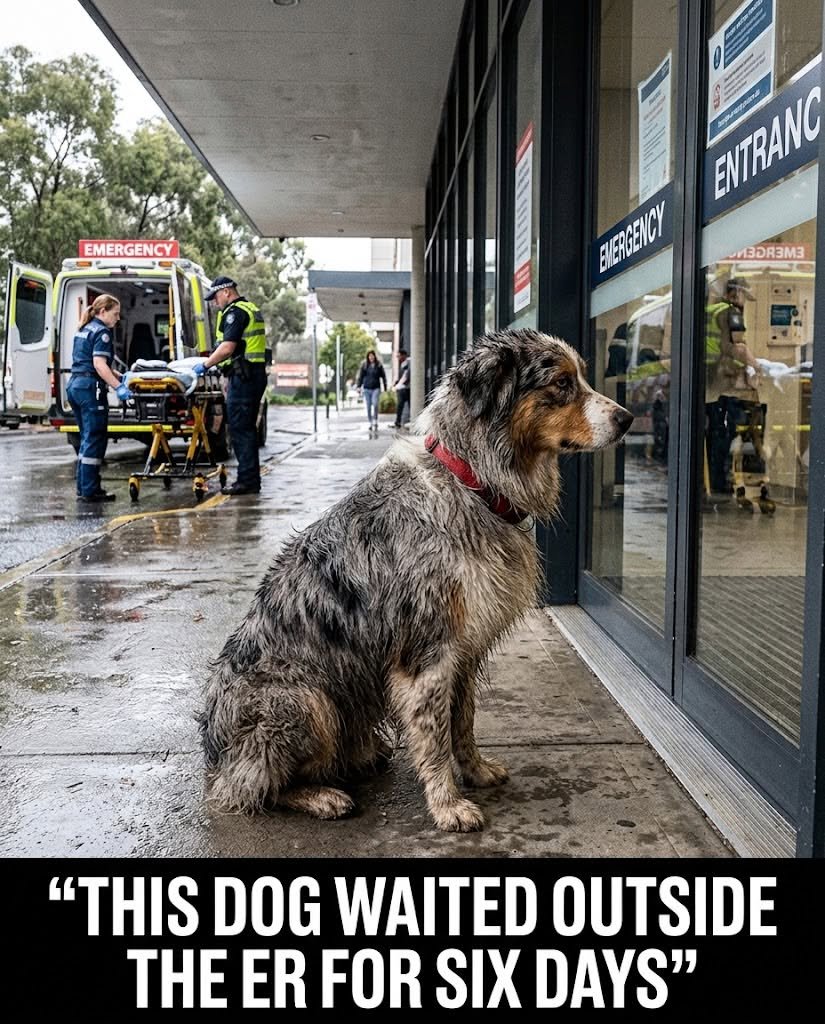
“Outside St. Mary’s,” Marisol explained. “Right by the emergency room entrance. He’d been sitting there for six days.”
Dr. Keller shut his eyes.
For several seconds, he remained silent. Lucy leaned against her mother, while Tony looked at Marisol with raised eyebrows.
Finally, the veterinarian got to his feet. He placed the scanner facedown on the counter, keeping its screen hidden from everyone.
“He has a microchip,” he said, his voice suddenly calm and carefully controlled. “The registration is outdated. The contact details are no longer valid. I’ll have to make a few calls.”
“So he belongs to someone?” Lucy asked quietly.
Dr. Keller didn’t respond. His attention remained fixed on the dog.
Then he did something unexpected.
He lifted his right hand, held his palm flat, and tapped two fingers against his chest.
The dog immediately rose, approached him, and placed his right paw on the veterinarian’s knee. Then he firmly nudged the man’s hand with his nose twice.
Dr. Keller curled his hand into a small fist and pointed toward the door.
The dog immediately spun around, raced to the examination room door, and barked three times. Each bark was loud and sharp. Then he hurried back and stood stiffly beside the veterinarian’s leg, every muscle tensed, supporting himself like a sturdy post.
Nobody in the room spoke.
“What did he just do?” Tony asked slowly.
The veterinarian’s voice sounded hoarse. “Alert. Get help. Brace.” He swallowed hard. “He’s a seizure-response dog. A very highly trained one. He can detect an approaching seizure, seek assistance when one occurs, and help support his handler when they try to stand afterward.”
Marisol stared at the filthy, tangled dog standing firmly against the veterinarian’s leg.
The hospital entrance where he waited. The way he positioned himself across Lucy’s doorway every night. The way he watched every stretcher that emerged from every ambulance.
“He was never a stray,” she whispered.
“No,” Dr. Keller replied. “He never was.”
He suddenly turned away and walked toward the window, showing them his back.
“Take him home, Mrs. Reyes. Give him something to eat. I’ll contact you.”
He offered no farewell. Instead, he left the examination room and closed his office door behind him.
That evening, the rain returned.
At seven o’clock, Lucy opened the front door to collect the mail. Muddy darted between her legs like a bullet and disappeared down the street before anyone could catch his collar.
“Muddy!” Lucy screamed.
Marisol snatched up her keys and rushed to the car.
She already knew where he was headed.
Three miles away. Through the rain. Across two busy roads. When Marisol finally pulled into the ambulance bay at St. Mary’s, the dog was already sitting in his familiar place beside the sliding glass doors. He was drenched from head to paw, staring through the glass.
She lowered herself onto the wet curb beside him. She made no attempt to drag him away.
Lenny, the security guard, came outside beneath an umbrella and stopped beside them.
“He came back, didn’t he?” Lenny said softly.
“He came back,” Marisol answered.
Lenny fell silent for a moment.
“There’s something I’ve been wanting to tell you,” he continued. “I wasn’t certain before, so I kept it to myself. But I think I understand why he’s here.”
Marisol lifted her eyes toward him.
“Six days before you brought him home,” Lenny explained, “an ambulance arrived from the river area. There was a young man, homeless, having terrible seizures on the stretcher. And right behind the ambulance, all the way up the ramp, ran a dog.” He nodded toward the soaked animal. “This dog. He tried to follow the stretcher inside, but we had to stop him at the doors.”
Marisol covered her mouth with her hand.
The dog had been waiting for someone. Someone who had disappeared through those doors and never returned.
Her phone vibrated inside her pocket. The number was unfamiliar.
“Mrs. Reyes?” Dr. Keller’s voice came through the phone. It sounded completely different from that morning. It was trembling. “I wasn’t honest with you today.”
Marisol held her breath.
“That microchip doesn’t belong to some stranger,” he said. “It’s registered in my name.”
Part 3: Atlas
Brookside Animal Hospital’s office smelled of stale coffee and aging paper. Dr. Keller hadn’t switched on the overhead lights. Only a desk lamp illuminated the room.
Marisol sat opposite him, with the rain-soaked dog resting at her feet. It was nine o’clock that night, and the clinic was deserted.
The veterinarian turned his computer screen toward her.
Microchip ID: 985112007344619. Registered name: ATLAS. Registered owner: Dr. Thomas Keller. Brookside Animal Hospital, Tulsa, OK.
“His name is Atlas,” Dr. Keller explained quietly. “I implanted that microchip myself eight years ago, right there on that examination table.”
Atlas raised his head when he heard his name. His tail struck the floor once.
“He was a birthday gift,” the veterinarian continued. “For my son.”
Marisol waited for him to continue.
“Nathan. We called him Nate.” Dr. Keller removed his glasses and rubbed his tired eyes. “He was nineteen. He’d been living with epilepsy since he was twelve. The seizures were severe. He would fall, injure his head, and regain consciousness confused on the bathroom floor. His mother…” He paused. “My wife, Ellen, was always the one who stayed awake with him. Then, that spring, Ellen died of breast cancer. It happened quickly.”
He remained silent briefly.
“I didn’t know how to cope with losing her. I buried myself in the clinic, working sixteen hours a day. Meanwhile, Nate was left alone at home, dealing with his seizures. For his nineteenth birthday, I bought him an Australian Shepherd puppy from a breeder in Claremore. I thought he needed companionship. That was the extent of my thinking.”
His eyes dropped to the dog.
“Nate trained Atlas himself. Every skill you witnessed today. Alert. Get help. Brace. He spent hours practicing every day for a year and a half. He watched countless videos and read every book he could find. By the time Atlas turned two, he could detect an approaching seizure fifteen minutes before it happened.” His voice faltered. “Nate had an extraordinary gift with dogs. He really did.”
“What happened between you two?” Marisol asked gently.
Dr. Keller let out a bitter laugh.
“I wanted him to become a veterinarian, just like me. I expected him to take over the practice one day. That had been my plan for him since he was a little boy. But Nate refused. He wanted to train service dogs instead. Dogs for people with seizures, dogs for those with PTSD, and dogs for children with diabetes. He told me that was what he was meant to do.”
He fixed his gaze on the desk lamp.
“I dismissed it as a hobby rather than a real career. I told him I wouldn’t pay for him to spend his life playing with dogs when his mother’s treatment had consumed every penny we had. I said plenty of other terrible things, too.” He swallowed. “He told me I had never asked what he wanted. Not even once. Not since his mother died.”
“Was he telling the truth?”
Dr. Keller said nothing. His silence answered her question.
“He was twenty when he packed a duffel bag, loaded Atlas into his old Corolla, and stood in our driveway. I told him, ‘If you walk out that door, don’t bother coming back.’”
The only sound in the office was the rain tapping against the window.
“That was seven years ago,” Dr. Keller whispered. “Seven years this coming June. I haven’t heard his voice since. I heard he lost his job at a kennel in Broken Arrow. Someone told me he was living in his car. After that, I heard nothing.”
Marisol’s hands began to shake.
“And now his dog is sitting outside the St. Mary’s emergency room,” Dr. Keller said, his voice breaking. “Waiting for him. That means Nate went inside. And he never came back out.”
He picked up the telephone on his desk and called the hospital’s patient information department. He provided his son’s full name, Nathan James Keller, along with his birthdate.
He listened carefully. Then the color drained from his face.
“There’s no patient by that name,” he said after ending the call. “No Nathan Keller has been admitted during the past month.”
“Maybe he arrived without identification,” Marisol suggested slowly. “Lenny said the ambulance came from the river camp.”
Dr. Keller nodded, looking stunned.
Suddenly, Marisol caught her breath.
The river camp. The bridge on 11th Street.
“Dr. Keller,” she asked cautiously, “do you have a photograph of your son?”
He opened his wallet and pulled out an old, worn photograph. It showed a young man wearing a high school graduation gown, smiling broadly with a woman’s arm wrapped around his shoulders.
But Marisol barely needed to look at the picture. Her face had already gone pale.
“Does your son,” she whispered, “have a scar running through his left eyebrow?”
Dr. Keller stared at her in disbelief.
“He fell during a seizure when he was fourteen and split his eyebrow open on the coffee table.” He slowly leaned forward. “How could you possibly know that?”
Part 4: Thursday Nate
Tony arrived at the clinic barely ten minutes later.
He glanced at the graduation photograph and immediately sank onto the edge of the desk.
“That’s Thursday Nate,” he said. “That’s him. He looks younger in the picture, and he doesn’t have a beard, but that’s definitely him.”
Dr. Keller looked back and forth between Tony and Marisol.
“Who are you talking about?”
Tony began explaining.
For two years, every Thursday evening, Tony had parked his small taco truck beneath the 11th Street bridge and handed out free meals to anyone who needed food. A local church helped cover the expenses, and Lucy often accompanied him, passing out napkins.
Every Thursday, toward the end of the line, a thin young man would appear. He had a reddish beard, wore a gray knitted beanie, and carried a scar through his left eyebrow.
“He was always respectful,” Tony recalled. “He said please and thank you and always called me sir. Every week, he asked me the same question: ‘Could I have another plate? My partner is waiting for me back at camp.’”
Dr. Keller let out a faint, broken sound.
“I assumed he meant a girlfriend or maybe a sick friend. He never brought anyone with him, but I always gave him the extra meal.” Tony glanced down at the dog lying on the floor. “He was talking about Atlas, wasn’t he?”
Atlas thumped his tail against the floor.
“He must have left Atlas behind to watch over his tent,” Marisol said quietly. “To keep anyone from taking his belongings while he was gone.”
“Last winter, Nate had a seizure while standing in the food line,” Tony continued. “It was frightening. Lucy was terrified. Afterward, Marisol drove him to the free clinic on Peoria so he could get more medication. He couldn’t afford to pay for it himself.”
“He talked about his father while we were driving,” Marisol added softly.
Dr. Keller raised his head.
“He told me his dad was a veterinarian,” she said. “He said, ‘My dad is the best vet in Tulsa. Everyone says so.’” She hesitated before continuing. “Then he added, ‘He just doesn’t think much of me.’”
Dr. Keller buried his face in his hands.
“Lucy drew him a picture once,” Tony said. “It showed a dog wearing a superhero cape. Nate kept it in his jacket pocket and showed it to me every week afterward.”
“Two years,” Dr. Keller murmured through his hands. “For two whole years, he was only three miles from my clinic, eating tacos beneath a bridge. And I crossed that very bridge every morning on my way to work.”
Nobody spoke.
Finally, Marisol rose from her chair.
“I work at St. Mary’s, and I know several of the nurses. If your son arrived without identification, they probably registered him as a John Doe. That would explain why nobody contacted you. Let’s go.”
They drove to the hospital in Dr. Keller’s car, with Atlas sitting in the back seat, his nose pressed against the window.
At the Intensive Care Unit reception desk, Marisol located her friend Patrice, the nurse in charge that night. She hurriedly explained everything. Patrice listened carefully before turning toward her computer.
“We have a John Doe in Room 12,” she said slowly. “A young man brought in by ambulance eight days ago from the river camp. He was suffering from status epilepticus, meaning his seizures wouldn’t stop. He subsequently developed aspiration pneumonia and sepsis. He’s been on a ventilator since the second day.”
She looked directly at Dr. Keller.
“He has a scar through his left eyebrow.”
Dr. Keller stood motionless.
Patrice led him down the hallway. Marisol remained behind. Through the glass wall of Room 12, she watched the silver-haired veterinarian stop in the doorway.
The young man lying in the bed was almost unrecognizable. His red beard had grown wild, and his face looked ashen. A breathing tube extended from his mouth to a machine that released a steady hiss every few seconds. Monitors beeped softly in the dim room.
On the bedside table, Marisol noticed a gray knitted beanie inside a plastic bag containing his belongings. Beside it was a folded crayon drawing of a dog wearing a superhero cape.
Dr. Keller approached the bed slowly. His trembling hand reached out and touched his son’s forehead, near the scar crossing his eyebrow.
“Nate,” he whispered. “It’s Dad. I’m here now. I’m so sorry. I’m here.”
The ventilator hissed again.
Nate remained still.
Outside in the parking lot, Atlas let out a long, mournful howl from the back seat of the car. Marisol could hear it all the way up on the hospital’s third floor.
Part 5: Forty-Eight Hours
Dr. Keller remained at the hospital for four straight days.
He slept in the plastic recliner beside Room 12’s bed, held his son’s hand, and spoke to him for hours. He talked about Ellen, the puppy from Claremore, and the night in the driveway when he had said the most hurtful words of his life.
“I was wrong,” he repeated again and again. “You were right. I never asked what you wanted. I’m asking you now. Please wake up and tell me.”
By the second day, the medical team had discontinued Nate’s sedation. His seizures were under control, and antibiotics were gradually bringing the infection under control. His lungs had improved enough for doctors to remove the ventilator.
Yet Nate remained unconscious.
“After seizures that last as long as his did, the brain sometimes needs time to recover,” Dr. Ana Patel, the neurologist, explained gently. “It can take several days. Sometimes…”
She left the sentence unfinished.
She didn’t need to say anything more.
The Reyes family visited every evening. Each time, Lucy brought another crayon drawing and taped it to the wall beside Nate’s bed. One showed a dog wearing a cape. Another featured a dog with a crown. A third showed a dog holding a sign that read WAKE UP NATE.
Atlas stayed with the Reyes family at home.
On the second day, he stopped eating. He lay beside their front door, pressing his nose against the gap underneath it. Whenever a car passed, he raised his head. Whenever a siren sounded along Harvard Avenue, he whimpered.
“He knows,” Lucy whispered to her mother as she gently stroked his freshly brushed fur. “He knows Nate is sick.”
On the fourth day, Dr. Patel asked Dr. Keller to meet her in the family conference room.
“I want to be completely honest with you, doctor to doctor,” she said quietly. “Nate’s brain scan shows swelling caused by the prolonged seizures. His reflexes are still present, but he isn’t responding to voices, pain, or anything else. If we don’t see a meaningful response within the next forty-eight hours…”
Dr. Keller sat perfectly still.
“You’ll need to begin considering what Nate would want for his long-term care,” she finished.
He returned to Room 12 as though he were walking in a dream.
Sitting beside the bed, he gathered his son’s limp hand between both of his. For the first time in seven years, Thomas Keller broke down completely and wept.
An hour later, Marisol found him there.
“There’s something I need to ask the hospital,” he said, his voice raw from crying. “I need your help.”
“Of course. Anything.”
“Please bring Atlas,” Dr. Keller pleaded. “Nate trained him to help bring him around after seizures. For years, Atlas would lick Nate’s hand, push his head beneath his palm, and bark until Nate regained awareness. That’s what he learned to do.” His voice cracked. “If anything can reach my son, it’s Atlas.”
Marisol went directly to the nurse manager.
The answer was no.
“I’m truly sorry,” the manager explained. “This is an intensive care unit. We have strict infection-control requirements and vulnerable patients throughout the ward. We can’t permit animals inside, including service dogs, unless they’re the patient’s own currently registered service animal and we have documentation.”
“But Atlas IS his service dog!”
“Can you provide the paperwork?”
Marisol had nothing to show her.
Nate had trained Atlas himself. There was no certificate, no official vest, and no identification card. There was only eight years of devotion and training beneath a bridge.
That night, at 2:14 a.m., alarms suddenly sounded in Room 12.
Nate’s oxygen levels were falling, and his heart rate was rising. Nurses hurried into the room. Dr. Keller was moved against the hallway wall as the medical team crowded around his son’s bed.
“His fever is returning,” someone announced. “Get respiratory therapy. We may have to intubate him again.”
Dr. Keller stood in the corridor, his shirt wrinkled and his face exhausted, watching through the glass as the team worked to stabilize Nate.
At 3:30 a.m., Dr. Patel emerged. She gently rested a hand on his shoulder.
“He’s stable at the moment,” she said softly. “But Tom, he’s getting weaker. If there’s anyone who needs to see him…”
She met his eyes with quiet compassion.
“You should call them tonight.”
Part 6: The Chip
At 3:45 in the morning, Dr. Keller called Marisol.
He didn’t bother with a greeting. He simply said, “Please.”
Marisol reached the hospital twenty minutes later, bringing Atlas with her. The dog was wearing a borrowed blue service-dog vest from the reading program at Lucy’s school.
This time, she didn’t approach the nurse manager. She went directly to Patrice at the charge nurse station.
“I understand the rules,” Marisol told her. “I know what you’re going to say. But please, just take a look at him.”
Patrice glanced down at the blue-merle dog sitting motionless beside Marisol. He was trembling, his gaze fixed down the hallway toward Room 12.
Then she looked at Dr. Keller, who stood nearby with a gray, exhausted face.
Patrice picked up the telephone and called the physician on duty. She spoke quietly for three minutes.
When she finished, she hung up.
“We can allow a compassionate visit,” she said. “Fifteen minutes. He’s been bathed, right?”
“Twice,” Marisol replied.
Patrice opened the door to Room 12 herself.
Atlas needed no directions.
He walked straight into the room and headed toward the bed, his nails making soft clicking sounds against the floor. He placed his front paws on the mattress edge and looked at the young man lying there, his face pale beneath an oxygen mask.
Then Atlas began doing what he had been trained to do.
He licked Nate’s motionless right hand once, then again. Next, he pushed his head beneath the hand and carefully lifted it until Nate’s palm rested on top of his head.
He gave a short, gentle bark. Then another. He nudged Nate’s hand again.
It was the same sequence he had performed thousands of times on countless floors—in bathrooms, kitchens, tents, and sidewalks.
Come back. Come back. I’m here. Please come back.
Dr. Keller stood frozen near the foot of the bed.
Atlas barked again, this time more loudly. He licked Nate’s fingers and pushed his head beneath the hand once more.
Then Nate’s fingers moved.
Slowly, they curled into the blue-merle fur behind Atlas’s ears.
Patrice gasped as the heart monitor suddenly registered a change.
Nate’s eyelids fluttered. His lips moved beneath the oxygen mask. His eyes slowly opened, just enough to find the dog beside him.
“Atlas,” he whispered.
Then his gaze moved beyond the dog and settled on the silver-haired man standing at the foot of the bed, tears streaming down his cheeks.
Nate stared at him for several long seconds.
“Dad?” he breathed.
Dr. Keller was unable to speak. He hurried around the bed, took his son’s other hand, and pressed it against his face.
Another three days passed before Nate regained enough strength to speak properly.
When he finally could, the first thing he told his father was what had happened on the night of his seizure. The paramedics’ report confirmed his account. He had collapsed inside his tent at two in the morning. Atlas had raced out from beneath the bridge and into the middle of 11th Street, barking at passing vehicles until a delivery driver finally stopped. The driver followed the dog down toward the river and called 911.
“He saved my life,” Nate said weakly. “Then he followed the ambulance. After that, he just stayed there. Waiting.”
Dr. Keller held his son’s hand tightly.
“There’s something I need to tell you,” Nate whispered. “About Atlas’s microchip.”
His father looked at him attentively.
“I could have changed the registration,” Nate explained. “Anytime during those seven years. At any shelter or veterinary clinic. It’s free and only takes five minutes.”
“Why didn’t you change it?”
Nate looked at Atlas, who was lying across the foot of his hospital bed.
“Because I have epilepsy, Dad. And I was living on the streets. I knew that one day, one of my seizures might kill me.” His eyes filled with tears. “If something happened to me, I wanted someone to scan his chip. I wanted them to send Atlas home.”
He swallowed hard.
“Home to you.”
Dr. Keller broke down again.
“I renewed his registration every year,” he whispered. “Every January. I kept the clinic’s phone number unchanged for seven years. I told myself it was just routine paperwork.” He wiped the tears from his face. “But it was the only connection I had left to you.”
Nate gently squeezed his father’s hand.
“You both kept a door open,” Marisol said softly from the corner of the room. “And Atlas found his way through it.”
Dr. Keller lowered his gaze to the dog.
For seven years, a father and son had been too wounded and too proud to make a phone call. Yet neither had allowed the last fragile connection between them to disappear.
And a scruffy, tangled dog waiting outside an emergency room in the rain had carried that connection the rest of the way.
Part 7: The Same Doors
Nate Keller left St. Mary’s Medical Center on a bright, chilly morning in April.
His father personally pushed his wheelchair.
The Reyes family waited for them in the ambulance bay beside the sliding glass doors. Tony had parked his taco truck at the edge of the parking lot and started preparing breakfast tacos at six that morning. He had made two plates for Nate.
“This one is for you,” Tony said with a grin as he handed them over. “And this one is for your partner.”
Nate laughed for the first time in weeks.
Lucy had prepared one final drawing for him. It showed a blue-merle dog wearing a superhero cape and standing between two people: a young man with a red beard and gray beanie, and an older man with silver hair and glasses.
Above the dog’s head, she had written in large, colorful crayon letters: ATLAS BRINGS PEOPLE HOME.
Nate moved back into his childhood bedroom at his father’s house in Brookside. His mother’s piano still stood in the living room. Dr. Keller had never brought himself to move it.
Their relationship didn’t heal overnight. They disagreed about little things and struggled to discuss the bigger ones. Every Tuesday afternoon, they attended family therapy, gradually learning how to communicate with each other again.
In June, Dr. Keller cleared out the storage room at the back of Brookside Animal Hospital. He hired a carpenter to install shelves and hung a new sign on the door.
BROOKSIDE SERVICE DOG TRAINING PROGRAM. Director: Nathan Keller.
The first dog Nate began training was a timid yellow Labrador puppy donated by a breeder in Claremore. Eventually, the puppy would learn to alert a seven-year-old girl when her blood sugar levels became dangerously low.
Atlas watched every training session from a dog bed beside the window. His coat was clean, smooth, and shining, and his worn red collar had been replaced with a new one. The brass tag attached to it read: ATLAS. If found, call Dr. Thomas Keller.
Nate had specifically asked his father to leave that detail unchanged.
But the moment Marisol would remember for the rest of her life happened that first April morning outside St. Mary’s, in the ambulance bay.
Lenny, the security guard, stood beside the curb with a broad smile. Patrice and three other nurses had come downstairs to wave goodbye.
The sliding glass doors opened.
For six days, a scruffy, matted dog had sat outside those doors in the rain, watching every face that emerged and waiting for someone to return.
That morning, two people walked out together. A father pushing his son.
And Atlas walked proudly between them.
If this story touched your heart, follow our page for more stories that remind us why dogs are the best of us. ❤️
Website Disclaimer
The information provided on this website is for general informational and educational purposes only. While we strive to ensure that all content is accurate and up to date, we make no guarantees regarding the completeness, reliability, or accuracy of any information published.
The views and opinions expressed in articles belong to their respective authors and do not necessarily reflect the views of this website. Any action you take based on the information found on this website is strictly at your own risk. We will not be liable for any losses, damages, or inconveniences arising from the use of our content.
Some articles may contain opinions, third-party information, or external links. We do not endorse or guarantee the accuracy of content on external websites and are not responsible for their practices or policies.
All content on this website is provided in good faith and is intended for informational purposes only. Readers are encouraged to verify information independently and seek professional advice where appropriate.