For the first year after Caleb died, I barely left the house except to buy groceries and visit his grave. My husband had passed away years earlier, and Caleb had been my only child. When I lost him, it felt as though the future I had spent my entire life imagining had disappeared overnight.
Every Sunday, I drove to the cemetery with fresh flowers. Sometimes I talked to Caleb as if he were sitting beside me. Other times, I simply sat on the grass and cried until I could no longer find the words.
Then, about eight months ago, I noticed the dog.
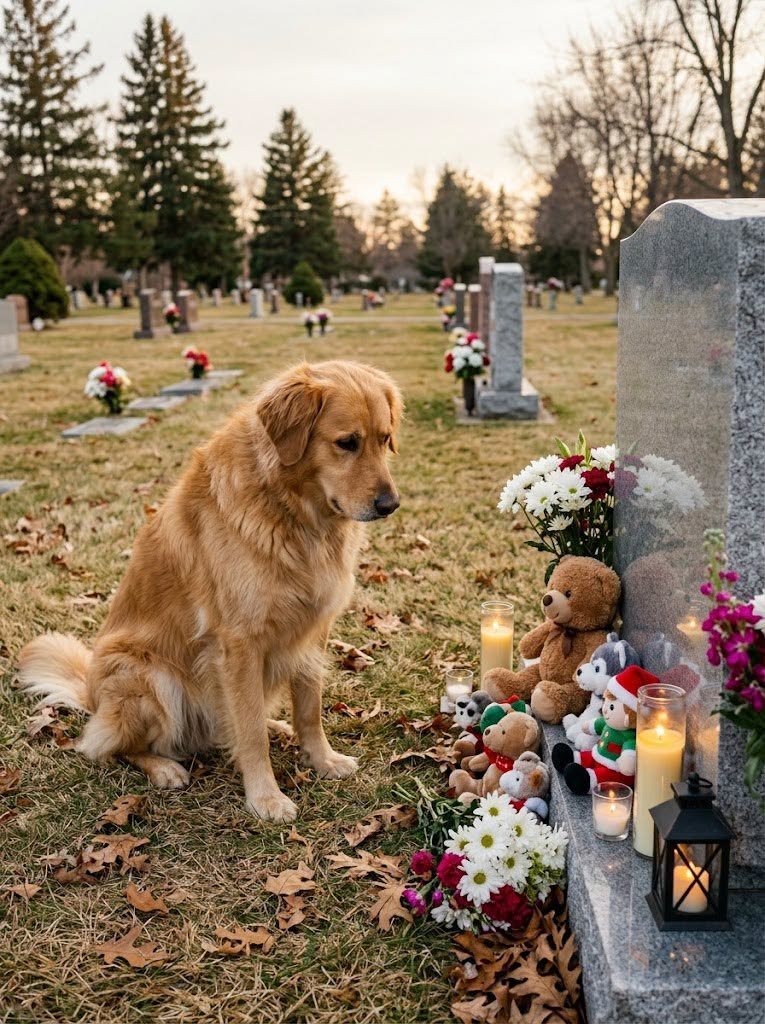
He was a medium-sized golden-brown dog with a white patch across his chest and one ear that drooped slightly lower than the other. He never barked or disturbed anyone. He simply sat beside Caleb’s grave, his nose resting between his paws, watching me with sad, patient eyes.
The first time I saw him, I assumed someone had brought him to visit another grave.
The second Sunday, he was there again.
By the fourth week, I began bringing an extra bottle of water and a little food for him. He accepted both gently, wagging his tail once before returning to his place beside Caleb’s headstone.
I asked the cemetery caretaker if he knew where the dog belonged.
“That one?” he said, glancing toward the animal. “He’s been coming here for months. Always on Sundays. Sometimes he sits by your son’s grave for hours.”
His answer sent a strange chill through me.
“Does anyone bring him?”
The caretaker shook his head. “Not that I’ve seen.”
I started wondering whether Caleb had known the dog. My son had always loved animals. As a child, he rescued injured birds from the garden and once spent an entire afternoon trying to coax a frightened stray cat out from beneath a neighbor’s porch.
But I couldn’t remember him ever mentioning a golden-brown dog.
Still, something about the animal felt familiar.
It wasn’t just his coloring or the way he tilted his head when I spoke. It was the way he looked at Caleb’s name on the headstone, as if he were waiting for someone who had promised to return.
One Sunday, I arrived earlier than usual.
The dog was already there.
I knelt beside him and gently scratched behind his drooping ear.
“Who are you, sweetheart?” I whispered. “And what brings you here every week?”
He looked directly into my eyes.
Then he stood, walked a few steps toward the cemetery gate, and stopped.
He looked back at me.
I hesitated before following him.
He led me past the rows of headstones, through the gate, and down a quiet residential street. Every few yards, he paused to make sure I was still behind him.
I knew I should have been cautious about following an unfamiliar animal, but he never seemed threatening. He moved with the confidence of a dog who knew exactly where he was going.
After nearly twenty minutes, he turned into a narrow lane lined with modest houses and old trees.
Finally, he stopped outside a small, weathered house with peeling white paint and a blue front door.
He sat on the doorstep.
Then he looked at me.
Before I could decide what to do, the door opened.
A woman in her late fifties stood in the doorway. Her gray hair was loosely tied back, and she wore a faded cardigan. She looked at the dog first, then at me.
“You’re here because of him, aren’t you?” she asked quietly.
I nodded.
The woman’s face changed.
“You’re Caleb’s mother.”
My heart seemed to stop.
“How do you know my son?”
She gripped the edge of the door.
For several seconds, neither of us spoke. Then she stepped aside.
“Please,” she said. “Come in. There’s something you need to know.”
I followed her into a small living room filled with old photographs, books, and the faint smell of coffee. The dog settled near the fireplace as if he had returned to his favorite place.
The woman introduced herself as Margaret.
She told me that Caleb had met her son, Daniel, several years earlier through a local volunteer organization. Daniel had struggled with loneliness after a difficult period in his life, and Caleb had become one of the few people who consistently checked on him.
“They became close,” Margaret explained. “Caleb would visit Daniel after work, bring groceries when he was short on money, and take him for walks when he couldn’t bear being alone with his thoughts.”
I listened, stunned.
Caleb had always been generous, but he rarely talked about the people he helped. He never wanted praise for doing something he believed was simply the right thing to do.
“What happened to Daniel?” I asked.
Margaret looked toward the dog.
“Daniel died last year.”
She explained that the dog’s name was Buddy. Daniel had adopted him from a shelter after Caleb encouraged him to give the frightened animal a chance. At first, Buddy had been nervous around everyone, but Daniel had patiently earned his trust.
Caleb had helped, too.
He had spent hours walking Buddy around the neighborhood, teaching him simple commands, and bringing treats whenever he visited.
When Daniel became seriously ill, Caleb had helped Margaret care for both of them. After Caleb died in the car accident, Daniel was devastated. According to Margaret, he kept saying that he had lost the one friend who had made him believe his life could get better.
I felt tears gathering in my eyes.
I had never known any of this.
I knew Caleb as my son, the little boy who used to crawl into my bed during thunderstorms, the teenager who pretended not to care about birthday cakes but always asked for a second slice, and the young man who called me every Sunday evening just to ask what I had eaten for dinner.
But there had been an entire part of his life that I had never seen.
A part filled with quiet acts of kindness that he had never thought to mention.
Margaret reached for a framed photograph on the mantelpiece.
“There’s one more thing,” she said.
She handed it to me.
The picture showed Caleb sitting on a park bench, laughing, with Buddy’s head resting on his knee. Beside them stood Daniel, smiling in a way that made him look years younger.
I pressed the photograph against my chest.
“When was this taken?”
“About four months before Caleb died.”
I could barely speak.
Margaret sat beside me and explained that after Daniel passed away, Buddy had begun wandering toward the cemetery every Sunday. At first, she thought he was searching for Daniel. But one day, she followed him and discovered him sitting beside Caleb’s grave.
After that, she let him go with her whenever she could accompany him safely.
“He seemed to know where he wanted to be,” she said. “And I couldn’t bring myself to stop him.”
I looked at Buddy.
He was lying quietly near the fireplace, his eyes half closed, his white chest rising and falling with each gentle breath.
For months, I had believed he was simply a stray dog who had somehow become attached to my son’s grave.
Now I understood that he was connected to a friendship that had outlived both of the people who created it.
But there was something else I still didn’t understand.
“Why did you never come and speak to me?” I asked Margaret. “Why didn’t you tell me about Caleb?”
Her eyes filled with tears.
“Because I was afraid.”
“Afraid of what?”
“That you would think I was trying to take something from you. You lost your son. I didn’t want to arrive at your door with stories about a part of his life you never knew about and make your grief even harder.”
I shook my head.
“You wouldn’t have taken anything from me.”
I looked down at the photograph again.
“You would have given me more of him.”
We sat together for a long time, sharing memories of a young man who had apparently left more kindness behind than either of us had realized.
Margaret told me about the evenings Caleb spent helping Daniel repair an old bicycle. I told her about the time Caleb drove forty minutes in the middle of a snowstorm because a neighbor’s elderly mother needed medicine.
We laughed at the small details. We cried over the things we wished we could tell him now.
And every so often, Buddy would lift his head, look at one of us, and wag his tail as if he recognized the sound of Caleb’s name.
Before I left, Margaret asked whether I would like to take Buddy home for a visit sometime.
I looked at the dog, then at the photograph in my hands.
“I would love that,” I told her. “But only if you come with us.”
She smiled through her tears.
“Deal.”
From that Sunday onward, my visits to the cemetery changed.
I still brought flowers for Caleb. I still sat beside his grave and told him about my week. The grief didn’t disappear, and I didn’t suddenly wake up one morning feeling whole again.
But now, sometimes, Margaret came with me.
And Buddy was always there, sitting quietly beside the headstone, his tail brushing the grass.
Eventually, Margaret and I began meeting for coffee during the week. We discovered that we had more in common than our connection to Caleb. We both loved old movies, disliked wasting food, and believed that a person could tell a great deal about someone by how they treated animals.
Over time, she became a friend I hadn’t known I needed.
One afternoon, I asked her whether she thought Buddy understood what had happened.
She considered the question carefully.
“I don’t know if dogs understand death the way we do,” she said. “But I think they remember who made them feel safe. And I think they remember where they felt loved.”
I thought about that for days.
Perhaps Buddy wasn’t visiting Caleb’s grave because he understood everything that had happened. Perhaps he was following familiar scents, familiar routines, and the memory of a person who had once made him feel that the world was a kinder place.
Whatever the reason, his visits had led me to a part of Caleb’s life I might otherwise never have discovered.
Three years after losing my son, I still reach for my phone some mornings before remembering that I cannot call him.
I still miss his voice, his laughter, and the ordinary conversations I once took for granted.
But now, when I think about Caleb, I don’t think only about the terrible night that took him away.
I think about the frightened young man he befriended. The abandoned dog he helped find a home. The elderly neighbor he quietly helped. The people who remember him for reasons I never knew.
I used to believe that losing Caleb meant losing every new memory I would ever have of him.
I was wrong.
Sometimes, the people we love leave pieces of themselves in places we never think to look.
Sometimes, those pieces find their way back to us through a photograph, a stranger’s story, or a dog who refuses to forget.
And sometimes, when grief has convinced us that the world has become unbearably small, a simple act of loyalty opens a door we didn’t know was waiting for us.
Buddy still visits Caleb’s grave every Sunday.
So do I.
And every time I see that golden-brown dog sitting beside my son’s name, I remember something I wish I had understood sooner:
Love doesn’t end when a life ends. It continues in the people we helped, the kindness we gave, and the hearts that still remember us when we’re gone.
And sometimes, it waits patiently beside a grave until someone is ready to follow it home.
Website Disclaimer
The information provided on this website is for general informational and educational purposes only. While we strive to ensure that all content is accurate and up to date, we make no guarantees regarding the completeness, reliability, or accuracy of any information published.
The views and opinions expressed in articles belong to their respective authors and do not necessarily reflect the views of this website. Any action you take based on the information found on this website is strictly at your own risk. We will not be liable for any losses, damages, or inconveniences arising from the use of our content.
Some articles may contain opinions, third-party information, or external links. We do not endorse or guarantee the accuracy of content on external websites and are not responsible for their practices or policies.
All content on this website is provided in good faith and is intended for informational purposes only. Readers are encouraged to verify information independently and seek professional advice where appropriate.