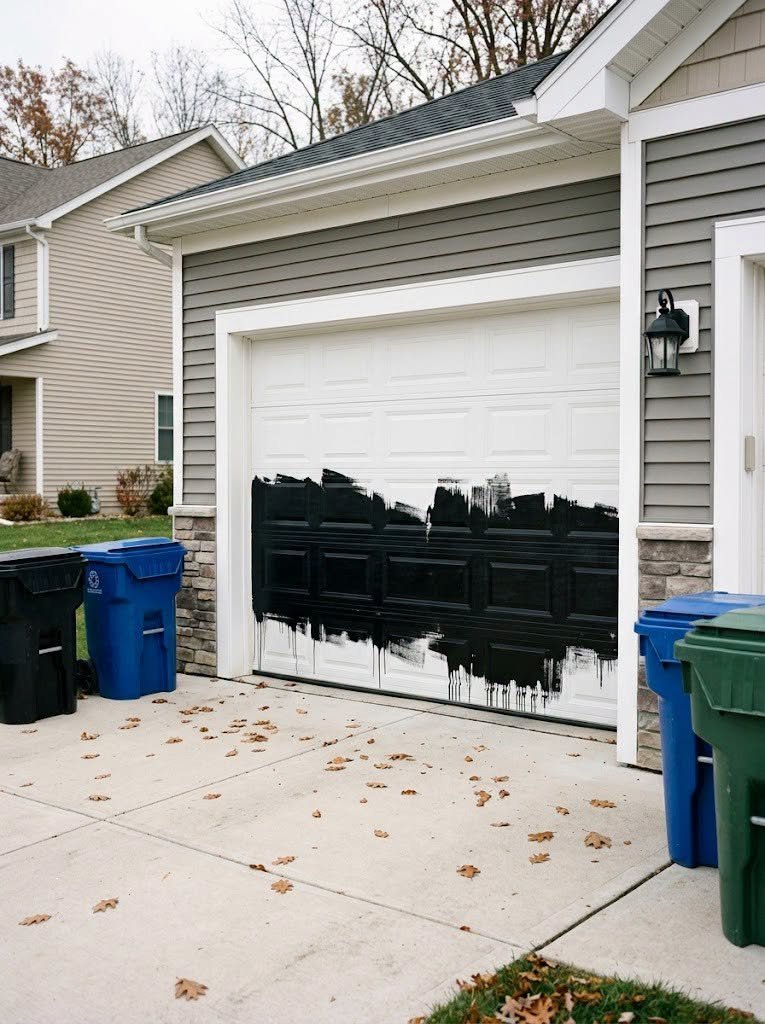
“What happened?” I whispered, staring at the black paint smeared across the garage door I had spent three evenings making perfect.
Our neighborhood’s annual Curb Appeal Competition was only four days away. Every year, residents decorated their homes, trimmed their hedges, planted flowers, and polished every visible corner of their properties. The winning house received a large trophy, a $2,000 prize, and, according to our neighborhood association president, “bragging rights for the entire year.”
I had never cared much about competitions before. But this year was different.
My late father had taught me how to restore old houses, and the garage door was the last project we had planned to finish together before he passed away. Painting it bright white had been my way of completing something we had started together. I had carefully sanded every panel, applied two coats of primer, and spent hours making sure the final finish was flawless.
Now someone had ruined it.
I stood there holding the trash bag, my stomach tightening as I examined the damage. The paint was fresh enough that a few drops had already begun dripping onto the driveway.
I checked the security camera above the garage, but the recording showed nothing useful. Whoever had done this knew exactly where the camera’s blind spot was.
At first, I wondered whether it was a prank. Then I remembered the conversation I had with our neighbor, Brenda, the previous weekend.
Brenda had lived in our neighborhood for nearly twenty years and had won the Curb Appeal Competition six times. She treated the contest as if the entire community depended on her victory. Every spring, she planted expensive flowers, hired landscapers, and arranged decorative lights around her house.
When she noticed me painting my garage door, she had stopped beside my driveway and studied my work.
“Going all out this year, aren’t you?” she had asked.
“I suppose I am,” I replied with a smile.
She glanced toward her own house, where a row of carefully trimmed shrubs framed a freshly painted entrance.
“Well, just remember,” she said, “some people have been doing this a lot longer than others.”
At the time, I had dismissed her comment as harmless competitiveness.
Now, standing in front of the vandalized door, I wasn’t so sure.
I cleaned the mess as best I could, but the black paint had already dried in places. I spent my lunch break buying supplies and most of the evening sanding and repainting the damaged panels.
By Saturday morning, the garage door looked almost perfect again.
Almost.
There was one small patch near the bottom that refused to blend with the rest of the finish. I considered repainting the entire door, but the competition was less than three days away, and I had already spent more money than I could comfortably afford.
I decided to leave it.
Then Sunday morning arrived.
The bottom half of my garage door was black again.
This time, the paint had been splashed across the entire surface. Someone had even written three words in crooked letters across the middle.
NOT YOUR YEAR.
I stood in the driveway, staring at the message. My hands shook with anger.
Whoever was doing this wasn’t simply trying to ruin my paint job. They wanted me to give up.
My first instinct was to call the police. Instead, I photographed everything, saved the camera footage, and asked two neighbors whether they had noticed anything unusual.
One of them, an older man named Walter, hesitated before answering.
“I saw someone near your garage last night,” he admitted. “It was dark, and I couldn’t see clearly. But I heard a car door slam around eleven.”
“Did you recognize the person?”
He looked uncomfortable.
“I don’t want to accuse anyone without proof.”
That answer stayed with me all afternoon.
I could have spent the next two days scrubbing, sanding, and repainting. I could have withdrawn from the competition and allowed whoever was responsible to get exactly what they wanted.
But as I stood in the garage looking at my father’s old toolbox, an idea began to form.
If someone wanted to make my house look terrible before the judges arrived, I would give those judges something they had never seen before.
I wasn’t going to hide the damage.
I was going to tell the story behind it.
On Monday morning, I bought a large sheet of weatherproof white board and placed it beside the garage door. Across the top, I wrote:
THE HOUSE THAT REFUSED TO GIVE UP.
Beneath it, I displayed photographs of the door before the vandalism, pictures of my father teaching me to paint, and a short explanation of why the project mattered to me.
Then I did something unexpected.
I turned the black paint into part of the display.
I carefully outlined the existing marks with a protective border and added small labels showing the dates of each incident. I didn’t write anyone’s name or accuse a particular neighbor. I simply presented the facts and let the photographs speak for themselves.
By Tuesday evening, people had begun stopping outside my house to read the display.
Some offered sympathy. Others shook their heads in disbelief.
And then Brenda appeared.
She stood at the end of my driveway with her arms folded, staring at the board.
“What exactly is this supposed to be?” she demanded.
“A record of what’s happened to my house,” I answered calmly.
“You’re making the whole neighborhood look bad.”
I looked at her.
“I’m not the one who painted my garage door black.”
Her expression changed for just a second. Then she turned and walked away without another word.
That night, I barely slept. I kept wondering whether I had made a mistake by turning the damage into a public display. Perhaps the judges would consider it inappropriate. Perhaps the entire idea would backfire.
But by Wednesday morning, I had received a message from Walter.
I think you should check your mailbox. I finally found something you need to see.
Inside the mailbox was a small memory card and a handwritten note.
Walter explained that his doorbell camera had captured part of the street the previous Sunday night. He had reviewed the recording after hearing about the second incident and recognized a familiar figure walking toward my garage carrying a paint container.
The image wasn’t perfect, but it showed the person’s face clearly enough.
It was Brenda.
I watched the recording three times, my heart pounding harder each time.
There she was, approaching my garage shortly before midnight. She looked around, poured the paint across the door, and stepped back to inspect her work before walking away.
I felt anger rise in my chest, followed by something I hadn’t expected: sadness.
I had known Brenda for years. We had exchanged holiday cookies, chatted about gardening, and waved to each other across our driveways. I couldn’t understand why winning a neighborhood competition had become important enough for her to do this.
I could have confronted her immediately. Instead, I contacted the neighborhood association and shared the footage with the competition committee.
Their response surprised me.
They thanked me for providing evidence, confirmed that the judges would be informed, and asked me not to make any public accusations before they had reviewed the situation.
I agreed.
On Friday afternoon, the judges arrived.
They visited the homes entered in the competition, examining flower beds, walkways, landscaping, paintwork, and decorations. Brenda’s house looked spectacular. Fresh flowers lined the entrance, tiny lights illuminated the garden, and a new decorative fountain sparkled beside her front steps.
When the judges reached my driveway, they stopped in front of the garage door.
One of them read the display silently. Another studied the photographs.
Finally, the oldest judge turned toward me.
“Why didn’t you simply repaint the door?” she asked.
I took a breath.
“Because I realized that a beautiful house isn’t just about perfect paint or expensive decorations. My father taught me that a home reflects the people who live in it. I wanted to finish this project in his memory, and someone tried to take that away from me. I decided I wouldn’t let them.”
The judge nodded slowly.
Then she asked to see the security footage.
I handed over a copy of the recording, along with the photographs documenting the vandalism. The committee had already reviewed the evidence, so there was no need for me to identify anyone publicly.
The judges watched the video in silence.
When it ended, one of them closed the folder in her hands.
“Thank you for letting us see this,” she said.
I had no idea what they would decide.
An hour later, the neighborhood gathered in the community park for the award ceremony. Brenda stood near the front, wearing a bright smile and speaking confidently with several residents. She seemed certain that another trophy was waiting for her.
The association president stepped onto the small stage.
“This year’s competition has reminded us that curb appeal is about more than flowers, paint, and perfectly trimmed lawns,” he announced. “A neighborhood is also defined by honesty, respect, and how we treat one another when no one is watching.”
The crowd grew quiet.
He explained that the committee had received verified evidence of deliberate property damage connected to the competition. The matter had been referred to the appropriate authorities, and the judges had taken it into account when evaluating the entries.
Brenda’s smile disappeared.
Then the president announced the winner.
My name.
For a moment, I genuinely thought I had misheard him.
People began clapping. Walter stood near the back, grinning and applauding harder than anyone else. I walked toward the stage, still struggling to understand what was happening.
The judges had awarded my home the competition’s special community spirit prize, along with the $2,000 award. They explained that my display had transformed an ugly experience into a powerful reminder of what the neighborhood was supposed to represent.
I accepted the trophy with tears in my eyes.
But the most satisfying moment came afterward.
Brenda approached me while the crowd was dispersing. Without her usual confidence, she looked smaller somehow.
“You didn’t have to show everyone,” she muttered.
I held the trophy against my side.
“I didn’t paint your house, Brenda. I didn’t ruin your work. I didn’t force you to do anything.”
She looked down at the ground.
For several seconds, neither of us spoke.
Finally, she admitted that she had become obsessed with winning. She had seen my freshly painted door and worried that someone new might take the title she believed belonged to her. What began as jealousy had turned into a decision she couldn’t undo.
She apologized, though her words came slowly and awkwardly.
I didn’t tell her everything was fine. It wasn’t. She had damaged my property and betrayed the trust of someone who had considered her a neighbor and friend.
But I told her that the first step toward making things right would be to take responsibility for what she had done.
In the weeks that followed, Brenda paid for the repairs and cooperated with the authorities. The neighborhood association also reviewed its competition rules to make clear that vandalism and intimidation would never be tolerated.
Eventually, I repainted the garage door one final time.
Bright white. Clean panels. No black streaks.
I kept the photographs of my father, though. They now hang inside my garage, beside his old toolbox, where I can see them whenever I work on the house.
The trophy sits on a shelf nearby.
Sometimes people ask me whether winning felt better because Brenda lost.
The truth is, it didn’t.
What mattered was that someone had tried to turn something meaningful into a source of fear and frustration, and I had refused to let them decide what it meant.
Brenda wanted the judges to see a perfect house.
Instead, they saw a damaged garage door, a family memory, and a person who refused to surrender her dignity just because someone else couldn’t handle the possibility of losing.
And that taught me something my father had tried to teach me all along.
You can’t always control what people do to your home, your hard work, or your happiness. But you can decide whether their worst behavior gets to define you.
Sometimes, the most unforgettable show isn’t the one you planned.
It’s the one you create when someone gives you every reason to give up—and you choose not to.
Website Disclaimer
The information provided on this website is for general informational and educational purposes only. While we strive to ensure that all content is accurate and up to date, we make no guarantees regarding the completeness, reliability, or accuracy of any information published.
The views and opinions expressed in articles belong to their respective authors and do not necessarily reflect the views of this website. Any action you take based on the information found on this website is strictly at your own risk. We will not be liable for any losses, damages, or inconveniences arising from the use of our content.
Some articles may contain opinions, third-party information, or external links. We do not endorse or guarantee the accuracy of content on external websites and are not responsible for their practices or policies.
All content on this website is provided in good faith and is intended for informational purposes only. Readers are encouraged to verify information independently and seek professional advice where appropriate.