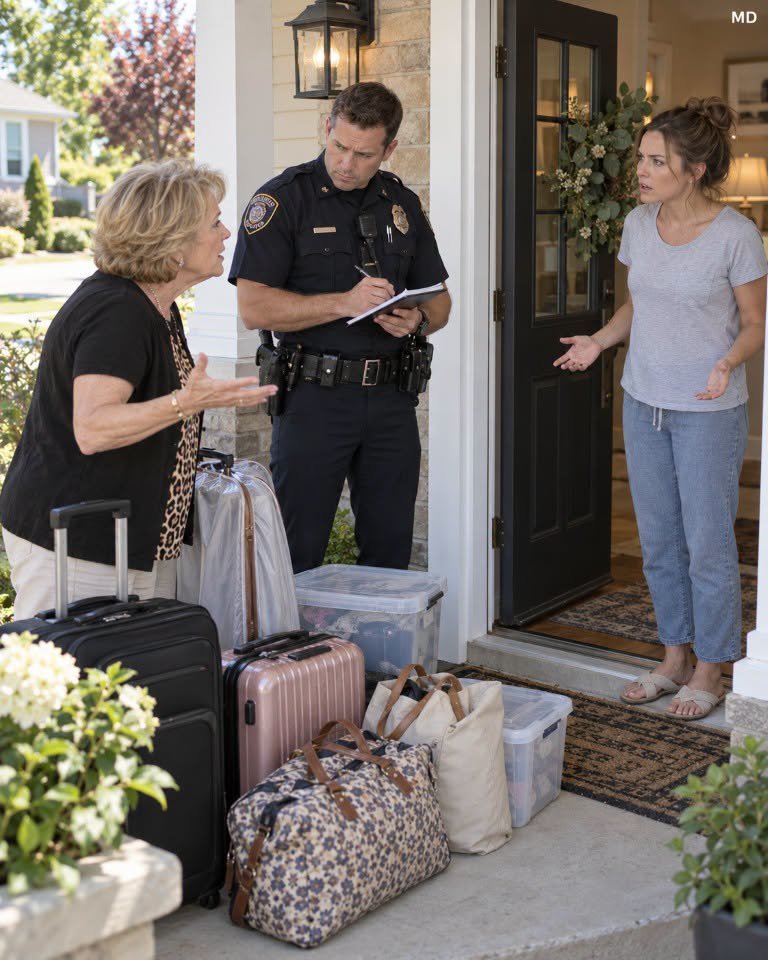
The police lights were already flashing across my driveway when my husband, Mark, finally pulled in and saw his mother’s mountain of luggage sitting on the porch. Three suitcases, storage bins, a garment bag, prescription bags, toiletries, and even her peace lily made it painfully obvious that Diane had not arrived for a short visit. Only minutes earlier, she had announced that she was moving into my home because, as she put it, “My son owns this house.” I almost corrected her, but years of comments about how “lucky” I was that Mark provided such a comfortable life suddenly came rushing back.
For years, Diane had treated me like a temporary guest in my own marriage. Whenever she visited, she inspected my kitchen, criticized my cooking, rearranged my furniture, and offered unsolicited advice about how I should treat her son. Mark always brushed it off. “That’s just Mom,” he would say, as if those four words excused every boundary she crossed.
But this time, she had gone too far.
Three days earlier, Diane had called to announce that she was selling her apartment and moving in with us permanently. She had not asked whether we had room. She had not asked whether I agreed. She simply informed me that her decision was final because Mark was her son and, in her mind, anything that belonged to him automatically belonged to her.
I told her she could not move into our home without both of us agreeing.
She laughed.
“Sweetheart, you married my son. You knew what you were getting into.”
Then she hung up.
The following afternoon, I returned home from work to find her standing in my living room, directing two delivery men as they carried in boxes. She had somehow obtained a spare key Mark had given her for emergencies and decided that her arrival was an emergency of her own making.
When I demanded an explanation, she folded her arms and gave me a look of complete disbelief.
“This is my family’s house,” she declared. “I shouldn’t need permission to live with my own son.”
I told the movers to stop unloading.
Diane immediately began shouting that I was disrespectful, selfish, and trying to separate her from her child. Then she pulled out her phone and called Mark, loudly explaining that I was throwing her belongings onto the porch.
What she conveniently left out was that she had entered our home without permission and attempted to establish permanent residence without my consent.
When I refused to let her bring anything else inside, she threatened to call the police herself.
“Go ahead,” I replied.
I never imagined she would actually do it.
But within twenty minutes, two officers arrived. Diane greeted them with tears in her eyes, claiming she was an elderly mother who had been abandoned by her own family. She explained that her son had promised her a place to stay and that his cruel wife was refusing to let her enter.
The officers listened patiently before turning to me.
I calmly explained what had happened, showed them the messages in which Diane had announced her plans without asking, and provided documentation confirming that the house was legally mine.
The property had been purchased four years before I met Mark. I had paid for it with my savings, and the deed was in my name alone. Mark and I had married later, but we had never transferred ownership or added his name to the title.
Diane had spent years assuming that because her son lived under my roof, he must own it.
The officers asked whether Diane lived there, received mail there, or had any legal agreement allowing her to occupy the property.
The answer to all three questions was no.
They explained that the situation was a civil matter and that they could not simply decide ownership based on a family argument. However, they advised Diane that she could not use a spare key as automatic permission to move in, and they documented the incident.
That was when Mark finally arrived.
He stepped out of his car, stared at the luggage, then looked at his mother standing beside the officers.
“What happened here?” he asked.
Diane rushed toward him.
“Your wife is throwing me out! I have nowhere to go, and she called the police on me!”
Mark looked at me, expecting me to apologize or somehow smooth things over as I had done so many times before.
Instead, I handed him a folder.
Inside were copies of the property deed, screenshots of Diane’s messages, and photographs of the boxes she had brought into the house.
“Your mother decided she was moving in without asking either of us,” I said quietly. “She entered our home while I was at work and started moving her belongings inside. When I told her she couldn’t, she threatened to call the police.”
Mark’s expression changed as he read the messages.
Then he turned to his mother.
“Mom, did you really tell her you were moving in permanently without discussing it with us?”
Diane lifted her chin.
“I shouldn’t have to ask permission to live with my own son!”
“But this isn’t my house,” Mark replied.
For the first time that afternoon, Diane had nothing to say.
I watched as the truth finally settled over her. She had spent years talking as if I were merely benefiting from her son’s success, never bothering to discover that the comfortable home she wanted to claim had nothing to do with him financially.
Then she turned on me.
“You deliberately kept this from me!” she snapped.
“I didn’t keep anything from you,” I answered. “You simply never bothered to ask.”
Mark rubbed his forehead, visibly exhausted.
“Mom, you can’t just move into someone’s house because you want to. You should have talked to us first.”
“Someone’s house?” Diane repeated, staring at him. “I’m your mother!”
“And I love you,” he said. “But that doesn’t mean you get to make decisions for my marriage.”
She looked between us, seemingly stunned that her son wasn’t automatically taking her side.
Then came the tears.
She claimed she had sold her apartment because she believed Mark would take care of her. She said she had already made plans, arranged deliveries, and packed nearly everything she owned. According to her, refusing to let her stay would leave her with nowhere to go.
For a moment, I felt a familiar tug of guilt. I knew moving was stressful, and I didn’t want an older woman to find herself in a difficult situation.
But compassion did not require me to surrender my home.
“Diane,” I said, keeping my voice steady, “I’m not going to leave you without options. We can help you look for an apartment, a senior community, or temporary accommodation. But you cannot move into this house without our agreement.”
She shook her head furiously.
“I don’t want an apartment. I want to live with my son!”
Mark took a breath.
“Then we can discuss what help I can reasonably offer. But you don’t get to decide that for us.”
The officers eventually finished documenting the incident and left after confirming that there was no immediate criminal matter for them to resolve. Diane remained on the porch, surrounded by her belongings, while Mark and I discussed the next steps.
He offered to pay for a hotel for a few nights while she contacted her real estate agent and considered her options. He also made it clear that she would need to arrange her own long-term housing.
Diane accepted the hotel offer, but she refused to speak to either of us before leaving.
As Mark helped her load the luggage back into her car, she turned toward me one final time.
“You’ve changed my son,” she said bitterly.
I met her gaze.
“No, Diane. I’ve simply stopped letting you make decisions for me.”
She climbed into her car without another word.
When the driveway finally fell silent, Mark stood beside me for a long time.
“I’m sorry,” he said. “I should have stopped this years ago.”
I wanted to tell him that everything was fine, that his mother’s behavior didn’t matter, that we could simply forget the afternoon had happened.
But that would have been another lie designed to keep the peace.
“It isn’t just about today,” I told him. “It’s about every time you expected me to tolerate something hurtful because she was your mother. I don’t need you to stop loving her. I need you to understand that loving her doesn’t mean letting her disrespect me.”
He nodded slowly.
For the first time, he didn’t defend her or tell me I was overreacting.
Over the following weeks, Diane found a small apartment near her friends. Mark helped her arrange the move, but he stopped making promises on behalf of our household without discussing them with me first. He also changed the locks and made it clear that spare keys were for genuine emergencies, not unannounced visits.
Our relationship with Diane remained strained for a while. She told relatives that I had humiliated her, and some family members accused me of being heartless. I learned to stop explaining myself to people who had already decided I was guilty.
Eventually, Diane began visiting again, but only after calling first. She still had opinions about my home, my cooking, and my marriage. The difference was that I no longer felt obligated to accept every criticism with a smile.
And Mark learned that setting boundaries with his mother wasn’t an act of betrayal. It was part of protecting the marriage he had chosen.
I sometimes think about that afternoon and the mountain of luggage on my porch. The suitcases were never really the problem. They were simply the most visible sign of something that had been happening for years: Diane believed that being family gave her unlimited access to my life, and I had spent too long trying to prove that I was a good person by keeping everyone else comfortable.
That day taught me something I wish I had understood much earlier.
You can love your family without giving them ownership of your life. You can offer help without surrendering your boundaries. And you can be compassionate without allowing someone to mistake your kindness for permission.
Because a peaceful home isn’t built by asking one person to tolerate everything. It’s built when everyone understands that respect is not optional, even when the person crossing the line shares your last name.
And sometimes, the strongest thing you can say to someone you love is simply this:
“You are welcome in my life, but you do not get to control it.”
Website Disclaimer
The information provided on this website is for general informational and educational purposes only. While we strive to ensure that all content is accurate and up to date, we make no guarantees regarding the completeness, reliability, or accuracy of any information published.
The views and opinions expressed in articles belong to their respective authors and do not necessarily reflect the views of this website. Any action you take based on the information found on this website is strictly at your own risk. We will not be liable for any losses, damages, or inconveniences arising from the use of our content.
Some articles may contain opinions, third-party information, or external links. We do not endorse or guarantee the accuracy of content on external websites and are not responsible for their practices or policies.
All content on this website is provided in good faith and is intended for informational purposes only. Readers are encouraged to verify information independently and seek professional advice where appropriate.