PART 1
The night before my second wedding, I drove to the cemetery to say goodbye to my first wife.
I told myself I would be there for twenty minutes. Clear the leaves away, place the flowers, say the few words I had been practicing in my head for weeks, and then go home. That was the plan. I’m the kind of man who likes having a plan. Anna used to tease me about that. She once joked that if people gave me the chance, I’d probably schedule my own surprise party.
I had no idea that before the night was over, the plan—and everything I thought I knew about myself—would change completely.
The rehearsal dinner ended shortly after eight. It was a small gathering at an Italian restaurant downtown, with Claire’s parents, my brother Mark and his wife, and Claire’s best friend Jenna, who had already cried twice before the bread even arrived. Claire looked radiant all evening. She wore a soft green dress and kept reaching beneath the table to squeeze my hand, as though she needed to make sure every few minutes that I was really there.
I was there. At least, most of me was.
A part of me had been somewhere else all day. Claire noticed, naturally. Claire notices everything. In the parking lot, while Jenna carried the leftover tiramisu to her car, Claire rose onto her toes, straightened my collar, and studied my face for several seconds.
“You okay, David?”
“Just tired,” I answered. “Tomorrow’s a big day.”
She examined my expression like a crossword clue she was certain she had already solved. Then she smiled and kissed my cheek. “Go home. Get some rest. I’ll stay at Jenna’s like we planned.” She hesitated. “And David? Whatever you need to do tonight, do it. I mean it.”
I didn’t ask what she meant. Maybe I was scared that she already knew.
Rain had been falling since late afternoon, a slow and constant drizzle that never seemed able to decide whether it wanted to end. I didn’t drive home. Instead, I passed our street, went by the grocery store, drove past the high school where Anna had taught chemistry for eleven years, and continued along the county road toward Maple Hill Cemetery.
On the way, I stopped at the florist on Fifth Street, the one that stays open late because it’s beside the hospital. I knew exactly what I wanted: yellow roses. Anna’s favorite. Bright, almost absurdly cheerful flowers that she once described as “a good mood you can hold in your hands.”
The girl behind the counter gave me an apologetic shake of her head. “We’re out of yellow. Wedding season. Someone bought the last ones earlier this week.”
So I bought red roses instead. Deep crimson, nearly black around the edges. They were beautiful, but they felt wrong, and I knew it as soon as she passed them to me. I had brought Anna red roses for every anniversary we shared—nine times—and every time she had laughed and reminded me, “You know yellow is my favorite, right?” And every time I had answered, “Red means love.” She would always reply, “Yellow means joy. Isn’t that better?”
I hadn’t brought her flowers in nearly three years. I told myself tonight was different. That doing this was simply the right thing. A gesture. Closure. That was the word everyone had used: closure. As though grief were a door you could simply close and leave behind.
The cemetery was covered in mist. The old lamps lining the main path gave off a weak glow, like exhausted stars that had forgotten their purpose. I parked farther away from her grave than I normally did, near the iron gate at the bottom of the hill, and walked the rest of the distance. I needed those few minutes on foot. I needed the cold air and the rhythm of my shoes against the wet gravel to calm the thoughts shaking inside my chest.
Anna died six years ago, in March. Ovarian cancer. The kind doctors call quiet because by the time it finally makes itself known, it can already be too late. We had twenty-two months between her diagnosis and her death. Twenty-two months filled with hospital hallways, waiting rooms that smelled like burnt coffee, and learning medical terms neither of us had ever wanted to understand. Twenty-two months during which she was braver than I was every single day.
During her final week, she could barely speak. But on the second-to-last night, she squeezed my hand and whispered, “Don’t you dare stop living, David Harmon. I’ll know.”
I nodded. I promised her I would. And then, for the next three years, I did exactly what she had begged me not to do.
I went to work. I returned home. I ate dinner while standing at the kitchen counter. I kept her reading glasses on the nightstand and her coat hanging from the hook by the door. I stopped returning my brother’s calls. I allowed the garden she had planted to disappear beneath weeds because I couldn’t bear taking care of it without her, but I also couldn’t bring myself to remove it.
Then, three years ago, my car broke down outside a used bookstore on a Saturday morning. A woman with paint splattered across her sleeves walked outside carrying two cups of coffee. She had watched me kicking my tire through the window and later told me she decided that “anyone who kicks a tire that hard needs caffeine more than he needs a mechanic.”
That woman was Claire.
I didn’t fall for her immediately. I wouldn’t allow myself to. But she kept showing up—warm, patient, and funny—never pressuring me and never demanding that I become anything other than the broken man I was. Somewhere along the way, without asking my permission, she made me laugh again.
And tomorrow, at two in the afternoon, I would stand before a hundred people beneath strings of white lights and promise to spend the rest of my life with her.
Anna’s grave is near the top of the hill, beneath an old oak tree she would have loved. Her headstone is made of simple gray granite. Anna Marie Harmon. Beloved wife, daughter, teacher. She made everything brighter.
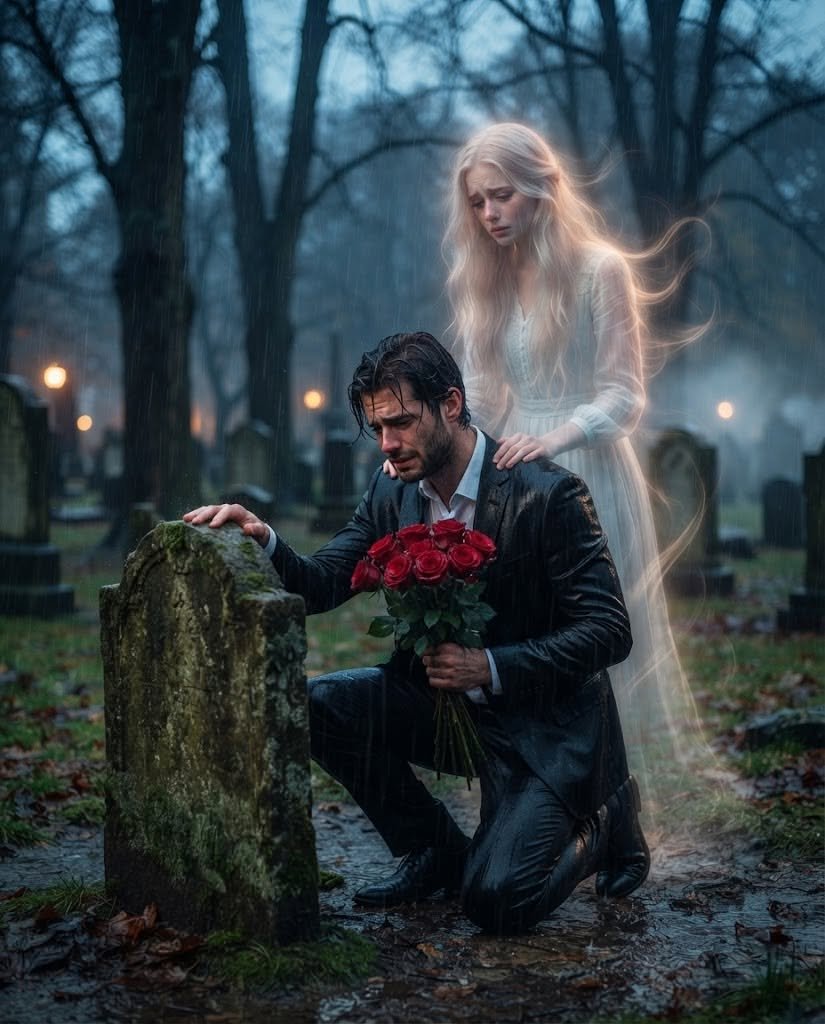
My shoes disappeared slightly into the soaked grass as I knelt before the grave. Her name was carved into the stone in a curve I had traced with my fingers countless times in my memory. I placed the roses beside me and began sweeping away the wet oak leaves gathered around the bottom of the headstone.
That was when I noticed them.
Tucked beside the left side of the headstone, partly concealed beneath the leaves, was a small bundle of yellow roses.
They weren’t exactly fresh. They looked several days old, perhaps. Their petals had begun curling and browning along the edges, but someone had arranged them carefully. The stems were wrapped in brown paper and secured with a strip of white ribbon. Whoever had left them there had clearly taken time to do it.
I stared at the flowers for several seconds.
Anna’s mother had died two years after Anna. Her father lived in a care home in Arizona and hadn’t recognized anyone for years. Anna’s former students had stopped visiting after the first anniversary. Her friends had continued with their own lives, as people eventually do.
So who had brought Anna yellow roses?
And how could they have known?
A strange sensation moved up the back of my neck, but I forced it aside. Probably a former colleague. Someone from the school. People remember details. That was all it was.
I placed my red roses beside the yellow ones. Next to them, they looked awkward, far too dark and far too bold. I used the sleeve of my good suit jacket to wipe the rain from the front of the stone, not caring that I was soaking it through.
“Hi, Anna,” I said.
My voice sounded strangely small in the open cemetery.
“I’m getting married tomorrow.”
The words felt unnatural, almost like I was speaking a language I had only learned from a book. I had rehearsed this moment. I had practiced what I would say in the car, in the shower, and alone in the dark at three in the morning. But now that I was finally standing here, every carefully prepared sentence disappeared.
“Her name is Claire,” I continued. “You’d like her. I think you’d really like her. I hope… I hope you’d understand.”
The rain gradually quieted until it was barely more than a whisper. I lowered my head and rested my forehead against the cold, rain-soaked granite. For a long while, there was nothing except the scent of damp earth and moss, water dripping from the oak branches overhead, and the hard pounding of my own heartbeat in my ears.
“I’m sorry,” I whispered. “I’m so sorry. I don’t even know what I’m apologizing for. I just am.”
Then I felt it.
A hand—gentle, warm, and unmistakably real—settled onto my right shoulder.
I went completely still.
Every rational explanation rushed through my mind at once. Maybe rain had fallen from a branch. Maybe it was a leaf. Maybe exhaustion, grief, and the two glasses of wine from dinner were finally affecting me. Maybe my imagination was simply giving way beneath the weight of a night I had been dreading for months.
But the warmth remained. It didn’t disappear. It stayed firm and steady. The fingers pressed softly against my shoulder, the way someone touches you when they don’t want to frighten you.
The same way she used to when she found me asleep at my desk.
Very slowly, I lifted my head from the gravestone.
Then I turned around.
She was standing directly behind me.
Website Disclaimer
The information provided on this website is for general informational and educational purposes only. While we strive to ensure that all content is accurate and up to date, we make no guarantees regarding the completeness, reliability, or accuracy of any information published.
The views and opinions expressed in articles belong to their respective authors and do not necessarily reflect the views of this website. Any action you take based on the information found on this website is strictly at your own risk. We will not be liable for any losses, damages, or inconveniences arising from the use of our content.
Some articles may contain opinions, third-party information, or external links. We do not endorse or guarantee the accuracy of content on external websites and are not responsible for their practices or policies.
All content on this website is provided in good faith and is intended for informational purposes only. Readers are encouraged to verify information independently and seek professional advice where appropriate.