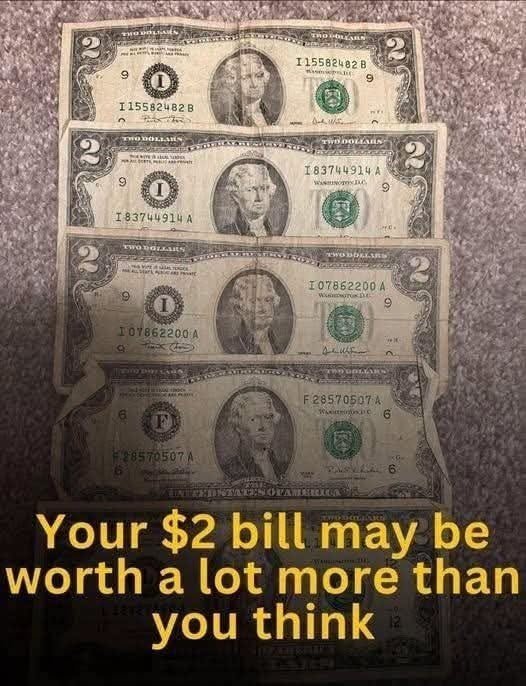
The Hidden Value of a $2 Bill
At one time, superstitious people believed the $2 bill was unlucky and even carried a curse. However, this myth is far from the truth. In fact, owning a $2 bill could bring you good luck—and maybe even a few thousand dollars if you know how to spot its value.
Often overlooked, the $2 bill has long been considered the unloved stepsibling of the $1 bill. Many Americans scoff at it, thinking it’s uncommon or no longer in circulation. This misconception has only added to the bill’s mysterious reputation.
Contrary to popular belief, $2 bills are still being printed by the U.S. Treasury. They circulate alongside other bills, but because they’re less common in everyday transactions, many people think they’re rare.
If you happen to find a $2 bill, it’s worth checking for unique features that could increase its value. Some bills from certain years or with special serial numbers are highly sought after by collectors.
One of the first things collectors examine is the date and series printed on the bill. Older $2 notes, particularly certain issues from the 19th and early 20th centuries, can be worth considerably more than their face value. However, age alone does not automatically make a bill valuable. Condition, rarity, demand, and the specific type of note all play a role.
The serial number can also make an ordinary-looking $2 bill more interesting. Collectors sometimes seek numbers with unusual patterns, such as very low numbers, repeating digits, sequential numbers, or other distinctive combinations. A bill with a particularly desirable serial number may attract attention even if it isn’t especially old.
Another feature to check is the printing itself. Certain printing errors, unusual serial-number combinations, misprints, or other production abnormalities can make a note collectible. Genuine errors are relatively uncommon, which is why authentication is important before assuming a bill is worth a fortune.
Condition matters, too. A crisp $2 bill with sharp corners, clean paper, and minimal signs of circulation generally has greater collector appeal than a heavily worn or damaged example of the same issue.
There is also an important distinction between legal-tender value and collector value. A modern $2 bill in ordinary condition is generally worth exactly $2. Simply having a $2 bill does not mean you have a rare treasure. Stories claiming that every $2 bill is worth hundreds or thousands of dollars are misleading.
Still, that doesn’t mean you should automatically spend one you find. Take a moment to examine the year, series, serial number, signatures, condition, and any unusual printing characteristics. If something looks unusual, compare it with reputable currency references or have it evaluated by a qualified currency dealer or professional grading service.
The next time someone hands you a $2 bill, don’t assume it’s worthless or unlucky. It may simply be an ordinary $2 note—but occasionally, a closer look can reveal something much more interesting.
So before you spend that $2 bill, check it carefully. That little piece of paper could be worth far more than its face value.
Website Disclaimer
The information provided on this website is for general informational and educational purposes only. While we strive to ensure that all content is accurate and up to date, we make no guarantees regarding the completeness, reliability, or accuracy of any information published.
The views and opinions expressed in articles belong to their respective authors and do not necessarily reflect the views of this website. Any action you take based on the information found on this website is strictly at your own risk. We will not be liable for any losses, damages, or inconveniences arising from the use of our content.
Some articles may contain opinions, third-party information, or external links. We do not endorse or guarantee the accuracy of content on external websites and are not responsible for their practices or policies.
All content on this website is provided in good faith and is intended for informational purposes only. Readers are encouraged to verify information independently and seek professional advice where appropriate.