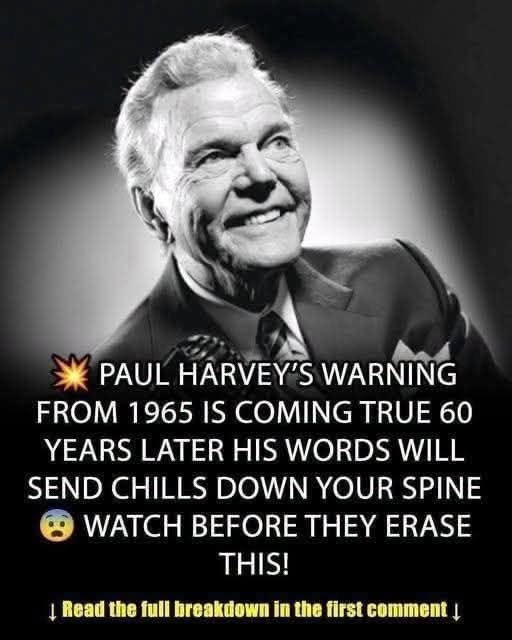
If I Were the Devil: Paul Harvey’s 1965 Broadcast and Why It Still Resonates
Paul Harvey’s 1965 broadcast “If I Were the Devil” has been shared for decades, but today, it feels almost unsettling in its accuracy. Hearing it now, it no longer sounds like a warning—it feels like a reflection.
In the broadcast, Harvey imagined what he would do if he were the Devil, determined not to destroy a nation by force, but by slowly corrupting it from within. He spoke of quiet whispers, shifting morals, and eroding faith. At the time, it was seen as dramatic radio commentary. Now, many see it as prophecy.
But there is an important distinction between prediction and interpretation.
Harvey wasn’t claiming to possess a supernatural vision of the future. He was using a familiar religious figure—the Devil—as a rhetorical device. His argument was that social decline, if it happened, would probably not arrive with a single dramatic event. Instead, it would happen gradually, through thousands of ordinary choices.
That idea is what makes the broadcast so powerful.
He imagined encouraging people to become distracted, divided, cynical, and increasingly indifferent to institutions that once held communities together. He described a strategy based less on open destruction and more on making destructive behavior seem ordinary.
More than sixty years later, listeners inevitably connect those themes to modern life.
They hear echoes of Harvey’s concerns in political polarization, endless arguments online, declining trust in institutions, sensationalized media, consumer culture, and the speed at which outrage spreads across social networks. Others hear something different: an old-fashioned moral argument being repeatedly repackaged to explain problems that are far more complicated than Harvey could have anticipated.
And that is where the broadcast becomes particularly interesting.
Some people share it as proof that Harvey somehow predicted the modern world. Others reject that interpretation entirely, arguing that many of the problems listeners identify today existed in some form long before 1965. Both reactions reveal something about the listener as much as they reveal something about Harvey.
The human tendency to recognize the present in old warnings is powerful.
Every generation looks backward and discovers passages that seem strangely relevant to its own struggles. A speech written during one period can acquire an entirely different meaning decades later because society has changed—and because the audience has changed with it.
Harvey’s greatest insight may therefore not have been predicting specific events. It may have been recognizing how gradual change can become difficult to notice while it is happening.
A dramatic collapse is easy to identify.
A slow shift is not.
Values change one conversation at a time. Institutions weaken one compromise at a time. Trust disappears after repeated disappointments. Communities become more divided after countless arguments. And eventually, people may look around and wonder when everything became so different.
That is why “If I Were the Devil” continues to circulate.
Not necessarily because Paul Harvey predicted 2026.
But because he created a thought experiment that asks a timeless question:
What happens when a society stops paying attention to the small changes happening around it?
The answer depends on whom you ask.
For religious listeners, the broadcast can sound like a warning about abandoning faith and moral responsibility. For others, it is a historical snapshot of American anxieties during the 1960s. For still others, it is simply a piece of compelling radio commentary whose language has acquired new relevance in the age of social media.
Perhaps the most useful way to hear it today is not as a prophecy that came true, but as an invitation to examine the present carefully.
What has changed?
What has improved?
What has been lost?
And which changes are genuinely dangerous—and which only feel dangerous because every generation naturally compares its complicated present with an idealized past?
Those questions are harder than simply declaring Harvey “right.”
And perhaps that’s exactly why his words have survived.
A good warning doesn’t have to predict the future perfectly.
Sometimes, it only has to make people stop, listen, and ask whether they like the direction in which they are going.
Website Disclaimer
The information provided on this website is for general informational and educational purposes only. While we strive to ensure that all content is accurate and up to date, we make no guarantees regarding the completeness, reliability, or accuracy of any information published.
The views and opinions expressed in articles belong to their respective authors and do not necessarily reflect the views of this website. Any action you take based on the information found on this website is strictly at your own risk. We will not be liable for any losses, damages, or inconveniences arising from the use of our content.
Some articles may contain opinions, third-party information, or external links. We do not endorse or guarantee the accuracy of content on external websites and are not responsible for their practices or policies.
All content on this website is provided in good faith and is intended for informational purposes only. Readers are encouraged to verify information independently and seek professional advice where appropriate.