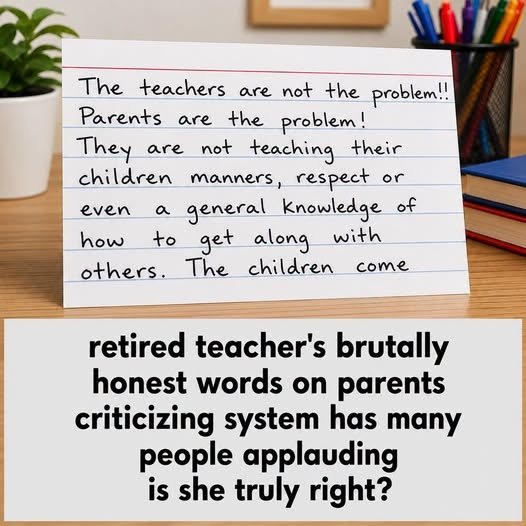
Few subjects generate as many strong opinions as education. Parents, teachers, students, administrators and policymakers often have different ideas about what children need in order to succeed in school. Discussions can involve classroom behavior, homework, school funding, teacher workload, parental involvement and the responsibilities schools are expected to carry. Because education affects children during important years of their development, disagreements over these questions can quickly become emotional.
One particularly direct contribution to that debate came from retired teacher Lisa Roberson in 2017. Roberson became widely discussed online after a short letter expressing her views about public education was published by The Augusta Chronicle. The letter was dated February 2017 and was later reproduced and shared extensively online. Her message was unusually direct: Roberson believed that teachers were receiving too much blame for problems that, in her experience, often involved a lack of support and accountability outside the classroom.
Her wording was deliberately forceful, and that helped the letter attract both enthusiastic agreement and significant criticism. It is important, however, to distinguish Roberson’s opinion from an established conclusion about the entire education system. Her letter reflected her own perspective as a retired teacher. It did not constitute research showing that parents as a group are responsible for struggling schools, nor did it prove that teachers or school systems have no responsibility for educational problems. The value of the letter lies primarily in the questions it raised about cooperation between families and schools.
Roberson began by expressing frustration with people who attempt to reform public education without, in her view, sufficiently understanding modern classrooms. She argued that teachers were often blamed for problems they could not solve alone. Her strongest claim was that some parents were not adequately teaching their children manners, respect or the social skills needed to interact successfully with other people.
She also described situations in which students arrived at school without basic materials such as pencils or paper. Roberson contrasted this with students sometimes wearing expensive clothing or shoes and said teachers frequently supplied missing classroom materials with their own money. Her example was intended to highlight what she saw as misplaced priorities and the growing expectations placed on educators.
That passage became one of the most frequently repeated parts of the letter because it captured a frustration familiar to some teachers. Educators are responsible for teaching academic subjects, but they may also find themselves dealing with missing supplies, behavioral problems, communication difficulties and other challenges that extend beyond lesson plans.
Roberson’s central argument was that education works best when responsibility is shared. She asked readers to consider whether parents attend school events, communicate with teachers and make sure their children arrive prepared for class. She also questioned whether homework is completed and whether schools have accurate contact information for parents or guardians.
Her attention then shifted toward students themselves. Roberson asked whether students take notes, complete assignments, listen during lessons and avoid disrupting classmates. In her view, those everyday behaviors should be considered when evaluating why some students or schools struggle.
From those observations, she reached a much broader conclusion. Roberson argued that teachers could not simultaneously perform their own professional responsibilities and assume every responsibility that normally belongs to parents. She believed stronger parental involvement was necessary before meaningful improvement could occur.
The letter’s language was intentionally uncompromising. It presented a clear defense of educators and placed substantial responsibility on families. That directness helped it spread far beyond the original newspaper readership.
A Facebook post reproducing the letter attracted widespread attention, and later websites repeatedly republished or discussed it. Coverage of the viral letter described reactions as mixed rather than universally supportive. Some readers praised Roberson for saying publicly what they believed many educators privately felt, while others objected to assigning such broad responsibility to parents.
That disagreement is significant because school performance is influenced by many factors. Parents can have an important role in children’s education, but classrooms are also affected by resources, curriculum, teacher staffing, school leadership, student needs, economic circumstances and many other conditions.
For that reason, Roberson’s claim that parents are “the problem” is best understood as her personal argument rather than an objective description of every family or every school. Parents differ enormously in their circumstances. Some have flexible work schedules and can attend school events regularly, while others may work several jobs or have responsibilities that make attendance difficult.
Families can also face transportation difficulties, language barriers, financial pressure or limited access to childcare. A parent who does not appear at every school event is therefore not automatically uninterested in a child’s education.
Similarly, children who arrive without school supplies do not necessarily do so because their parents have chosen luxury purchases over education. Financial hardship and unstable family circumstances can sometimes contribute to a lack of supplies. Roberson’s example reflected something she had observed, but it should not be used to make assumptions about every student in that position.
At the same time, her broader point about communication between families and teachers remains a legitimate subject for discussion. Teachers generally have more information about what happens inside classrooms, while parents and guardians understand important parts of a child’s life outside school. When those two sides communicate effectively, problems can often be identified earlier.
Homework provides one example. A teacher may notice repeated missing assignments, but a parent may know that a child is struggling with the material, overwhelmed by other responsibilities or avoiding work because of frustration. Communication can help both sides understand the situation rather than immediately assuming laziness or neglect.
Behavior is another area where collaboration can matter. If a student repeatedly disrupts lessons, teachers need the ability to maintain an environment in which everyone can learn. Parents can help by reinforcing expectations at home and discussing problems with educators.
Teachers, meanwhile, need to communicate concerns clearly and respectfully rather than assuming every behavioral issue originates from poor parenting. Children can struggle for many reasons, and effective responses often require understanding the individual situation.
This is where the discussion becomes more complicated than a simple choice between blaming teachers and blaming parents. Schools and families perform different roles, and neither can completely substitute for the other.
Teachers are trained to provide instruction, evaluate academic progress and manage classrooms. Parents and guardians have a different but equally important relationship with their children. The strongest outcomes are more likely when those responsibilities complement one another rather than becoming competing sources of blame.
Roberson’s letter also predates one of the most disruptive periods in modern education. She wrote it in February 2017, more than three years before the COVID-19 pandemic caused major interruptions to schooling around the world.
Beginning in 2020, schools had to adapt rapidly to closures, remote instruction and other measures. Families suddenly experienced parts of the educational process in ways they had not previously encountered, while teachers were required to redesign lessons and communication methods.
Those circumstances were not part of Roberson’s original argument and therefore should not be retroactively attributed to her letter. Her comments addressed the education environment she knew before the pandemic.
The years that followed nevertheless made conversations about the roles of parents, teachers and schools even more visible. Remote learning placed additional responsibilities on many families, while educators faced new technological and instructional challenges.
The experience reminded many people that education depends on cooperation among several groups. A teacher can create an excellent lesson, but students still need opportunities and support to engage with it. Parents can encourage children to work hard, but they still depend on trained educators and functioning schools.
Students themselves are another important part of the equation. Discussions about education sometimes describe young people as passive participants, yet their decisions and circumstances also affect classroom outcomes.
Older students in particular gradually assume greater responsibility for assignments, attendance, preparation and behavior. However, the amount of responsibility reasonably expected from a student depends heavily on age and individual development.
Roberson’s letter raised these questions by asking whether students were taking notes, listening and completing homework. Those questions encouraged readers to consider student behavior alongside teacher performance.
Still, a single explanation cannot account for every struggling student. One child may need stronger boundaries at home. Another may require additional academic support. Another may be dealing with circumstances adults around them do not yet understand.
The same principle applies to schools. A school experiencing poor results may have problems involving attendance, family engagement or student discipline, but it may also face staff shortages, insufficient resources or other structural challenges.
Treating every struggling school as evidence of failed parenting would therefore oversimplify a complex issue.
Conversely, treating every student difficulty as evidence of teacher failure would be equally simplistic.
That balance is one reason Roberson’s letter continues to generate discussion years after it first appeared. Its strongest value may not be that it provides a complete solution, but that it challenges readers to think about how educational responsibility is distributed.
Some teachers who encountered the letter online said its frustrations sounded familiar. They identified with the experience of providing classroom materials themselves and attempting to communicate with families.
Other readers believed the letter was too harsh toward parents and did not sufficiently recognize the pressures many families face. Reports about the viral response described both support and disagreement.
Both reactions can exist without requiring one side to be portrayed as completely right and the other completely wrong.
Teachers can reasonably ask families to participate in their children’s education.
Parents can reasonably expect schools to provide professional instruction and safe learning environments.
Students can reasonably be expected to take increasing responsibility as they mature.
Schools and governments also carry responsibilities relating to staffing, resources and educational policy.
The challenge is deciding how those responsibilities fit together.
Blame may generate attention, but collaboration is generally more useful when an individual child is struggling.
A teacher who notices declining grades can communicate with a family.
A parent who sees a child struggling can contact the teacher.
A student can explain where additional help is needed.
School administrators can help when problems require resources beyond what one teacher or family can provide.
These ordinary conversations may be less dramatic than viral debates, but they are often where practical solutions begin.
Roberson’s frustration should also be viewed in the context of what she described as expectations placed on teachers. Her letter suggested that educators sometimes felt responsible not only for instruction but also for supplying materials and addressing behaviors they believed should have been handled earlier at home.
Whether every reader agrees with her conclusion or not, that sense of frustration deserves to be understood rather than dismissed.
Parents’ experiences deserve the same consideration. Families do not all have identical resources, schedules or circumstances. Some parents may want to be more involved but face barriers that are not immediately visible to teachers or other families.
Acknowledging those realities does not eliminate parental responsibility. It simply makes the discussion more accurate.
Likewise, acknowledging difficulties teachers face does not mean schools should be protected from legitimate criticism. Education systems can and should evaluate teaching quality, leadership, curriculum and student support.
Roberson’s letter becomes most useful when read as one experienced educator’s contribution to that larger conversation.
It should not be presented as proof that every educational problem originates at home.
Nor should its concerns about parental participation be dismissed simply because the language was provocative.
Her questions about preparedness, communication, homework and behavior remain recognizable parts of everyday education.
The larger lesson is that educating a child rarely belongs to one person.
Teachers have an essential role.
Parents and guardians have an essential role.
Students increasingly develop responsibilities of their own.
Administrators and public institutions influence the environment in which all three operate.
When one part of that relationship breaks down, the others may feel additional pressure.
That was ultimately the frustration at the center of Roberson’s 2017 letter.
She believed educators were being asked to carry responsibilities beyond what teachers alone could realistically accomplish.
Her solution was stronger parental accountability.
Others may believe the answer requires broader changes as well.
The disagreement has continued because education does not offer a simple formula that applies equally to every child, household or classroom.
Nearly a decade after the letter first circulated, it remains an example of how quickly discussions about schools can become debates about responsibility.
Its history is factual: Lisa Roberson identified herself as a retired teacher, wrote the letter in 2017, and strongly argued that parents needed to take greater responsibility for their children’s preparation and behavior. The letter subsequently spread widely online and generated both support and criticism.
Its conclusion, however, remains an opinion.
Readers can agree with some of Roberson’s observations without accepting every generalization in the letter.
They can also disagree with her emphasis on parents while recognizing that family engagement matters.
That distinction allows the discussion to remain constructive rather than becoming an argument over which group deserves all the blame.
Ultimately, teachers and parents share a goal that is far more important than winning that argument: giving children the strongest possible opportunity to learn, develop and prepare for adulthood.
Roberson’s letter was forceful enough to capture widespread attention, but the lasting conversation surrounding it points toward a more nuanced conclusion.
Schools cannot reasonably solve every challenge children face on their own.
Parents cannot replace professional educators.
Teachers cannot replace families.
And students themselves gradually become active participants in their own education.
When those groups communicate and understand their respective responsibilities, the discussion can move beyond deciding who is “the problem.”
It can instead focus on the question that matters most: what combination of support, responsibility and cooperation gives children the best opportunity to succeed?
Website Disclaimer
The information provided on this website is for general informational and educational purposes only. While we strive to ensure that all content is accurate and up to date, we make no guarantees regarding the completeness, reliability, or accuracy of any information published.
The views and opinions expressed in articles belong to their respective authors and do not necessarily reflect the views of this website. Any action you take based on the information found on this website is strictly at your own risk. We will not be liable for any losses, damages, or inconveniences arising from the use of our content.
Some articles may contain opinions, third-party information, or external links. We do not endorse or guarantee the accuracy of content on external websites and are not responsible for their practices or policies.
All content on this website is provided in good faith and is intended for informational purposes only. Readers are encouraged to verify information independently and seek professional advice where appropriate.