Few television comedies have remained as recognizable for as long as Gilligan’s Island. The CBS sitcom originally aired from 1964 to 1967 and produced 98 episodes over three seasons, yet its cultural life continued for decades after the final original episode. Through syndication, reruns, reunion projects and constant references in popular culture, the seven stranded castaways became familiar to generations of viewers who were not even born when the show first premiered.
The premise was simple enough to explain in a single song. Gilligan, the Skipper and five passengers left on what was supposed to be a three-hour sightseeing trip aboard the S.S. Minnow. After bad weather damaged the boat, the group ended up stranded on an uncharted island. From that moment on, almost every episode revolved around either an escape attempt, an unexpected visitor or a strange problem that somehow made island life even more complicated.
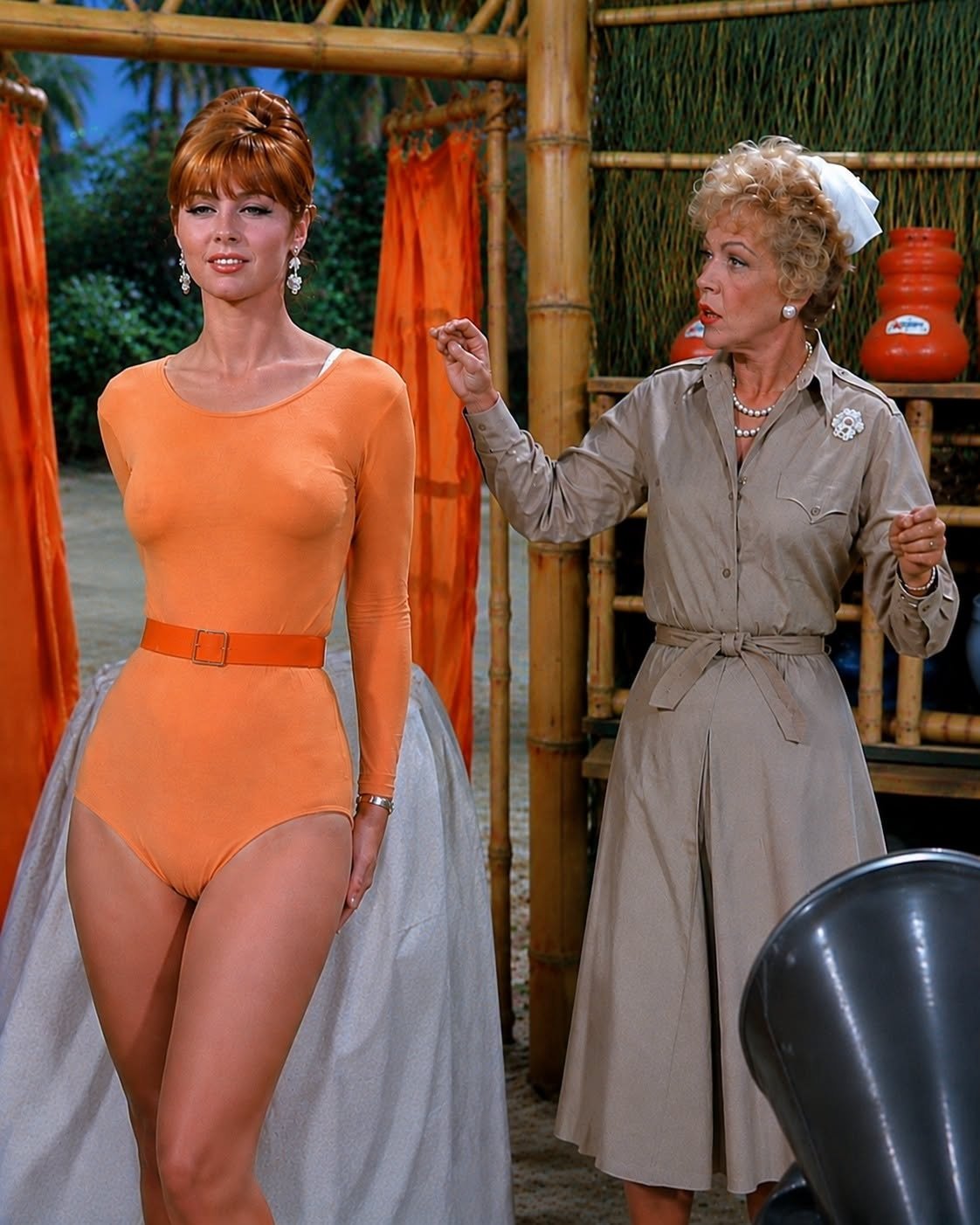
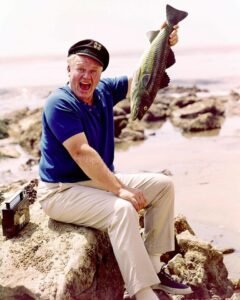
Bob Denver played the well-meaning but accident-prone Gilligan, while Alan Hale Jr. portrayed the Skipper, Jonas Grumby. Jim Backus and Natalie Schafer played wealthy couple Thurston Howell III and Lovey Howell. Tina Louise appeared as movie star Ginger Grant, Russell Johnson played Professor Roy Hinkley, and Dawn Wells became Mary Ann Summers. The strength of the series came largely from placing seven very different personalities together and allowing them to function like an unlikely family.
The concept was created by Sherwood Schwartz, who later became known for creating The Brady Bunch as well. Schwartz wanted a program in which people from different social backgrounds had no choice but to cooperate. On the island, wealth, celebrity and professional status suddenly mattered far less than practical skills and teamwork. That contrast created much of the comedy.
One of the most memorable pieces of trivia involves the boat itself.
The S.S. Minnow was reportedly named after Newton Minow, who served as chairman of the Federal Communications Commission during the early 1960s. Minow became famous for describing much of American television as a “vast wasteland.” Schwartz disagreed strongly with Minow’s criticism of the television industry and later explained that naming the shipwrecked vessel after him was a deliberate joke.
The boat’s spelling used two “n” letters, like the word for the fish, rather than copying Minow’s surname exactly.
That small joke remained hidden in plain sight for millions of viewers.
Another detail that still attracts attention appears in the opening credits.
Fans who carefully study some of the wide shots of the S.S. Minnow have noticed that the number of visible people does not always match the seven familiar castaways. Exterior scenes could use stand-ins or crew members when the principal actors were not clearly visible from a distance. Production shortcuts like that were common at the time and were far harder to notice on small television screens.
Modern viewing technology changed everything.
Today, viewers can pause an episode, enlarge a frame and examine details that might have appeared for less than a second during the original broadcast. That has made classic television a favorite hunting ground for bloopers and continuity mistakes.
Gilligan’s Island contains plenty of them.
Some involve props changing position between camera angles.
Others involve shadows or parts of studio equipment appearing briefly.
In occasional scenes, elements of the production environment can be seen beyond the vegetation that was supposed to make the island look completely isolated.
Those mistakes are less surprising once the production process is understood.
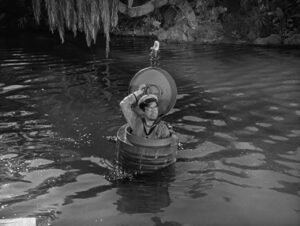
Much of the series was filmed on constructed sets and controlled outdoor areas in California. The island viewers saw on television was created through a combination of studio work, artificial foliage, lagoons, exterior photography and careful camera positioning.
The tropical wilderness was therefore partly an illusion.
Plants and set pieces were positioned to hide buildings and equipment.
Camera operators had to frame shots carefully.
If an angle changed slightly, a piece of the real studio environment could suddenly become visible.
That makes some episodes especially interesting to rewatch.
One often-discussed example is “The Friendly Physician.”
The episode features Vito Scotti as the eccentric Dr. Boris Balinkoff, who brings the castaways away from their familiar island and involves them in bizarre experiments. The storyline becomes even stranger when characters appear to switch bodies.
It is one of the most unusual episodes in the series.
Fans have also pointed out moments in which background elements undermine the idea that everyone is far away from civilization.
Such details were probably almost invisible when the program originally aired.
The show was never intended for high-definition frame-by-frame analysis.
Another fascinating historical detail comes from the original pilot.
Filming took place in Hawaii during November 1963.
While production was underway, President John F. Kennedy was assassinated on November 22.
The news deeply affected the country and disrupted normal activity, including portions of the production.
Footage used in the first-season opening sequence contains an American flag visible at half-staff.
That background detail connected the cheerful fictional departure of the Minnow with a very real national tragedy.
It remains one of the most striking pieces of history hidden inside the series.
The pilot itself differed considerably from the program audiences eventually received.
Several characters were changed before CBS ordered the final series.
The familiar seven-person ensemble was refined during development.
Even the music was different before the final version of the program appeared.
Television pilots frequently change before becoming regular series, and Gilligan’s Island is a particularly interesting example.
Alan Hale Jr. also had an unusual journey to his audition.
Hale was working on the Western film Bullet for a Badman in Utah when he learned about the opportunity to test for the Skipper.
According to accounts repeated by people connected with the show, reaching Los Angeles was not simple.
Hale reportedly left the remote filming area on horseback, eventually reached a highway, hitchhiked toward Las Vegas and then caught a flight to Los Angeles.

He made the audition.
The effort turned out to be worthwhile.
Hale became so closely associated with the Skipper that imagining another actor in the role is difficult today.
His physical presence, expressive reactions and affectionate chemistry with Bob Denver became essential to the show.
The Skipper could become furious with Gilligan one moment and protect him the next.
The familiar phrase “little buddy” captured the relationship perfectly.
Gilligan regularly ruined escape plans by accident.
The Skipper regularly became angry.
But the conflict almost never lasted.
Their friendship was one of the emotional foundations of the series.
Another famous story concerns the opening theme song.
During the first season, the lyrics introduced Gilligan, the Skipper, the millionaire and his wife, and the movie star.
Russell Johnson and Dawn Wells were not named.
Instead, the song ended with the phrase “and the rest.”
That changed in the second season.
Bob Denver reportedly insisted that Johnson and Wells deserved to be recognized with the other principal cast members.
The later theme therefore included the famous line naming “the Professor and Mary Ann.”
Today, it is difficult to imagine the song without them.
Both characters became essential to the series.
The Professor often provided scientific explanations and improbable inventions.
Mary Ann brought warmth, practical intelligence and emotional balance.
She became one of the most beloved characters in the series.
The contrast between Mary Ann and Ginger also became part of American popular culture.
Tina Louise’s Ginger represented Hollywood glamour.
She was elegant, confident and theatrical.
Dawn Wells’s Mary Ann represented a more approachable, everyday type of charm.
She was friendly, practical and wholesome.
That contrast eventually produced the long-running question: “Ginger or Mary Ann?”
The debate lasted far longer than the original television series.
People who had barely watched the show often still understood the reference.
Wells later explained that the appeal of Mary Ann was precisely that she felt like someone viewers might actually know.
She also spoke respectfully about Tina Louise’s beauty and presence.
The idea of constant personal rivalry between the actresses has often been overstated in later retellings.
They had different personalities and different relationships with the show.
That is not the same thing as proving a dramatic off-screen feud.
Tina Louise had already established herself as an actress before Gilligan’s Island.
She had worked on stage and in movies and had ambitions beyond sitcom television.Movies
After Ginger became enormously famous, Louise sometimes expressed frustration with being typecast.
She wanted to be considered for a wider variety of roles.
That complicated relationship with the program became part of her public image.
At the same time, she never completely disappeared from the legacy of Ginger.
The role remained one of the most recognizable television characters of the 1960s.
Louise continued receiving fan attention decades later.
Dawn Wells had a different relationship with Mary Ann.

She generally embraced the affection surrounding the character.
Wells continued attending fan events and discussing the show for many years.
She died in December 2020.
Her death left Tina Louise as the last surviving member of the original seven principal castaways.
As of 2026, that remains true.
Jim Backus died in 1989.
Alan Hale Jr. died in 1990.
Natalie Schafer died in 1991.
Bob Denver died in 2005.
Russell Johnson died in 2014.
Dawn Wells died in 2020.
Tina Louise remains the last living member of the core cast.
That fact has made retrospective photographs of the seven actors increasingly emotional for longtime fans.
Each performer brought something different to the ensemble.
Jim Backus turned Thurston Howell III into a classic television caricature of extreme wealth.
Howell continued behaving like a millionaire even while living on a deserted island.
Money, expensive tastes and social status remained important to him even when none of those things could purchase a ticket home.
Natalie Schafer’s Lovey Howell matched that comic style perfectly.
She remained elegant and socially refined regardless of the circumstances.
The Howells somehow seemed to have brought far more clothing and luxury items than anyone reasonably would have packed for a short sightseeing trip.
That was part of the joke.
Realism was never the point.
Ginger’s wardrobe created the same question.
How could someone preparing for a three-hour boat excursion possibly have so many glamorous outfits?
The show did not care.
The clothes helped establish her character visually.
Viewers accepted the logic because the series operated according to sitcom rules.
The Professor created even more entertaining questions.
He could build complicated machines using bamboo, wires, coconuts and scraps.
He could solve medical mysteries.
He understood chemistry, physics, engineering and countless other subjects.
But somehow, he could not permanently repair the Minnow or build a boat capable of taking everyone home.
That contradiction became one of the most famous jokes about the series.
It was not really a production mistake.
It was necessary for the premise.
If the Professor solved the central problem permanently, there would be no show.
The same rule explains why so many visitors reached the island without rescuing the castaways.
Scientists, musicians, criminals, soldiers and adventurers appeared.
Some knew how to reach civilization.
Others eventually left.
Yet the regular cast almost always remained stranded.
The logic was ridiculous.
It was also necessary.
Episodes depended on returning the situation to normal by the closing credits.
The audience understood that.
That knowledge became part of the comedy.
Another group of frequently discussed mistakes involves animals and nature.
The fictional island contained whatever creature a particular episode required.
Some animals would have made little ecological sense in the setting.
But the island was never defined with enough realism to function as an accurate biological environment.
It existed to support stories.
If the writers wanted a gorilla, the island could have a gorilla.
If they wanted unusual insects, those could appear too.
If a bird was useful for a joke, it could arrive.
Scientific accuracy was secondary to comedy.
One frequently cited example involves a woodpecker gag.
Fans sometimes point out that the bird would not necessarily belong on the type of remote oceanic island the series seemed to depict.
That criticism may be technically interesting.
But the show itself never attempted to establish a scientifically precise ecosystem.
It was a fictional comedy island.
The same relaxed attitude applied to geography.
The castaways supposedly remained difficult to locate.
Yet visitors repeatedly reached them.
Weather systems appeared when necessary.
Radios somehow worked.
Different vessels passed nearby.
None of it needed to make strict sense.
The show depended on fantasy.
Its humor came from watching familiar characters react to impossible situations.
Some bloopers, however, were genuine production slips.
Viewers have noticed Bob Denver’s real wedding ring in shots where Gilligan, who was unmarried, should not have been wearing one.
These details are much easier to detect today.
An actor’s hand might appear on screen for only seconds.
On a 1960s television set, the ring could pass unnoticed.
On a modern digital transfer, viewers can pause the image.
That difference explains why so many old television “mistakes” are only becoming famous now.
The production crews were not expecting viewers to analyze every frame sixty years later.
They were producing weekly television on demanding schedules.
Sets had to be prepared quickly.
Actors rehearsed scenes.
Camera crews adjusted positions.
Props were moved.
Episodes had to be completed in time for the next production cycle.
Continuity errors were inevitable.
The real surprise is how convincing much of the show still looks.
Even when viewers know the lagoon was artificial, the island still feels familiar.
The huts, palm trees and shoreline became visual symbols of the program.
The illusion survived because audiences were focused on characters rather than backgrounds.
Some of the show’s funniest production tricks involved water.
Scenes that looked as though they took place in open ocean could be filmed in controlled tanks or lagoons.
That allowed crews to manage cameras and actors more safely.
Occasionally, the edge of a tank or other evidence of the controlled environment can be seen.
Boom-microphone shadows have also been identified in certain shots.
Again, such things appeared very briefly.
A modern viewer intentionally searching for errors has an enormous advantage over someone watching a normal broadcast in 1964.
That makes blooper hunting almost a separate hobby.
Fans already know the episodes.
They know the jokes.
They know the dialogue.
Looking for production secrets gives them a new reason to return.
A coconut cup suddenly becomes interesting because of how it was manufactured.
A background building becomes evidence of where the camera was positioned.
A visible stand-in reveals how wide shots were filmed.
The mistakes become windows into the production process.
Even the coconut props have an interesting history.
Early versions reportedly used genuine coconut shells.
Real shells were not always convenient because they could absorb liquids and create practical problems.
Prop versions were eventually produced to look like coconuts while functioning more reliably.
It is a tiny detail.
But details like that remind viewers that even the simplest island object had to work repeatedly under television-production conditions.
The program also depended heavily on physical comedy.
Bob Denver was especially effective at turning Gilligan’s clumsiness into something lovable rather than irritating.
Gilligan broke things.
He misunderstood instructions.
He caused accidents.
He ruined plans.
Yet he often also helped save the group after creating the original problem.
The writers kept him sympathetic.
That was important.
A character who only destroyed everyone’s chances of rescue could easily become disliked.
Instead, Gilligan remained the emotional center of the group.
His intentions were almost always good.
The Skipper understood that.
So did the other castaways.
Their frustration rarely became permanent resentment.
That kindness is one reason the series aged differently from more cynical comedies.
The characters argued, but the show usually returned to warmth.
Mary Ann often contributed to that atmosphere.
She was practical without being self-important.
She cooked, helped others and approached problems calmly.
Dawn Wells gave the character an understated charm.
Mary Ann did not need to be glamorous or wealthy to matter.
Her reliability became part of her appeal.
Ginger offered a completely different form of confidence.
Tina Louise used theatrical mannerisms that emphasized Ginger’s identity as a movie star.
The character could transform even an island situation into something resembling Hollywood drama.
The contrast between the two women made both more memorable.
Neither needed to replace the other.
The Howells provided another comic contrast.
They represented wealth in a place where money had almost no practical value.
Mr. Howell could have enormous financial resources in the outside world.
On the island, a coconut or a working radio could be more useful than a bank account.
That reversal produced endless jokes.
The Professor represented knowledge.
The Skipper represented authority.
Gilligan represented chaos.
The ensemble worked because every role served a different purpose.
That structure allowed the writers to create many types of stories.
A scientific problem naturally involved the Professor.
A show-business plot could center on Ginger.
A social-status joke involved the Howells.
A domestic problem often gave Mary Ann an important role.
A physical challenge suited the Skipper.
Gilligan could become involved in all of them.
Guest characters also helped expand the possibilities.
The island somehow attracted people from every imaginable background.
Visitors created temporary changes to the group dynamic.
Some appeared to offer rescue.
Others created danger.
Many disappeared at the end of the episode.
The pattern became predictable, but that predictability was comforting.
Viewers knew the castaways would remain together.
That stability helped make the series perfect for syndication.
Episodes did not require audiences to follow complicated long-term storylines.
Someone could start watching almost anywhere.
The theme song explained the premise.
The characters were easy to understand.
The island situation reset regularly.
That made the show ideal for afternoon reruns.
Children discovered it decades after the original broadcast.
Then those children became adults and introduced it to someone else.
The series effectively survived through repetition.
Only 98 episodes existed.
But they were broadcast countless times.
That explains why the program feels larger than its original three-season run.
Some television shows produce twice as many episodes and disappear.
Gilligan’s Island became part of cultural memory.
Its cancellation did not end its popularity.
In some ways, syndication strengthened it.
The show no longer depended on weekly ratings or network scheduling.
It could simply exist as a familiar comedy that audiences encountered repeatedly.
Reunion projects later extended the story.
Several actors returned to their characters in television movies.
Animated versions also appeared.
The franchise kept resurfacing in new forms.
References to Gilligan and the island appeared in other television programs, movies, advertising and comedy.
The characters became shorthand.
A white sailor hat could immediately suggest Gilligan.
A red shirt and navy cap could suggest the Skipper.
The phrase “three-hour tour” became recognizable outside the original context.
The theme song played a major role in that staying power.
It does more than introduce the cast.
It tells a complete miniature story.
The boat leaves.
The weather worsens.
The ship is lost.
The passengers end up stranded.
By the time the episode begins, every viewer understands the situation.
That efficiency made the opening unforgettable.
The decision to add Professor and Mary Ann by name made the later version even stronger.
All seven castaways became part of the song.
That was appropriate because none of them felt secondary once the series became established.
The show’s enduring popularity also comes from how little emotional risk it usually contains.
The castaways face danger.
But audiences generally know that everyone will survive.
The island may be inconvenient.
It rarely feels truly threatening.
The characters may want to escape.
Yet the island also becomes a kind of home.
They celebrate events together.
They build things.
They perform shows.
They create routines.
They form friendships.
The supposed disaster becomes the foundation of a community.
That may be one reason audiences find the series comforting.
The premise says everyone is stranded.
The tone says everyone is safe together.
Those two ideas coexist.
It creates a world where even failure is temporary.
An escape plan can collapse.
Someone can become frustrated.
By the next episode, the group is still together.
That structure made the series almost ideal comfort television.
It also explains why the production mistakes do not damage the experience.
Fans usually enjoy them.
A visible studio building does not destroy the island.
It simply reminds viewers that talented crews built the illusion.
A wedding ring does not ruin Gilligan.
It becomes a piece of trivia.
An extra person on the boat becomes something to search for.
The errors add personality.
They make the show feel handmade.
Classic television often has that quality.
Sets are clearly sets.
Props can look artificial.
Effects may be simple.
But audiences connect with performances more than technical perfection.
Gilligan’s Island is a perfect example.
The series was not realistic.
It was not supposed to be.
Its strength came from chemistry.
Bob Denver and Alan Hale Jr. were believable as friends.
Dawn Wells made Mary Ann warm.
Tina Louise made Ginger memorable.
Jim Backus and Natalie Schafer created a comic married couple unlike anyone else on the island.
Russell Johnson made even absurd scientific explanations sound serious.
Together, they created something larger than the scripts.
That chemistry also explains why later attempts to imagine replacements are difficult.
The character names may seem like simple archetypes.
But fans remember specific performances.
They remember Hale’s voice.
Denver’s nervous expressions.
Backus’s mannerisms.
Schafer’s elegance.
Johnson’s serious delivery.
Wells’s warmth.
Louise’s glamorous presence.
Those details cannot easily be recreated.
Time has made the original cast even more significant.
With Tina Louise now the only surviving member of the seven principal castaways, the program increasingly represents a completed era of television.
The actors are gone or elderly.
The studios changed.
The cable and broadcast industries changed.
Television itself changed.
Yet the episodes remain.
That permanence is part of what makes recorded entertainment unusual.
A viewer today can watch Bob Denver stumble across the island exactly as viewers did decades ago.
Alan Hale Jr. is still the Skipper in that moment.
Dawn Wells is still Mary Ann.
Jim Backus is still arguing about money.
Natalie Schafer is still perfectly dressed.
Russell Johnson is still explaining something scientifically impossible.
Tina Louise is still Ginger.
The performers do not age inside those episodes.
That is why classic television can feel strangely timeless.
Historical facts around the production also become more interesting as the years pass.
The half-staff flag visible after Kennedy’s assassination is one example.
What was once a background detail becomes a historical artifact.
Alan Hale’s difficult trip to his audition becomes part of casting history.
The theme-song change becomes a story about cast solidarity.
The Minnow’s name becomes a joke involving television regulation.
Each detail adds a new layer.
Some stories passed around online should still be treated carefully.
Classic television attracts myths.
A small piece of trivia can become exaggerated after years of repetition.
A fan observation can eventually be repeated as fact.
For that reason, the most interesting behind-the-scenes stories are the ones supported by interviews, production records or reliable historical accounts.
The real history is already entertaining enough.
There is no need to invent additional drama.
That is especially true with claims about the actors’ relationships.
People often want old television casts to contain secret romances or feuds.
Sometimes they did.
But speculation should not be presented as fact.
Dawn Wells spoke openly about her friendships with several cast members.
She described Bob Denver as a close friend and Alan Hale Jr. as a fatherly figure.
She also once joked that if she were choosing romantically among the male characters, the Professor would have been the appealing one because of his intelligence and looks.
That is very different from proving that an actual romance occurred.
The cast worked together professionally.
Some friendships lasted.
Others were less close.
That is normal.
The show did not need secret romantic drama to remain interesting.
Its on-screen relationships were already memorable.
The same caution applies to bloopers.
Not every unrealistic detail is technically an error.
The Professor’s inventions are intentional fantasy.
Ginger’s wardrobe is part of characterization.
The Howells’ luggage is a joke.
Visitors leaving without rescuing anyone is a narrative device.
Those should not be confused with accidental continuity mistakes.
Real bloopers come from production.
A visible boom shadow.
A changing prop.
A crew member or stand-in appearing accidentally.
A background structure appearing when it should not.
Those details reveal something about filmmaking.
The unrealistic story logic reveals something about comedy.
Both are fun, but they are different.
The production was created at a time when viewers experienced television very differently.
Episodes were not designed for streaming.
People could not rewind instantly.
Most viewers saw programs once at broadcast time unless a rerun appeared.
Television screens were smaller.
Image quality was lower.
That environment allowed small visual mistakes to pass unnoticed.
Today, classic shows are treated almost like films under examination.
People create videos dedicated entirely to mistakes.
They compare frames.
They identify filming locations through buildings or mountains in the background.
They examine costumes.
They analyze credits.
That level of attention would probably have amazed the original production crews.
It also demonstrates how deeply audiences still care about the show.
Nobody spends hours studying a program they have forgotten.
The blooper culture surrounding Gilligan’s Island exists because people continue watching it.
The show still feels familiar.
Its artificial island remains recognizable.
Its theme song can still be identified within seconds.
That is an extraordinary achievement for a sitcom that ended in 1967.
The cultural environment that created it is gone.
Yet the basic comedy still works.
Gilligan tries to help.
Something goes wrong.
The Skipper reacts.
The others scramble to fix the situation.
That pattern remains understandable without explanation.
Physical comedy ages differently from topical humor.
A person falling into a hole is still a person falling into a hole.
A frustrated expression is still readable.
A misunderstanding still works.
That helped the series survive changing generations.
Its warm tone helped as well.
There is very little cruelty in the core relationships.
The characters can become irritated.
But they care about one another.
Even the Howells eventually function as members of the group despite their social superiority.
The Professor shares his knowledge.
Mary Ann helps everyone.
Ginger contributes when needed.
The Skipper protects the others.
Gilligan repeatedly risks himself to help friends.
The castaways become a community.
That emotional simplicity may be the show’s greatest strength.
Viewers do not need to worry about betrayal or permanent conflict.
They know the group will remain together.
For a comedy, that reliability is powerful.
It turns the island into a place audiences enjoy visiting even though the characters supposedly want to leave.
That contradiction is one of the hidden charms of the concept.
If viewers truly wanted the castaways rescued immediately, the show would end.
Instead, each failed escape creates another episode.
The audience hopes for rescue while secretly enjoying the fact that rescue never comes.
The characters cannot leave.
The viewers do not want to leave either.
Syndication proved that.
Decades after cancellation, audiences kept returning.
The program became larger in memory than it had been during its original run.
The cast became television icons.
The theme song became part of popular culture.
Even the mistakes became famous.
That is why searching for bloopers feels affectionate rather than critical.
Fans are not trying to prove the show was badly made.
They are enjoying the chance to look closer.
The mistakes make the production more human.
They remind viewers that dozens of people were creating an artificial world under deadlines.
Sometimes the camera revealed too much.
Sometimes a prop changed.
Sometimes an actor opened an eye too early.
Sometimes something modern appeared in the background.
Then everyone moved on to the next scene.
Those imperfections survived along with the series.
Now they are part of its history.
The Kennedy-era flag is history.
The Minnow’s name is history.
Alan Hale’s audition journey is history.
The theme-song change is history.
The cast’s later lives are history.
And the 98 episodes themselves are television history.
Gilligan’s Island may never have been realistic.
But its cultural impact is completely real.
Three seasons were enough.
Seven castaways were enough.
One unforgettable theme song was enough.
The series entered syndication and never completely disappeared.
More than sixty years after its premiere, people still debate Ginger and Mary Ann.
They still quote the Skipper.
They still recognize Gilligan’s hat.
They still search the background for mistakes.
They still wonder how the Professor could build everything except a boat.
And they still know exactly what happened on that “three-hour tour.”
That endurance is the real secret behind the show.
It was built as a simple sitcom.
It became a television time capsule.
The sets sometimes reveal Hollywood.
The props sometimes betray the production.
The story often ignores logic.
None of that weakened the affection surrounding it.
If anything, the imperfections make it more enjoyable.
They give longtime fans another reason to watch.
Every viewing can reveal a detail someone missed before.
A background figure.
A costume change.
A production trick.
A historical clue.
That is why the more people learn about Gilligan’s Island, the more interesting it becomes.
The comedy remains on the surface.
The television history sits underneath.
Together, they explain why a three-season sitcom has remained part of popular culture for more than half a century.
The Minnow may have been lost.
The show never was.
Website Disclaimer
The information provided on this website is for general informational and educational purposes only. While we strive to ensure that all content is accurate and up to date, we make no guarantees regarding the completeness, reliability, or accuracy of any information published.
The views and opinions expressed in articles belong to their respective authors and do not necessarily reflect the views of this website. Any action you take based on the information found on this website is strictly at your own risk. We will not be liable for any losses, damages, or inconveniences arising from the use of our content.
Some articles may contain opinions, third-party information, or external links. We do not endorse or guarantee the accuracy of content on external websites and are not responsible for their practices or policies.
All content on this website is provided in good faith and is intended for informational purposes only. Readers are encouraged to verify information independently and seek professional advice where appropriate.