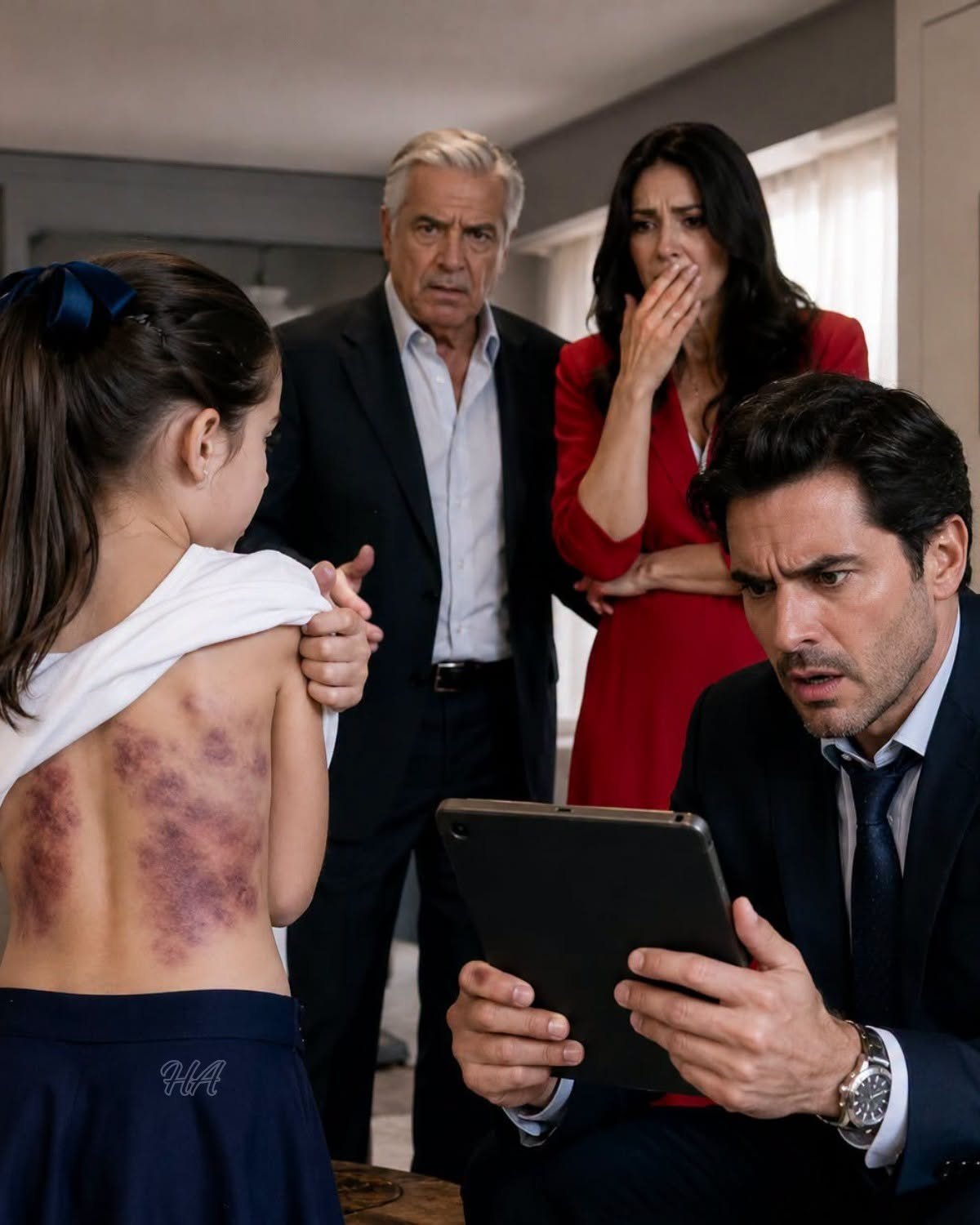
PART 3 —
She had already been investigating my father.
I unlocked the bedroom door only after I heard a second voice downstairs identify herself as a child-protection investigator.
Fernanda stood in the hallway with one hand raised, as if she had been about to strike the door. The moment she saw Camila in my arms, she stepped back.
“Put her down,” she said. “You’re frightening her.”
Camila buried her face against my shoulder.
I didn’t argue. I didn’t ask Fernanda how long she had known or why she had allowed it. Questions could wait.
My daughter could not.
I walked toward the back staircase.
Fernanda grabbed my sleeve.
“Your father will destroy us if you take that tablet outside this house.”
Her words stopped me for half a second.
Not because I was afraid of Armando.
Because she had said us.
Not him. Not me.
Us.
“You already chose your side,” I said.
She let go.
At the bottom of the stairs, a woman in a navy suit stood beside a uniformed officer. She was in her early forties, with tired eyes and a leather folder tucked under one arm. Beside her was a child-protection investigator named Hannah Cole.
“I’m Assistant District Attorney Dana Brooks,” the woman said. “Mr. Vega, is your daughter safe enough to speak with us?”
“Not here.”
Dana looked past me at Fernanda, who had followed us down.
“Agreed. We have a vehicle outside.”
The front door opened before we reached it.
My father entered wearing a charcoal suit and the silver tie Camila had given him for Christmas. He carried a bouquet for the recital and smiled as though he had arrived for a family photograph.
Then he saw Dana.
His smile disappeared.
“What is this?” he asked.
Dana stepped between him and Camila.
“Armando Vega, do not approach the child.”
My father looked at me, not her.
“Ricardo,” he said softly, “you need to think very carefully about what you’re doing.”
For most of my life, that tone had been enough to make me feel twelve years old.
It was the voice he used when I brought home a B, when I questioned one of his rulings, when I tried to defend my mother during an argument.
Calm. Controlled. Certain that resistance would eventually become obedience.
But Camila’s fingers were gripping my collar.
I kept walking.
“That girl lies when she wants attention,” Armando said.
Camila heard him.
Her whole body tightened.
I turned around.
“My daughter has a name.”
For the first time, my father looked uncertain.
Dana opened the rear door of an unmarked SUV. Hannah sat beside Camila while I climbed in on the other side.
Before the door closed, I saw Fernanda standing on the porch with her arms wrapped around herself. Armando spoke rapidly into her ear.
She nodded.
Even then, she was still listening to him.
We were taken to a child advocacy center, where a trained interviewer spoke with Camila while I watched from behind one-way glass.
“You’ll still be here?” Camila asked.
“I’ll be right behind the glass.”
When Dana said Fernanda could join only if Camila requested her, my daughter answered without hesitation.
“I don’t want her here.”
That was the first answer she gave without whispering.
Then she described the wall punishments, the missed meals, the forced piano drills and the way Armando squeezed her ribs when she cried too loudly.
She explained that Fernanda sometimes stood in the kitchen and turned up the television.
Then the interviewer asked about the other girls.
Camila named three children from Armando’s foundation: Lily, Marisol and Tessa.
They were all scholarship students who attended weekend music lessons at the foundation building. Armando called them his “special discipline group.”
My stomach turned.
“How do you know what happened to them?” the interviewer asked.
“Grandpa made me sit outside the office,” Camila said. “I heard them crying.”
She also told the interviewer something she had never told me.
A month earlier, Lily had slipped a folded note into Camila’s piano book. It contained only six words:
PLEASE RECORD HIM. NO ONE BELIEVES US.
Camila had hidden the note beneath the lining of her backpack.
Dana closed her eyes when she heard that.
Afterward, she told me a school counselor had reported abuse connected to Armando’s mentoring program.
The first child’s mother withdrew her complaint after someone threatened her housing and immigration status.
Then an anonymous audio file, uploaded through a school network, captured Armando claiming that judges, police officers and social workers all worked for him.
“Camila sent it to her teacher,” I said.
Dana nodded.
“That is how we reached your house so quickly.”
I took the tablet from my jacket and placed it on the table.
“There’s more.”
A digital-forensics officer copied nine videos and fourteen audio clips.
Some showed Armando punishing Camila. Others captured Fernanda warning him that Camila was asking questions and agreeing to delete security footage.
Then we heard the recording that changed the case.
Fernanda’s voice came first.
“I brought the three girls on the dates you gave me. I told their parents it was private coaching.”
Armando answered, “And the consent forms?”
“Signed.”
“They didn’t read them?”
“They trusted the foundation.”
A chair scraped across the floor in the recording.
“Good,” my father said. “Then if anyone complains, we call it behavioral intervention authorized by the parents.”
I stared at the speaker.
Fernanda had not merely remained silent.
She had helped him bring children within reach.
Dana stopped the audio.
“Mr. Vega, I need to ask you a difficult question. Did your wife have any official role at the foundation?”
“She volunteered at events. She handled schedules sometimes.”
“Did she receive money?”
“I don’t know.”
Dana opened a bank record already inside her folder.
“Over the past ten months, the foundation transferred forty-eight thousand dollars to a consulting company registered in her name.”
I felt something inside me collapse.
Fernanda had told me the money for our kitchen renovation came from a small inheritance left by her aunt.
There had been no inheritance.
The district attorney’s office requested emergency search warrants for our home, Armando’s home and the foundation.
Because of his former judicial position, Dana contacted the state attorney general’s office and asked for an outside team to supervise.
“We cannot risk a courtesy call from someone who owes him a favor,” she said.
For the first time that day, I understood how many people had probably looked away from my father because looking directly at him came with a cost.
A doctor documented bruises in different stages of healing and signs that Camila had been deprived of food.
When asked whether she felt safe with me, she looked at my face for several seconds.
“Yes,” she said. “If Mom and Grandpa aren’t there.”
I had never been so grateful and so ashamed at the same time.
That afternoon, a judge barred them from contacting her and granted me temporary sole custody.
While Camila slept at the advocacy center, my younger sister, Laura, called.
Laura had moved away after a furious argument with Armando. He told everyone she was unstable.
“Fernanda called me,” Laura said. “She claims you’re having a breakdown.”
“I have recordings.”
Laura went silent.
Then she began to cry.
“Ricardo, check the storage room behind Dad’s old chambers.”
“What?”
“The foundation owns the building now. There’s a storage room behind the office that used to be his chambers. He keeps a red filing cabinet there. Years ago, I saw folders with children’s names.”
“Why didn’t you tell me?”
“I tried. You told me Dad had spent his whole life protecting children.”
Her words cut deeply because they were true.
I remembered the conversation.
Laura had called him controlling and dangerous. I had accused her of being ungrateful. I had repeated Armando’s language so perfectly that I might as well have been speaking with his mouth.
“What was in the folders?” I asked.
“Discipline reports. Photographs. Letters from parents. Some of the reports were from before the foundation existed.”
“How long ago?”
“Ricardo, one had my name on it.”
I sat down.
At fourteen, Laura had endured Armando’s “correction program” after skipping school. He isolated her, limited her food and documented her reactions as if she were a criminal defendant.
I had been away at college.
When he said she was acting out, I believed him.
She had waited twenty years for someone in our family to ask the right question.
Dana added her statement to the search-warrant affidavit. By eight that evening, investigators had entered the foundation building.
The red filing cabinet was exactly where Laura said it would be.
Inside were records on twenty-three children.
Some dated back more than fifteen years.
Armando had created his own private system of punishment, first for children of family friends, then for scholarship recipients whose parents depended on his money or influence.
He called the sessions “character correction.”
He kept photographs of bruises, written confessions he forced children to copy and signed documents designed to make terrified parents believe they had authorized everything.
The worst discovery was not a photograph or a video.
It was a spreadsheet.
Fernanda had created it.
Each child’s name was listed beside family weaknesses: unpaid rent, immigration concerns, custody disputes, addiction history, outstanding warrants or employment problems.
A final column was labeled:
LEVERAGE.
Camila’s row contained one sentence:
FATHER STILL LOYAL TO A.V.; MOTHER COOPERATIVE.
I read it three times.
My father had counted on my loyalty.
My wife had counted on my ignorance.
Together, they had mistaken both for permission.
That night, police arrested Fernanda outside Laura’s apartment, where she had gone to demand a retraction.
Officers found foundation hard drives and shredded documents in her car.
Armando was arrested at the airport the next morning with a one-way ticket, fifty thousand dollars in cash and a phone registered under another name.
A reporter captured him saying:
“This is a misunderstanding created by a disobedient child and a vindictive son.”
The clip played on every local news station.
Camila saw ten seconds before I turned off the television.
“He still says I’m lying,” she said.
I knelt beside her.
“He can say anything he wants. The truth does not change because he refuses to admit it.”
“Will people believe me?”
“They already do.”
That was not entirely true yet.
But I intended to make it true.
At the custody hearing, Fernanda’s attorney claimed I had manipulated Camila.
Dana played the recording about hiding the bruises.
The attorney stopped speaking.
The judge granted me temporary sole legal and physical custody, with no contact from Fernanda.
As we left, Fernanda called my name from the courtroom screen.
I turned around.
“I was afraid of him,” she said.
For one terrible second, I wanted that explanation to be enough.
Fear was something I understood. My father had built our family around it.
Then I remembered the spreadsheet.
“You were paid to help him choose children who could not fight back.”
Tears ran down her face.
“He said it was discipline. He said they would thank us one day.”
“You watched our daughter hide bruises.”
“I thought I could control how far he went.”
“No,” I said. “You controlled how much she was allowed to tell.”
I walked out.
After the arrests, withdrawn complaints resurfaced. Former scholarship students called investigators, and a retired clerk admitted Armando had pressured her to bury reports.
Then came the deeper twist.
He had created the foundation to protect his judicial legacy.
While on the bench, he had ordered minors into harsh private programs where several were injured. When complaints surfaced, his charity offered families money in exchange for broad confidentiality agreements.
The scholarships and public awards were not merely camouflage.
They let him monitor the families who could expose him.
My daughter’s videos did more than prove what happened inside our home.
They connected his private cruelty to a system he had spent years hiding.
The attorney general appointed a special prosecutor. Dana remained part of the trial team because she had built the original case.
Over eleven months, Armando’s attorneys called the recordings edited, the parents consenting, Laura bitter and me vindictive.
But the files were authenticated.
The injuries were documented.
The financial records matched the spreadsheet.
One by one, eleven former participants testified.
Lily was the bravest.
She was twelve, small for her age, and wore a yellow bracelet that Camila had made for her.
She told the jury that Armando had threatened to have her mother deported if she discussed the punishments.
When the defense attorney asked why she had not spoken sooner, Lily looked directly at Armando.
“Because powerful adults kept telling me silence was the same thing as safety.”
No one in the courtroom moved.
Fernanda eventually accepted a plea agreement.
She pleaded guilty to child endangerment, evidence tampering, conspiracy and obstruction. She agreed to testify against Armando and identify every family she had helped target.
The judge sentenced her to five years in prison, followed by three years of supervised release.
Her parental rights were not immediately terminated, but the family court suspended them indefinitely and required a full risk assessment before she could request any contact.
People asked whether I felt sorry for her.
The honest answer was complicated.
I believed she had feared Armando.
I also knew she had taken his money, organized his access, hidden Camila’s injuries and helped silence other children.
Fear explained some of her choices.
It did not erase them.
Armando refused every plea offer.
He was convicted on multiple counts of child abuse, unlawful restraint, witness intimidation, conspiracy, fraud and obstruction of justice.
The jury deliberated for less than seven hours.
At sentencing, Armando called himself the victim of an attack on discipline.
The judge answered by reading the children’s words.
One still slept in her shoes, afraid she would be removed from her home before morning.
Another apologized whenever anyone gave her food.
Camila’s statement contained only three sentences:
I THOUGHT MY FATHER WOULD CHOOSE HIS FATHER.
HE CHOSE ME.
NOW I KNOW GROWN-UPS CAN BREAK A FAMILY BY TELLING THE TRUTH, BUT THEY CAN ALSO SAVE ONE.
Armando was sentenced to twenty-eight years in state prison.
The judge ordered that he have no contact with any victim or witness. His law license was revoked, his judicial pension was partially seized for restitution, and the foundation’s remaining assets were transferred into an independent trust for survivors.
I watched workers remove his name from the foundation building while Laura and several survivors’ families stood beside me.
When the final metal letter came down, Laura reached for my hand.
“I hated you for not believing me,” she said.
“I deserved that.”
“I know.”
We stood quietly for a moment.
Then she squeezed my fingers.
“But you believed Camila when it mattered.”
I wished that erased the past.
It did not.
What it did was give us a place to begin.
Camila stopped playing piano for six months.
When I tried to encourage her, her therapist asked whether encouragement could still feel like pressure.
So we packed the keyboard away.
Camila chose art classes, adopted a stubborn orange cat and slowly began sleeping through the night.
Some mornings she laughed before breakfast.
Other mornings a slammed cabinet made her freeze.
Healing did not move in a straight line.
I entered therapy too and learned how my father had trained me to confuse obedience with peace.
I had admired a man who taught me not to recognize fear unless it left a visible mark.
Camila changed that.
One year after the arrests, the child advocacy center held a small fundraiser.
There was no press, no grand ballroom and no speeches from powerful men.
Families sat at folding tables beneath paper handprints made by children.
A piano stood near the wall.
Halfway through the evening, Camila tugged my sleeve.
“Can I play one song?”
“You don’t have to.”
“I know.”
Those three words nearly undid me.
She walked to the piano in a blue dress she had chosen herself.
Her hands trembled when she sat down. She looked toward the back of the room, where Lily and the other girls were waiting.
Then she began.
It was not the difficult piece Armando had forced her to practice for the spring recital.
It was a simple melody she had written with her music teacher.
A few notes stumbled.
She paused once.
No one corrected her.
No one told her to start over.
No one asked whether she deserved dinner.
When she finished, the room rose to its feet.
Camila did not bow.
She ran straight to me.
I held her while the applause continued.
“Was it good?” she asked.
“It was yours,” I said. “That made it perfect.”
Later that night, after I tucked her into bed, she asked whether families could still be families after someone went to prison.
I sat beside her.
“Yes.”
“Even if Mom never comes home?”
“Yes.”
“Even if Grandpa says we betrayed him?”
I looked at the child who had been brave enough to gather proof while every adult around her underestimated her.
“We did not betray him,” I said. “We stopped him.”
She considered that.
Then she reached beneath her pillow and handed me the old note Lily had written.
PLEASE RECORD HIM. NO ONE BELIEVES US.
On the back, Camila had added a new sentence in purple marker:
WE BELIEVED EACH OTHER.
I framed that note.
It hangs beside our front door now, not because I want Camila to remember what happened, but because I never want either of us to forget what ended it.
Not my anger.
Not my father’s reputation collapsing.
Not the courtroom verdict.
A child told the truth.
And this time, an adult acted.
THE END
Website Disclaimer
The information provided on this website is for general informational and educational purposes only. While we strive to ensure that all content is accurate and up to date, we make no guarantees regarding the completeness, reliability, or accuracy of any information published.
The views and opinions expressed in articles belong to their respective authors and do not necessarily reflect the views of this website. Any action you take based on the information found on this website is strictly at your own risk. We will not be liable for any losses, damages, or inconveniences arising from the use of our content.
Some articles may contain opinions, third-party information, or external links. We do not endorse or guarantee the accuracy of content on external websites and are not responsible for their practices or policies.
All content on this website is provided in good faith and is intended for informational purposes only. Readers are encouraged to verify information independently and seek professional advice where appropriate.