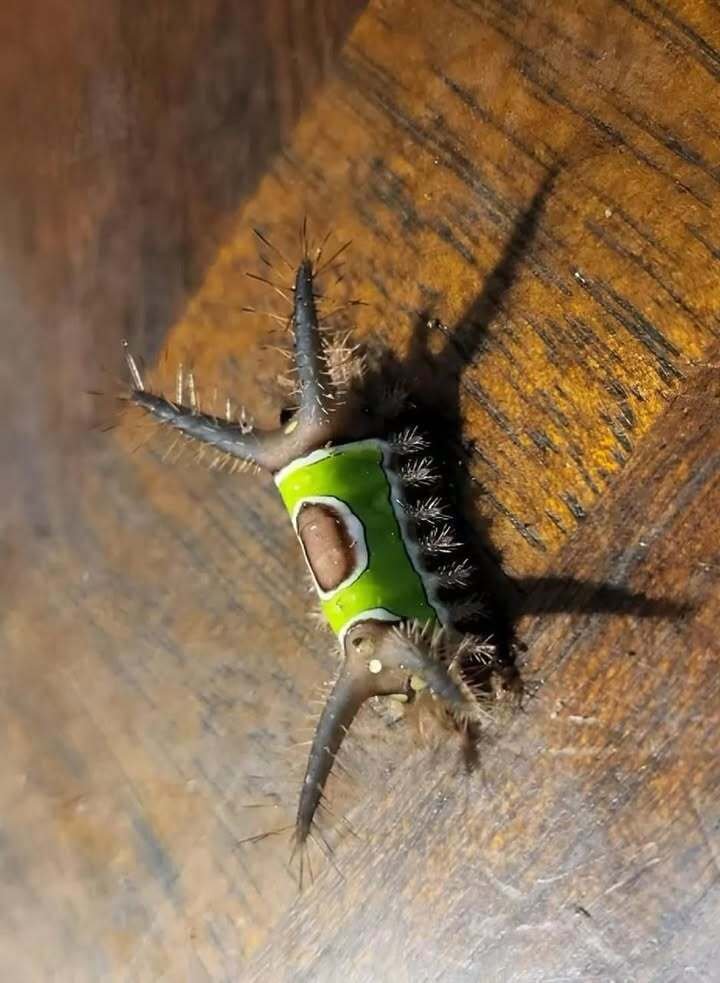
It happened in an instant. I was tidying up the living room when I noticed what looked like a small green leaf on the floor, shaped almost too perfectly to be real. It had tiny brown spots and odd little bumps that looked like plastic decorations. I thought a plant had shed something unusual, so I bent down to scoop it up.
That moment of ordinary curiosity nearly became a very painful mistake.
As I reached for it, something made me pause. Maybe it was the strange shape, or the way the “leaf” seemed to sit on the floor with more weight than a real leaf would. I leaned closer, squinting. And that’s when I saw it: the tiniest movement. The “leaf” wasn’t a leaf at all.
It was a saddleback caterpillar.
Small, bright, almost toy-like in appearance — and one of the most unpleasant creatures you can accidentally touch.
The Caterpillar That Looks Like a Toy but Packs a Serious Sting
Saddleback caterpillars are native to many parts of the United States, especially in the East and Southeast. They’re small, usually less than an inch long, and unmistakably colorful. Their bright green bodies, deep brown “saddle” markings, and little horn-like projections make them look harmless, even decorative.
But those cute little spines?
They can deliver a painful sting.
These spines contain a toxin that causes immediate, intense discomfort if they break the skin. While most people recover fully with proper care, the sting can create symptoms that feel alarming:
• A sharp, burning pain
• Redness and swelling
• Tender welts or blisters
• Sensitivity at the sting site for hours
• Headache or nausea in more reactive individuals
Most stings can be treated safely at home with cleaning, cold compresses, and over-the-counter pain relief, but some people — especially children, older adults, or those with allergies — may need medical attention.
The danger isn’t dramatic or life-threatening for most, but the pain is real, and it’s definitely something you don’t want to learn about firsthand.
How Close I Came to Finding Out the Hard Way
Once I realized what it was, a chill ran through me. I had been a breath away from grabbing it with my bare hand. Instead, I backed up and took a deep breath. The little creature wasn’t doing anything wrong — it had probably hitched a ride indoors on a plant or come in through a door left open.
Still, I needed to get it safely outside.
I found a glass jar, a thin piece of cardboard, and slowly coaxed it inside without touching it. Even the process made my heart pound. When I walked it to the far edge of the yard and released it into the garden, I stood there for a moment, realizing how easily the situation could have gone differently.
A careless moment could have turned into hours of pain and stress — or a visit to urgent care.
A Small Encounter, A Big Reminder
Since that day, I’ve changed how I approach anything small and unusual on the floor or on a plant. Instead of picking things up automatically, I pause. I look closely. I let my eyes adjust and ask myself whether what I’m seeing is truly what I think it is.
Nature is full of surprises, and not all of them are dangerous — but some require a respectful amount of caution.
The saddleback caterpillar is a perfect example: tiny, beautiful, and capable of causing a very uncomfortable afternoon if handled carelessly.
How to Stay Safe Around Caterpillars (Indoors or Outdoors)
If you ever spot an unfamiliar caterpillar, here are simple guidelines:
• Avoid touching it with bare hands. Many species have irritating hairs or spines.
• Use a tool or jar to gently move it if you need to relocate it.
• Wear gloves when gardening, pruning, or clearing debris.
• Teach children not to handle fuzzy or brightly colored insects.
• If stung, wash the area, apply a cold compress, and monitor symptoms. Seek medical care if swelling spreads or symptoms escalate.
These steps aren’t about fear — they’re about awareness.
That tiny creature on my floor taught me a valuable lesson: nature often hides its warnings in beauty. A little caution goes a long way, especially when a moment of curiosity could turn into hours of discomfort.
Now, whenever I see something unusual in the corner of my eye — a curled leaf, a strange shape, a speck of color that doesn’t belong — I pause.
I look.
And I remember how close I came to discovering the sting of a saddleback caterpillar the hard way.
Website Disclaimer
The information provided on this website is for general informational and educational purposes only. While we strive to ensure that all content is accurate and up to date, we make no guarantees regarding the completeness, reliability, or accuracy of any information published.
The views and opinions expressed in articles belong to their respective authors and do not necessarily reflect the views of this website. Any action you take based on the information found on this website is strictly at your own risk. We will not be liable for any losses, damages, or inconveniences arising from the use of our content.
Some articles may contain opinions, third-party information, or external links. We do not endorse or guarantee the accuracy of content on external websites and are not responsible for their practices or policies.
All content on this website is provided in good faith and is intended for informational purposes only. Readers are encouraged to verify information independently and seek professional advice where appropriate.