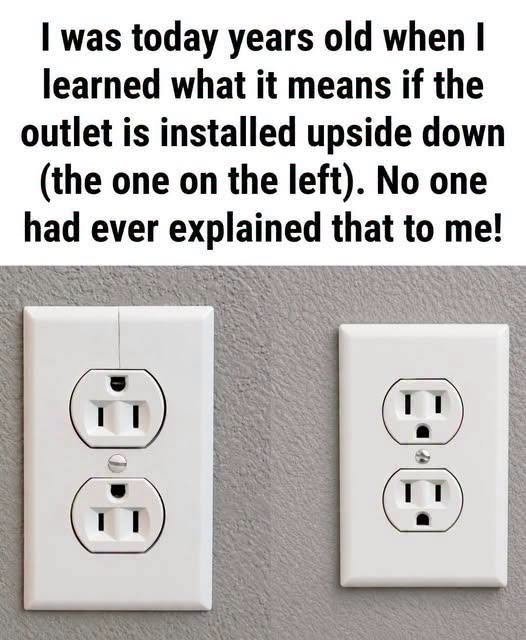
If you’ve ever seen a wall outlet with the ground hole facing upward, it might look like a mistake—but it often isn’t. In many cases, the orientation is intentional and linked to how the outlet is used or wired.
One common reason is switched outlets. In older homes, wall switches were often used to control lamps before ceiling lights became standard in every room.
In these setups, one half of the outlet may be controlled by a switch, while the other half stays always on. This lets you plug in a lamp for easy on/off lighting while still powering devices like chargers or clocks.
Some electricians install these outlets upside down as a visual cue that they function differently from standard ones. However, this is a convention, not a rule.
There is no national electrical code requiring a specific orientation. That means the way outlets are installed can vary depending on the electrician, region, or builder preference.
Because of that, an upside-down outlet doesn’t always mean it is switched. In some homes, it’s simply a stylistic choice or part of local building habits.
The only reliable way to know how an outlet is wired is to test it. Plugging in a lamp and trying nearby switches will quickly reveal whether it is controlled or always powered.
What looks unusual at first is often just a practical wiring choice, reflecting convenience, flexibility, or installer preference rather than an error.
Website Disclaimer
The information provided on this website is for general informational and educational purposes only. While we strive to ensure that all content is accurate and up to date, we make no guarantees regarding the completeness, reliability, or accuracy of any information published.
The views and opinions expressed in articles belong to their respective authors and do not necessarily reflect the views of this website. Any action you take based on the information found on this website is strictly at your own risk. We will not be liable for any losses, damages, or inconveniences arising from the use of our content.
Some articles may contain opinions, third-party information, or external links. We do not endorse or guarantee the accuracy of content on external websites and are not responsible for their practices or policies.
All content on this website is provided in good faith and is intended for informational purposes only. Readers are encouraged to verify information independently and seek professional advice where appropriate.