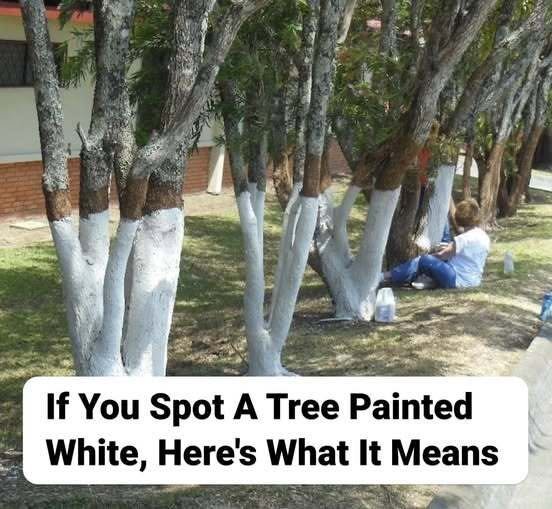
Venturing through the vast landscape of the internet, you’re bound to stumble upon a vibrant community of passionate plant enthusiasts from every corner of the world. Among these green-thumbed individuals, none exhibit more unwavering dedication than those committed to the noble cause of tree planting. Growing a mighty fruit tree from a tiny sapling is no small feat, and these ardent tree planters have some intriguing tricks up their sleeves. Have you ever wondered why some of them throw nets over their trees or why, on occasion, trees sport a coat of white paint?

For those familiar with the colorful language of tree markings, an orange dot often signals the impending fate of a tree – it’s earmarked for removal. Occasionally, you may encounter trees adorned with a regal purple hue, indicating territorial boundaries and issuing a warning to potential trespassers. But what about the pristine white coat?

The phenomenon of painting the lower trunks of trees white serves a crucial purpose in preventing sunscald, a potentially damaging occurrence during winter. Drastic temperature fluctuations between bone-chilling nights and sun-drenched days can induce bark splitting, a vulnerability that tree enthusiasts strive to shield against. The strategic application of light-colored paint acts as a shield, preventing the overheating of the wood and thwarting the emergence of future splits and cracks. This protective measure is commonly employed on slender residential trees or those gracing orchards with their fruitful bounty.

Crucially, the choice of paint is paramount, and water-based latex paint takes center stage in this horticultural performance. Dilution becomes an art form, with the ideal mix being one gallon of paint to an equivalent gallon of water. Some enthusiasts opt for a mixture comprising equal parts water, latex paint, and joint compound, crafting a concoction that not only shields against the elements but also acts as a deterrent to boring insects seeking to wreak havoc on the tree.
When the time comes to cloak the tree in its protective coat, the trusty paintbrush emerges as the tool of choice. While spraying is an option, the efficacy of the protective layer may be compromised, failing to deliver the desired results. A well-executed painting session, usually an annual ritual, becomes the arboreal equivalent of donning a winter coat to brave the elements.

In the vibrant world of tree enthusiasts, the act of painting trees white emerges not as a mere aesthetic choice but as a strategic defense against nature’s unpredictable whims. With every stroke of the paintbrush, these guardians of the green realm ensure the longevity and resilience of their leafy charges, leaving an indelible mark on the landscape they so ardently cultivate.
Website Disclaimer
The information provided on this website is for general informational and educational purposes only. While we strive to ensure that all content is accurate and up to date, we make no guarantees regarding the completeness, reliability, or accuracy of any information published.
The views and opinions expressed in articles belong to their respective authors and do not necessarily reflect the views of this website. Any action you take based on the information found on this website is strictly at your own risk. We will not be liable for any losses, damages, or inconveniences arising from the use of our content.
Some articles may contain opinions, third-party information, or external links. We do not endorse or guarantee the accuracy of content on external websites and are not responsible for their practices or policies.
All content on this website is provided in good faith and is intended for informational purposes only. Readers are encouraged to verify information independently and seek professional advice where appropriate.