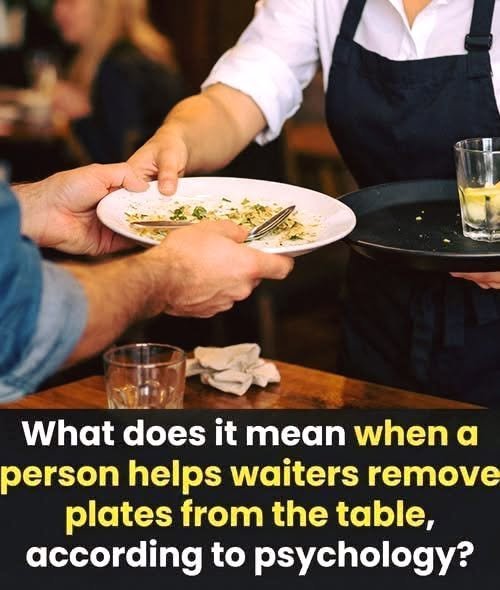
In everyday life, small behaviors often reveal more about human nature than we realize. One such behavior can be seen in restaurants when a guest quietly gathers empty glasses, stacks plates, or organizes the table before the server arrives.
In everyday life, small behaviors often reveal more about human nature than we realize. One such behavior can be seen in restaurants when a guest quietly gathers empty glasses, stacks plates, or organizes the table before the server arrives. At first glance, this may appear to be nothing more than simple politeness or habit. However, psychologists suggest that these small actions may reflect deeper aspects of empathy, awareness, and social sensitivity.
Restaurants are often busy environments filled with constant movement, conversation, and pressure. Servers move quickly between tables, balancing multiple tasks at once. In such settings, even small gestures from customers can subtly ease the workload. What may seem like an ordinary act can actually carry meaningful psychological and emotional weight.
Understanding the Nature of Micro-Kindness
Psychologists often refer to these types of actions as micro-acts of kindness. These are small, spontaneous behaviors that are intended to benefit another person without expecting anything in return. They are not planned or performative but instead occur naturally in response to awareness of someone else’s effort or difficulty.
According to experts in human behavior, such actions are closely linked to empathy—the ability to recognize and understand the emotions or experiences of others. When a person notices a server struggling with multiple tables and chooses to help by organizing dishes, it reflects an intuitive understanding of shared responsibility.
These gestures are often so subtle that they go unnoticed by others at the table, yet they can have a meaningful impact on the person receiving the help.
The Role of Empathy in Everyday Behavior
Empathy plays a central role in shaping prosocial behavior, which refers to actions that benefit others without personal gain. In restaurant settings, this might include stacking plates, passing items to the edge of the table, or preparing dishes for easier pickup.
Dr. Martin L. Hoffman, a well-known psychologist who studied empathy and moral development, explained in his research that empathetic individuals are more likely to engage in behaviors that improve the well-being of others, even in small ways. These actions are often automatic rather than calculated.
People who show this type of behavior are not necessarily trying to make a statement. Instead, they are responding naturally to social cues and environmental awareness.
Influence of Personal Experience
For many individuals, the habit of helping servers comes from personal experience. Former restaurant workers often report that they continue these behaviors even after leaving the industry. Having experienced the demands of fast-paced service work, they understand the physical and mental strain involved.
Long shifts, constant movement between tables, and the need to remain polite under pressure can make restaurant work physically and emotionally demanding. Because of this, those who have worked in such environments often develop a natural instinct to reduce unnecessary burden for others in similar roles.
Even outside of professional experience, people who are observant and socially aware may develop similar habits simply by recognizing when others are busy or overwhelmed.
Different Perspectives on the Same Behavior
While many people view helping servers as a kind and considerate act, perspectives can vary depending on cultural background or personal beliefs. In some cases, individuals believe that handling dishes or assisting staff may interfere with professional boundaries, while others see it as a respectful and supportive gesture.
Online discussions often reflect this difference in opinion. Some people describe the behavior as a sign of respect and humility, while others view it as unnecessary or outside the role of a customer. These differing interpretations highlight how social norms can shape the way small actions are understood.
Despite these differences, the underlying intention behind the behavior is usually rooted in awareness and consideration.
Prosocial Behavior in Psychological Terms
In psychology, actions such as helping clear a table are categorized as prosocial behavior. This term describes voluntary actions intended to benefit another person or contribute to social harmony. Importantly, prosocial behavior does not require recognition or reward.
Research in behavioral science suggests that individuals who frequently engage in such actions tend to be more sensitive to nonverbal cues. They are often able to detect when someone is under pressure or in need of assistance without being explicitly told.
These behaviors may seem small, but they contribute to smoother social interactions and can improve the overall experience for both parties involved.
The Emotional Impact on Service Workers
For people working in service roles, even minor acts of assistance can make a noticeable difference. A slightly organized table or stacked dishes can reduce physical strain and save time during busy shifts. More importantly, these gestures can also provide emotional encouragement.
Working in customer service often involves managing stress while maintaining a positive attitude. In such environments, moments of unexpected kindness can serve as a reminder that their effort is seen and appreciated.
Although these actions do not replace proper working conditions or staffing needs, they can still offer brief moments of relief during demanding hours.
Kindness, Well-Being, and Human Connection
Studies in psychology have shown that people who engage in regular acts of kindness often report higher levels of well-being and life satisfaction. Helping others can activate positive emotional responses, reinforcing a sense of purpose and social connection.
These benefits are not limited to large or life-changing actions. Even small, everyday gestures—such as assisting someone in a restaurant—can contribute to a more positive mindset over time.
This connection between kindness and emotional health suggests that human behavior is deeply influenced by social interaction and mutual care.
A Reminder of Everyday Humanity
In a world where much communication now happens through screens, small face-to-face gestures stand out more than ever. They are unfiltered, spontaneous, and genuine. Actions like helping a server clear a table are not performed for attention but arise naturally from awareness of others.
These moments may seem insignificant individually, but collectively they reflect something important about human nature: the ability to notice, care, and respond to the needs of others in simple ways.
Ultimately, such gestures remind us that kindness does not always need to be grand or visible to have meaning. Sometimes, it is found in the quietest actions at an ordinary restaurant table.
Website Disclaimer
The information provided on this website is for general informational and educational purposes only. While we strive to ensure that all content is accurate and up to date, we make no guarantees regarding the completeness, reliability, or accuracy of any information published.
The views and opinions expressed in articles belong to their respective authors and do not necessarily reflect the views of this website. Any action you take based on the information found on this website is strictly at your own risk. We will not be liable for any losses, damages, or inconveniences arising from the use of our content.
Some articles may contain opinions, third-party information, or external links. We do not endorse or guarantee the accuracy of content on external websites and are not responsible for their practices or policies.
All content on this website is provided in good faith and is intended for informational purposes only. Readers are encouraged to verify information independently and seek professional advice where appropriate.